Garden, Plant, Cook!

Showing posts with label desert gardening. Show all posts

Monday, October 03, 2016

Garlic Planted, Cilantro Re-Seeded, Baby Pumpkin, Me and Roselle, Brining


Dear Folks,

The rain yesterday did two things in my gardens, settled in the garlic I planted on Saturday, October 1st and saved us a watering day.

We got nearly a half inch which means the gardens are nice and wet and do not need the scheduled watering.  Pictured is a clove Elephant Garlic being planted.  Beside that clove are regular garlic ready to be planted.  Plant garlic cloves with the pointy side up.  This will be the center stalk from which the mature head of cloves comes from.

The Allium family includes onions, chives, shallots, garlic, leeks and elephant garlic.  The familiar common Garlic is Allium sativum, while Elephant Garlic is Allium ampeloprasum.   Elephant Garlic is actual a form of leek - on steroids!  It has a milder flavor compared to common garlic's strong, even zingy flavor.

Both grow well here in the valley.  If it looks like I planted too close together -- I did on purpose.  I planted 39+ cloves of common garlic and 8 of the Elephant type.  I always plant extra by planting 3-4 inches apart, so I have "green garlic" to harvest like scallions through the fall/winter/spring.  This delicious addition to your cooking ingredients is a "scallion" only with garlic flavor instead of onion.  Harvest when the greens are about 8-10 inches tall and the clove has swollen slightly.  You can replace with another garlic clove to continue the harvest capability.   Instead, by harvesting every other plant as I need during the cool times, the space between widens allowing more room for each clove to grow to head size.

In April start watching for the plant to send up its flower stalk, called a Scape, it's spiral growth continues and you cut them off when they reach the height of the leaves -- this year it was early May.  Scapes are an edible delicacy only available about 1-2 weeks a year.  Once the Scape is cut off, watch for the leaves to begin turning yellow, about 2-3 weeks later.  This is harvest time. 
Gently dig each plant out, brush off the dirt and hang to dry in a shaded area in the garden or patio.  When the outside skin turns papery it is ready to store.  You can use the green tops as you would scallion tops.  Even the hard center stalk can be used to flavor broths, stews, soups and then removed at serving time.

From the aromatic to the gorgeous, this is my Roselle Hibiscus sabdariffa, now reaching taller than me and beginning the flowering stage moving toward harvest of the gorgeous lemony/cranberry flavored Caylx.  The entire plant is edible.  I've been using the leaves in place of lettuce with their tangy flavor.  While the caylx is known for its high Vitamin C component (if you see "hibiscus" or "red hibiscus" as an ingredient in teas - this is the plant), the leaves also have vitamin C as do the flowers.

Meanwhile, my Cilantro re-seeded and I spotted the new seedlings last week.

I love my gardens.  Many of my favorite plants freely re-seed coming back year after year.  Successive generations of seed is "regional adaptation" at its best.  The seeds which come up naturally are the strongest in your garden.

For this reason I urge you to direct sow if you can.  All of the seeds may not come up, but those which do will be the hardiest.

I am excited about the prospect of an heirloom pumpkin.  I have baby pumpkins on the vine, which has a mind of its own and has spilled out of the raised bed and ranging towards the trees.  I am going to let it roam and just try to keep it out of harm's way while it, hopefully, produces "Upper Ground Sweet Potato Pumpkin" reported to taste like sweet potato and once grown in Thomas Jefferson's gardens at Monticello.

In an "inspired" moment I decided to sow the pumpkin seeds in with the sweet potato, because the SP provided some "nurse" shade to the seed area.  It worked nicely as you can see a bed of sweet potato and pumpkin vines.   I hope to be harvesting pumpkin and sweet potatoes for Thanksgiving.

And, finally I decided to brine more of the Caper buds and berries and have set them to 'work' on the counter.  This is a fermentation brine with no vinegar and when I tried it for the first time, the buds turned out great but the berries not so much because I waited to long to pick them.  This time I picked the berries younger.  What I am looking for is that the berry seeds had not matured turning dark, and that I picked the berry while the seeds are white and immature.  The dark seeds proved to be very bitter, while the berry it self was tasty but not worth eating.  We shall see.  I want to be ready for next spring when the plants start budding and begin a large fermentation jar where I will pick buds regularly adding to my caper version of the old fashioned pickle barrel.  The food you are brining needs to be held completely covered under the liquid so I have a pickle weight wrapped in cheese cloth and tied with a string to allow me to lift and re-position any that rise to the top.  I have a light plastic food cover over it (not seen in the picture) to keep dust off, but allow any bubbles to escape.

That is all for today, folks.  I am always happy to answer questions.

Be sure to check out my youtube channel where I post short videos with helpful tips.

Have a great week in your fall garden!


-- Catherine, The Herb Lady

Website

P.S. I started a Cafepress "store" where I chose some of my favorite photos from the gardens and put them on t-shirts and other things.  The link is in the sidebar.  I welcome feedback and/or suggestions for products you might like to see offered.

If you enjoyed this post, subscribe in the upper side bar link, to get all my posts! And, Please Share.

Disclaimer: Clicking on links on this blog may earn me a small commission if you purchase something. Your price does not change.


Thursday, August 18, 2016

2017 Gardening Month-By-Month Wall Calendar Is Out! Early Bird Pricing!

Dear Folks,


My 2017 Month-By-Month Wall Calendar Is Finished!

All the timely/seasonal gardening info you need to be successful in the desert and USDA Zone 9b and above.  Get your herbs, fruits, vegetables and edible flower growing on!

Earl Bird Pricing is in effect Until Midnight September 14, 2016

SRP is $19.95 BUT the Early Bird Price is $15.96
 

Know any family in the desert southwest or deep south who needs a little help?

Whether here in our wonderful Valley of the Sun, or in the Gulf, interior or Coastal areas USDA Zone 9b or above, it is more than the air temperatures or heat, it is about daylight hours and soil temperatures.

Some of the beloved foods like peas and kale like their feet cool and are happy with short daylight hours, while tomatoes and basil love their feet warm with long daylight hours.

If you are just considering starting or extending your garden, the 2017 calendar can be used this September and forward for all the seasonal planting/sowing and maintenance information, and then all of 2017 too!

What are you waiting for?

:-)

Calendar Link

Have a best day in the garden!

-- Catherine, The Herb Lady

Website

If you enjoyed this post, subscribe in the upper side bar link, to get all my posts!

Disclaimer: Clicking on links on this blog may earn me a small commission if you purchase something. Your price does not change.

Sunday, July 17, 2016

August Sowing In The Desert Garden + Tips on Critter Control and Dense Planting for Success

Dear Folks,

Thyme To Sow For Fall!    The picture at the right is me crumbling leaves between the double berms of my Barbados Cherry tree.

Yes, I know it is 105+ on average, but if you want winter squash/pumpkins for the holidays and get a jump start on your fall gardening. Sowing in August and forward into the fall is the way to grow.

Note: I am off traveling for until early August.  I am providing a lot of information to help you ready your fall garden.

Below is my monthly planting guide.  SOWING, not transplanting is the key here. 

Shade the soil not the plant.  Density of planting. ["NURSE PLANT"  -- Pictured is one of my 2 foot wide posts using purslane to protect the soil of some pepper and moringa plants.]  As much as possible there should be little or no soil showing.  Light twig or leaf mulch* over the seed bed can help deter birds and critters and keep the seeds moist.Seed beds need to be kept uniformly moist, so the seeds never dry out before breaking the soil surface.  This may require sprinkling each evening.

"Nursery Beds" can be used, with existing plants or summer loving flowering plants like Portulaca (Moss Rose), where you use the edge of the flower canopy to sow under.

Critter control can be maintained with chicken wire hats.  My Frist  Short Video on using chicken wire.  I just created a second video on choosing a different Chicken Wire Hat, when the critters are really intent on your seedlings.  I also show using a collar to ward off sowbugs, slugs and snails.

*Light twig or leaf mulch the picture of me at the top is from my short video on double berming a tree, but the same principle of crumbling leaves as a mulch applies to sown beds.  Just crumble the leaves to a light dust, to help retain moisture to the seeds while they germinate underground.

Two principles of sowing here in the desert garden are key to success.

1)  Seeds respond to soil temperature and fall primarily into two categories -- those that love their feet warm and those that like their feet cool.  In other words the seeds and plants respond to soil temperature.  They also respond to daylight hours and that coincides with the soil temperature.  Carrots like cool soil and don't mind shortened daylight hours.  Tomatoes need their feet warm and the longer the day the better.

2)  Seeds are dormant.  To break dormancy consistent moisture and temperatures are needed to keep the seed germinating.  If you let the soil dry out while the seed is germinating underground - it will die.

If you think August is too soon to sow, last August 1st I sowed cilantro and chervil seeds - on September 25th I saw the Chervil seedlings, followed shortly thereafter by the cilantro responding to the soil cooling!  The plants then took off.

I am repeating here a post from my facebook page on the density of planting and radiant heat.  

Density Planting and the issue of radiant heat.

I talk about this, a lot, particularly now while we are in our high heat times, but it is applicable year-round in the desert garden. If you shade the soil, not the plants, you will have better production and healthy plants.

If you put your hand on the hood of car on a July afternoon, or touch a metal handle that is in direct sun, you know exactly what radiant heat feels like.

It is really simple. The direct sun bakes everything, even in the winter the temperatures of objects (pots, concrete, block walls, bare soil) exceeds the air temperature. In the winter I found the effects of our desert sun on the sides of pots (for example) to be 20+ degrees higher than the air temperature. In the summer it is more like 80+ degrees over air temperature. You know all the jokes about frying an egg on a street in July? That does not occur at 105 or 110 air temperature, but it does occur at radiant heat of 180+.

I took a picture of the edge of my strawberry bed to give you a visual of what is happening. The edges of the bed are dried to crispy-critter stage. Move in and you see lush green with only a tiny dried leaf edge here and there.

The mass of green holds in moisture, minimizes moisture loss, and lessens the over all temperature of the soil and root zone.

Keep this in mind as you review your garden and for planning, planting and sowing activities. I am getting a blog post together on August Sowing and Gardening Tips.

Mulch is the secondary density. Use 2-4 inches around plants, but not touching them.

AUGUST PLANTING:
           Large selection of seed-only (sowing) planting.
Anise
Beans, Snap (bush and pole)
Bok Choy
Broccoli
Brussels Sprouts
Cabbage
Caraway
Carrots
Cauliflower
Chervil
Cilantro
Corn        
Cucumbers
Dill
Fennel
Greens, all
Kale
Kohlrabi
Lettuce
Mustard
Onions, Green
Parsley
Pumpkin
Purslane
Squash, Winter

EDIBLE FLOWERS TO PLANT:
Marigolds, including Tangerine Scented (Tagetes Lemonii), Citrus Scented (Tagetes Nelsonii)
Nasturtium
Portulaca (Moss Rose)
Stock
Sweet Alyssum

GARDEN TIPS for August
    The new-to-desert gardener may be asking how can anyone plant in August, with 105+ temps.  Well consider:  If you want pumpkins for Halloween, you have to count back 90-120 days for seeding in.  These seeds will germinate in the 'cooling' soil.
    Cool weather annuals and biennials can be sown every 2-4 weeks (beginning in August) through end of January for a continuous crop through next spring.
    With food plants such as pumpkin and corn and their long growing season requirements, a one-time planting is sufficient.  AND, give the pumpkins room!
    With corn, plant in 'blocks' not 'rows' space the individual seeds approximately 6 inches apart imagining a 12 inch square, then the next square etc. you will have rows in a sense, but not the typical farmers rows.  The reason for this is pollination - the anthers of the corn knock together better with the closer planting and therefore you get more corn.
    PLANT ONLY one variety of corn a season - otherwise they may cross.  Save one or two cobs, allowed to dry on the stalks at the end of the season for, replanting next corn season
    Heavy pre-fall seed planting begins now (corn, pumpkin, etc.).
    Higher humidity can reduce moisture loss to plants, reducing watering frequency, but check with water meter regularly.
    Hold off on any major TRANSPLANTING until the fall when the temperatures drop back to prime planting weather.
    Chlorosis may appear particularly in the fruit trees.  This yellowing of the leaves, leaving the leaf vein showing through bright green is the result of the iron in the soil being made unavailable to the plant due to excess water in the soil which causes the iron to bind to other minerals.
    Easily treated with an application of ironite or green sand before watering.  These elements do not burn the plants and can be used as needed throught the season.  The yellowing of the leaves usually resolves within 1 to 2 weeks of the application.  Use only ironite or green sand and not a fertilizer containing it as you could overfertilize and THEN burn the plants.
    Although this is a result of a lot of water in the soil it does not necessarily mean you are overwatering, only that the additional water required due to the high heat of the season is causing the situation.  It sometimes also occurs in the winter time when the cold soil causes the same thing to happen.

HOWEVER - you can over water during the Summer Monsoons.  Use your moisture meter to check soil moisture after heavy rains.  You may be able to skip the next watering cycle if it is within 2 days of the rain.

SUNBURN damage:  Like frost damage - do not prune until danger of sunburn is over - the damaged plant protects the lower growth.

TOMATO "RESTART" TIP
    Tomato plants that have continued through the summer will start setting fruit again as soon as the night time temperatures drop below 80 again. Towards the end of August to September prepare for new flowering times by pruning back about 1/3 to ½ of plant, do this gradually over several days, to give the protected lower growth time to adjust to the higher light levels.

TIME to watch for aphids and other pests that start to flock back as the night time temps dip down at the end of August.
    They like the cooling weather as we do!  The squash family (pumpkin) is particularly vulnerable so keep your safe soap spray handy (1 quart of water, 1 teaspoon each of vegetable oil and dawn dish detergent)  Shake spray, shake spray undersides and tops of leaves every 5 days as needed.  Do this in the evening so the spray does not sunburn the plants.
    With the cabbage family another food plant favored by the bugs, pour a quarter cup of light soapy solution right down the center stalk once a week (1 quart of water and a finger tip of dawn dish detergent)  Grandma would dump the used dish pan water down the plants to do the same thing.


Geoff Lawton shared a short video with an Australian Permaculture Farm - well worth watching for the concept of dry land farming possibilities using permaculture practices.

That is all for now folks.  I know I threw a lot at you here, I want you to be successful in your gardening journey.

You can find links to sellers of my calendar and books at on my website or the side bar here.


-- Catherine, The Herb Lady

If you enjoyed this post, subscribe in the upper side bar link, to get all my posts!

Disclaimer: Clicking on links on this blog may earn me a small commission if you purchase something. Your price does not change.

Tuesday, June 07, 2016

I Harvested Onions, and Preserved with Sun and Crockpot.

Sun Dried-in Jars, Caramalized and Frozen
Dear Folks,

I harvested some onions yesterday and did several things with them.  I cut the roots off an replanted - I'm hoping for some green tops to harvest as needed (this works, just it maybe too hot now for the onions to sprout again.  We will see.

onion roots planted and covered
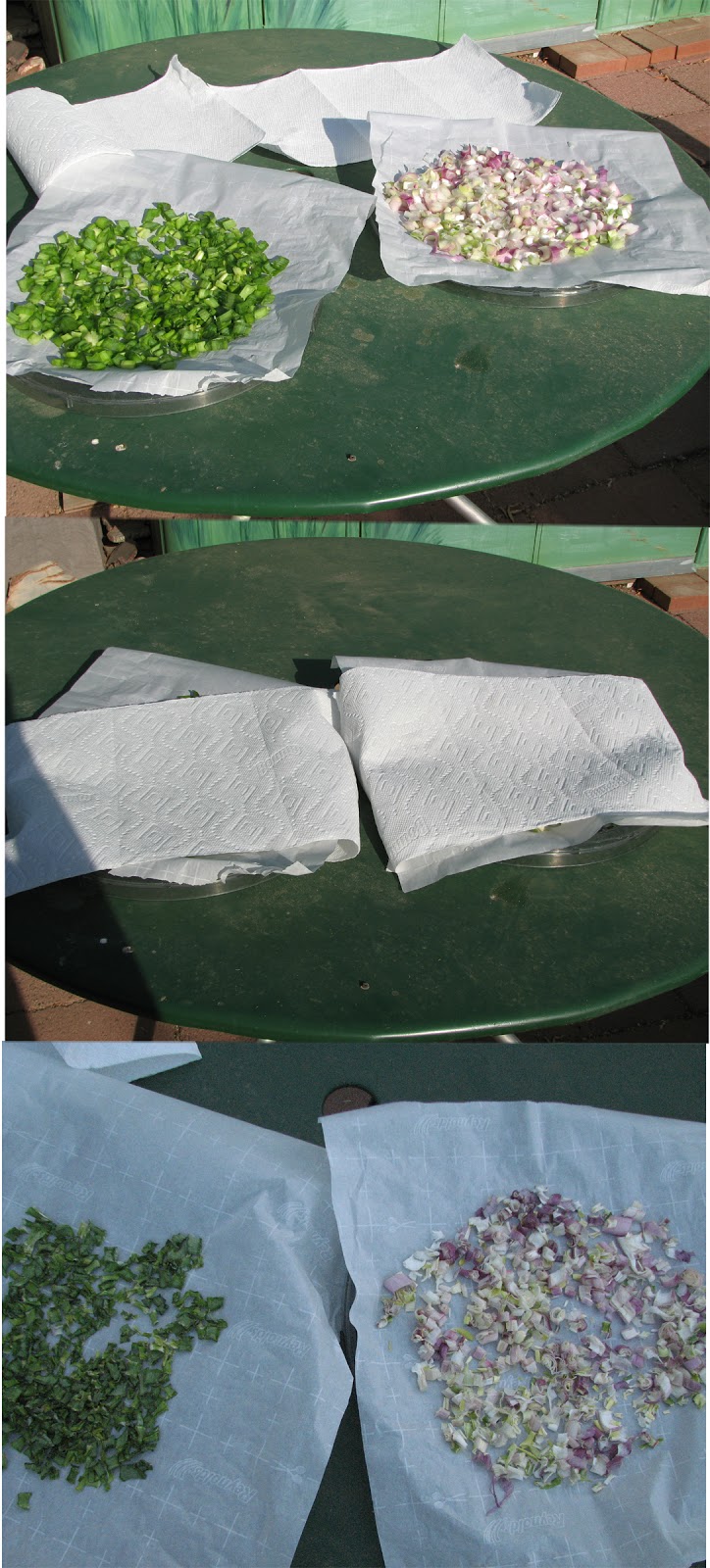
I also sun dried the green tops and cut 'scallion' separately.  The greens have a milder flavor so I have options AND, I caramelized a batch in the crockpot!.

I also distributed the extra greens through out the garden to discourage pest bugs. I don't expect it to last long as a deterrent but for now it is good.  It will dry and provide some mulch.

I already knew I wanted to dry some of the onions, but I had a lot of them.  3-4 of them filled my drying trays when chopped up.  I thought caramelized onions, but they take a long time and heat up the kitchen.  I frequently use the crock pot for cooking in the summer (I've even made bread) because I put it out on the patio and further keep the extra heat outside.

I went looking and found a recipe for caramelizing onions in a crock pot :-)

The suggestion was olive oil or melted butter.  And this was going to be different because I was not using big fat onions I was using large scallions.  I needed to get these out of the garden because the volunteer tomato and pichu berry were completely shading the onions.

(It takes about 10 months for onions to reach storage bulb size here in the desert (last year it was August.)

Cock Pot Caramelized Onions

Chop or thinly slice your onions and toss with olive oil or melted butter to coat all.  I chose to use olive oil, and put a thin amount in the crockpot first before I tossed the chopped with more.

Fill your crock pot about 3/4's full.  Turn on low and let cook for about 10 hours.

Worked like a charm.

The caramelized onions will only last about a week in the frig, so I decided to freeze in a ziplock.  The oil will allow me to break off chunks for use when I want to add to pasta, soup, or stew or use on a sandwich.

SOME NOTES:  The aroma and flavor of these is awesome.  Since I used scallions which had less density than a regular onion, I could have stopped at about 8 hours.  My wonderful scallions cooked down almost to a jam and the approximate 3 cups or so of chopped reduced to about 3/4 of a cup.  I was fine with that, but will keep the ratio reduction in mind for the future.  The recipe I based this on said 10 hours for regular caramelized onions but if you want "jam" cook for a couple more hours.

Since I was already sun drying the other onions in the sun, and it was HOT (yesterday when I started this it got to 109+) I thought I would see what would happen with a small amount of the olive oil tossed onion in the sun.  The result was significantly difference from the crock pot.  Obviously the sun did not mimic the crock pot heat and moisture.  We used most of the sun cooked onions on hot dogs last night and I'm using the rest of them when I use my potatoes for a potato salad later today.

Sun Drying Onions

After chopping the sun does all the work.  The green parts dried in about half a day, but I had to take the white/red part (these are red onion / scallions) in overnight because they were not quite dry, put them out this morning for about 2 hours and they were perfectly dry.

I mentioned before that I had an opportunity to purchase a round set of dehydrator trays (without the motor) which allowed me to have more capacity for sun drying.

You can cover with paper towel as I show or one of those picnic mesh domes.  I also sometimes stack the trays with their cover.  This is nice and compact, but you need to rotate the trays, through out the day as, the top tray and sometimes the bottom one dry out fastest.

Anything that is not completely dry, bring in overnight so they do not start to reabsorb moisture.

As with cooking, sun drying or any drying method reduces the volume of the food with the moisture withdrawn.  They store very well in mason jars and are ready to use when I need dry.  I still have some dried from last summer and they are still fragrant and tasty.  Always store in the cool, dry and dark to preserve flavor and aroma.

Here are some links to a few of my prior blog posts on sun drying.

Homemade dried vegetable bouillon - a mix of my herbs and veggies

Sun Dried Tomatoes

Sun Drying Fruit and Herbs

Finally, while you are harvesting, don't forget to let some of your beloved veggies and herbs go to flower and seed so you can harvest the mature and dry seed for re-sowing later.

This is "regional adaptation" at its best.  What did great in your garden will produce subsequent generations of stronger and more adapted plants.

Find me on Facebook

Have a great week in, and "from" the garden,


-- Catherine, The Herb Lady

herbs2u.net

If you enjoyed this post, subscribe in the upper side bar link, to get all my posts!

Disclaimer: Clicking on links on this blog may earn me a small commission if you purchase something. Your price does not change.

Monday, April 18, 2016

May Planting - Plant, Sow, Harvest Seeds, And Tips!

Dear Folks,
My Ripe Alpine Strawberries - Yesterday!!

If you are new to gardening in the desert, it is all about planting at the right (optimal) time for best success.

May is one of those months when desert gardeners get either excited (more flowers and fruit ripening) or apprehensive about the impending hot weather.

Timing is everything in our gardens, so sip a cup of iced sun tea and read on.

If you have children or grandchildren read my post on making Sunflower Houses or Teepees.

MAY PLANTING:
Artichoke, Jerusalem
Beans, Soy
Cantaloupe
Cucumbers
Eggplant
Fig Trees
Fruit Trees (With Care)
Melons, Musk
Okra
Peppers, Sweet
Peppers, Chilies
Potato, Sweet
Squash, Summer
Squash, Winter
Tomatillo
SEED IN:  Basil, Chive (Garlic or Onion), Epazote, Perilla, or Catnip-- making use of the canopy of flowering or vegetable plants.

EDIBLE FLOWERS TO PLANT:

Impatients Wallarana
Marigolds, including Tangerine Scented (Tagetes Lemonii), Citrus Scented (Tagetes Nelsonii)
Portulaca
Purslane
Roselle (sow)
Scented Geraniums
Sunflower

GARDEN TIPS for May
    By the end of the month harvest the rest of your potatoes, keeping the smallest ones as “seed” potatoes for next January — store in cardboard egg cartons in your crisper -- don't store near other vegetables or fruits.

Bee-Aware!
    As more and more flowers open and fill the air with their perfume, all the pollinators enjoy the garden as much as you, including bees.
    Swarming is where a new queen goes looking for new digs, taking with her some of the workers (as many as 50,000).  Swarming bees are a challenge to deal with because of the Africanization of the honey bee population.
    But intelligent handling of any contact will not result in a problem for you. First, the bees are not interested in you.  They are usually filled with honey for the new trip and interested in finding a new house before the supply runs out.
    Wear white or light colored clothing while gardening.
    Do not do stupid things to bees!  That should be self-evident, but some of the reports of bee encounters makes me wonder how we have survived as a species.
    If you are near a swarm or they get near you:
    a.  Move slowly and do not make aggressive moves.
    b.  Walk slowly to a house or car and get inside until the swarm moves off.  Keep all pets, children and other people from the area.
    c.  Do not go into the pool!  If the bees have been aggravated, they--will--wait--for--you!
    d. Usually the swarm will move off within a short time.
    e.  If they do not move off, then you have to call a professional service or the fire department.  They will kill the bees.  They do not have a choice because of the danger — and you do not have a choice as a homeowner — they either have to kill the swarm or you have a hive full of dangerous 'neighbors.'

Transplanting and Sowing

This time of year we are in one of those transition times, where going from mild to hot can occur in one felled swoop of heat.

Transplanting vs sowing can be a challenge as transplanting can stress the plants.

1) Harden the plants off by placing in the sun 1 hour then moving to shade, next day in sun 2 hours, move to shade - repeat until the plants have been in the sun for 4 hours and you can transplant then with a whole less stress and shock to the plant.  If the temps are already in the 90+ range double the days for each hardening, e.g., 2 days for 1 hour, then shade, 2 days for 2 hours then shade.  Your plants will thank you by being less likely to die as soon as they are put in the gorund!

2)  Use my "flower mulching" technique for transplant in warm/hot weather.  Get a six pack of flowers at the nursery and either plant your target plant (basil for example) and surround the basil with the flowers (about 5 inches apart), OR plant all at the same time -- imagine a 12 inch circle and plant the basil in the center and 4-6 flower plants around.  Flower mulching canopies the soil and shades the sides of the basil, while allowing the basil to get all the sun it needs.

Use edible flower plants like impatiens wallerana and portulaca to provide 'mulch' around the new transplants.  You can also use Sweet Allysum another edible flower but it can be a bully if it is really happy.  The portulaca does the gardener the supreme favor of dying off completely when the cool weather comes in the fall, although it may reseed next late spring.

3) Sow seeds under existing plants, just under the edge of the plant/flower canopy.

Both the "flower mulching" and the "edge sowing" are variations of the "nurse plant" concept seen in the desert where the cactus seed settles at the base of a Mesquite tree.  Shielded from birds and other critters, the seed, is held in place, watered with the rain and grows up with the mesquite protecting it.

Consider SWEET POTATOES to be planted in late May through early July.  They need 90-120 days of warm weather to grow properly.  I've planted in huge containers and in-ground using leaf cover as I do with the Irish potatoes.  In fact I sometimes use the same bed, planting the sweets after I harvest the Irish.

In case you don't know sweet potatoes, unrelated to the Irish (Solano) family, are completely edible, tuber, leaf and vine.

The sweets can produce an amazing amount of leaf and vine cover so be prepared.  Some varieties are more bushy than others.

Seed Saving

Catching the seed from winter crops like sugar peas, lettuces, celery, parsley, radishes etc. is a way to save money AND get stronger plants the next year.  “Regional adaptation” grows plants more and more suited to your backyard and the area you live.  Remember to perfectly dry them.  I store in paper envelopes labeled with harvest date, in a cool, dry, dark place until next planting time.

Looking at head to June and July, there is little suggested planting options for June, but by mid-July be ready to start seeding (not transplanting) for the fall garden.

If that sounds counter-intuitive, think about wanting pumpkins for Halloween or Thanksgiving and count backwards 90 - 120 days.

Mid-July you can under-seed tomatoes (choose short-maturity varieties) and basil for a fall crop, if you do not have tomatoes or want more.  Tomatoes give us two crops a year (spring and fall) if planted in February.  They stop setting flowers in the middle of the summer because the nights (not the days) are too hot for the pollen to activate.

Save Wood Herb Stems

Harvesting or pruning herbs?  Save woody parts to throw on the grill coals the last 15 minutes to add herb smoke flavor to the food - or better yet do it from the inside out, use woody, soaked branches of herbs to make kabob skewers.

. . .

My Month by Month planting Wall Calendar gives you my monthly tips at your "finger-tips".

Amazon

My Publisher's Site


My Beginners Guide to Edible Landscaping in the Desert is popular with those who want a quick reference guide.  "Edible Landscaping in The Desert Southwest: Wheelbarrow to Plate"

Amazon

My Publisher's Site


Have a wonderful Month in Your Garden and Kitchen!


-- Catherine, The Herb Lady
If you enjoyed this post, subscribe in the upper side bar link, to get all my posts!
Disclaimer: Clicking on links on this blog may earn me a small commission if you purchase something. Your price does not change.

Wednesday, December 16, 2015

25 Days of Herbs and Celebrations - December 16

Dear Folks,


Celebrating the Multicultural festivities of December, I thought I would pick an herb or spice which is referenced in the Bible (land of three of the Major Religions of the world) and used in many cuisines around the entire world, as a way of gathering together all the wealth of diversity around us - in true celebration.
My Syrian Oregano in July - with Bee!


Day 16
Herb:  Hyssop – of the Bible is generally recognized as Syrian Oregano Origanum syriacumaka Origanum maru, is native to the lands of the bible.  Leviticus 14:52 "He shall thus cleanse the house with the blood of the bird and with the running water, along with the live bird and with the cedar wood and with the hyssop and with the scarlet string. 53 "However, he shall let the live bird go free outside the city into the open field. So he shall make atonement for the house, and it will be clean."

Syrian Oregano is a superior culinary herb and can be used in place of Greek Oregano Origanum vulgare.  Where Greek Oregano has a distinctive “bite” the Syrian is slightly sweeter, still having all of the culinary and medicinal properties of oregano.

If you have enjoyed the authentic Middle Eastern spice blend Za’atar, then you have tasted Syrian Oregano, known as “Za’atar in that region.  The blend is a combination of ground sesame seeds, sumac berries (a specific plant -- Rhus coriaria -- known as the “lemonade tree” for the tangy flavor of the ripe berries – not to be confused with poison sumac) and Syrian Oregano, and is the “go-to” blend for seasoning many dishes.  Many Za’atar blends substitute some form of Thyme for the Syrian Oregano.

Planting:
Baker Creek sells the seeds and they germinate easily in our desert gardens. The herb can get really happy in the garden if planted in full sun, well draining soil, giving you years of harvest potential.  http://www.rareseeds.com/oregano-wild-zaatar/

Craft Project:
Yule Log!  The Yule Log is an old tradition used by both pagans and Christians for different celebrations.  It is a fun project for the family to create for use in your fireplace (do check on burn restrictions because of air quality), firepit or chiminea.

Gather ingredients for a Yule Log.  The Log can be lite on December 20th/ 21st (celebrating the Solstice) or December 24th (Celebrating Christmas Eve) or both.  It can be used as a centerpiece and/OR you can burn it - to burn it the herbs etc. must be perfectly dry or it will smoke.

My 'yule log' "recipe" - this is a fun project using all edible herbs and spices for decoration and aroma. You can make the log exactly as described or use your own special herbs, edible plants, fruits and flowers - just be sure if you are going to actually burn it (it makes a lovely centerpiece) that all components are perfectly dry before lighting or it will smoke.  Pictured are the ingredients I chose from my garden, some wrapping paper, paper ribbon, some of the last of my Roselles, lavender, myrtle, rosemary, orand and grapefruit peeo, and bay leaf, I also gathered some cloves to tuck in here and there and elmer's glue.  I am so not creative, but I think this turned out nice.  It will dry nicely and be ready to light in a week or so.

YULE LOG
--1 piece of log wood with bark, cut to fit your fireplace, chiminea or fire pit (the knurlier the better) - use hardwood for fireplace or concrete/metal fire pit; use softwood for chiminea (this is important hardwood will get so hot it can crack your terra cotta chiminea).
--Peel of 2 oranges, cut in strips, small pieces or spirals
--Elmer's (or other white) glue (not cement, hot glue or like – will create toxic fumes)
--Sprigs of rosemary, lavender, oregano, thyme, sage or any aromatic herb
--Any combination of whole spices:  allspice, star anise, cloves, cinnamon sticks
--1 Bow (or you can arrange orange peel in the form of a bow before drying) you can use strips of Christmas paper to make a bow or bows.  The paper ribbon which can be twisted using a sharp blade are pretty also.

     Glue herb sprigs decoratively all over top and sides of log.  Arrange and glue orange peel in amongst the herbs.  Fill in with whole spices.  Add bow.

       If the bow is not made of paper or orange peel, remove before lighting.

       Legend says the longer the log burns the longer your good luck for the new year. 
      For Christians, traditionally lite on Christmas Eve, this is so fragrant and pretty you may wish to make several and use during our winter months for special celebrations.

Music:

White Christmas
Bing Crosby

Oh Christmas Tree (from the Perspective of the Cat)


. . .

Garden more successfully in the Desert with my month-by-month planting calendar.


-- Catherine, The Herb Lady
If you enjoyed this post, subscribe in the upper side bar link, to get all my posts!

Disclaimer: Clicking on links on this blog may earn me a small commission if you purchase something. Your price does not change.

Wednesday, December 09, 2015

FREEZE Warning!

Dear Folks,

FREEZE possible - the new system moving in Thursday Night will bring temps down into the low 30s or lower by Saturday early morning.  This will be around for at least a couple of weeks, so have your frost protection covers handy for sensitive plants.  You can mound dried leaves or straw completely over sensitive plants to try and protect if we get hard freezes - 32 or lower for extended hours.  Covers can be kept on plants for up to 5 days without damage, but if possible remove during the day to let sunlight in.

https://www.facebook.com/Catherine-The-Herb-Lady-and-Herbs-2-U-113673778894/


-- Catherine, The Herb Lady

 If you enjoyed this post, subscribe in the upper side bar link, to get all my posts!

 Disclaimer: Clicking on links on this blog may earn me a small commission if you purchase something. Your price does not change.

Sunday, February 08, 2015

New! MOBILE "Desert Gardening Perpetual Calendar"

Dear Folks,

Many of you know and have purchased (thank you!) my brand new Wall Calendar designed specifically for gardening with edibles in the desert.

With all of the "mobility" tech devices out there, I thought a downloadable version of the calendar would be helpful.

While the calendar is for 2015, all of the month-by-month planting information, gardening maintenance, and tips don't change. The planting and "To-Do" chores are the same next February as this February.

I do plan on bringing out a new Wall Calendar each year with new pictures from our gardens and any additional tips I can pass on to you, however both the wall calendar and the digital calendar can be treated as a PERPETUAL calendar.

So, I created a PDF version of the calendar.


See information below on PDF readers.

WHY purchase a digital edition?

Convenience!  That is the primary reason everyone has a smart phone or eReader handy.

Let's say you are out shopping and think:  "Now what plants / seeds did I need to get this month?"  Check the calendar on your device.

You are discussing things you would like to do in the garden with friends or family and you are away from home - check the calendar on your device!

Your friend or relative knows you garden and asks what to can they plant?   Check the calendar on your device!

The PDF file is $6 (the wall calendar is $16.96 plus shipping).  I think my wall calendar is beautiful and useful (and so do many of you), but something that is even more convenient for you and if it will get you growing more of your own food, I don't mind one bit if you go the less expensive way, plus have a calendar that will work from year to year.  (There is a preview under the picture on the site.)

Desert Gardening Success - Perpetual Calendar


PDFs can be read on any device which has a PDF reader, Adobe supplies these all free as a download.  You can also store the file on all of your devices: phone, ereader and computer

Here is a link for Adobe's free mobile app for smart phones and iPad

http://www.adobe.com/products/reader-mobile.html

Adopbe has a free "digital editions" app for certain other eReaders

http://www.adobe.com/solutions/ebook/digital-editions.html

And, if you do not the Adobe PDF reader on your computer or laptop, you can get it free here.

http://www.adobe.com/products/reader.html

Mac version of the Adobe PDF reader

http://www.adobe.com/support/downloads/product.jsp?platform=macintosh&product=10


If you would like the wall calendar here is the link for it.

You may wish to check out the PDF version of my cookbook 101+ Recipes from The Herb Lady

There is also a preview under the cover picture.


Helping you grow more of our own food, successfully!

Have a great day in the desert garden,


-- Catherine, The Herb Lady

Friday, September 30, 2011

Planting Now In The Desert - Fall 2011

Dear Folks,

Yesterday I seeded in more beets, carrots, turnips and parsnips, plus radishes, "red" celery and some Kale.

I also harvested and grated my horseradish.  To grow horseradish successfully in the desert you need to plant it in the fall and harvest summer to fall.  The roots take several years to get to good size and this year I harvested the biggest roots I've gotten so far.  Pencil thin 2 years ago, thin carrot size last year and this year and inch or more in diameter on some.   I keep what I want to grate, save some with parts of their tops if possible and replant immediately.  I've been expanding the area out a little get more growing.  Deane can't take hot peppers, but he can enjoy horseradish.   You can find my prior year blogs on horseradish, by using the search box on the sidebar.

Horseradish and ginger and two root crops which can present some difficulty for desert gardeners.  One is a cold-climate lover and the other a true tropical.

I have ginger growing now also, and I found it loves a mostly summer shaded area, although it will tolerate some summer southern sun with dense planting around it.  The shaded area ginger is far happier.

Tomorrow I plant my garlic, an October 1st tradition.  Garlic is very easy to grow, but you need patience, as the mature head is not ready until April.  I am growing Purple Glazer this year, one I've grown before and really enjoyed, as do my market customers.

I have some 'left-overs" I kept in the crisper for replanting and because last year's crop, which was intended to be green-garlic, matured to too-tiny head garlic because of our rare winter freezes, I'm going to re-plant them for green garlic over the next couple of months.

I recently opened up an old bed, reclaimed from the many-years old garlic chives (I will be dealing with seed sprouting for a while I'm sure) to plant the root crops etc. I mention at the top for our use in the coming weeks and months.  You read one of my 'irregular' newsletters I posted yesterday about successive planting here.

For many years I have used the gardens as my laboratory to experiment with my trowel and error edible landscaping so I could find out how to grow the things I love to eat and use in the kitchen.  That T&E is how I can write and help you garden successfully in the desert garden.  We have the climate and the opportunity to grow much or most of the food we need year round, why not take advantage of it!

Unfortunately I have let mint and garlic chives take over several large areas so I am going to rein in the mint and take some space back for more seasonal edibles.  I have given myself quite the chore to get the mint under control.  I planting on restricting it using roof flashing - I will keep you posted on my T&E there and Deane's reactions (RIGHT!!!) to this effort.  He always helps, sometimes doing most of the digging for my projects, but he can't stop pointing out that I'm too successful and neither the garden nor me are trainable.  We will see :-)

The red celery mentioned above is new to me and I am excited about my new experiment to grow it here in the desert.  I chose this because of the licopene aspect and also that this particular variety can be harvested a stalk at a time, once it reaches a good size.  Keep your fingers crossed for me :-)

Have a great time in the garden,


-- Catherine, The Herb Lady

Sunday, May 15, 2011

Solid Gold - A New Definition - Apricots -- and Around The Garden

Dear Folks,

I decided while biting into one of our ripe apricots that eating these luscious morsels is like eating solid gold!  You really need to get to your local farmers market to get them ripe, OR, grow you own.  The season is short for apricots usually only about a month per variety.  We have Katy and Gold Kiss.  The Gold Kiss was planted in 1998 and still (we are happy to say) going strong.  It is getting a bit long in the tooth, but so far Deane has had to take only the occasional dead wood from it in addition to an annual pruning.


Check out my booklet "What's A Chill Hour..." to learn how to choose stone-fruit trees, including apricots, for the desert garden.  Available as print or PDF download - the download file is only $2.95.

. . .

One of the fun things that happen in our garden, and since I am not a stickler for orderliness - is finding the random pleasant surprise that is always a treat.  Deane is far more interested in keeping a park-like look, but he also enjoys the blazing display of edible flowers and other garden delights.

We have a small patch of summer lawn (bermuda) designed specifically to encompass the dry wells for our septic system should the plumber ever need access.  While walking through the garden the other day, I noticed a yellow violet and figured the birds had dropped a flower on the lawn.  NO, the plant was growing there - serendipity!  It has also given me the idea to over-seed the lawn in the winter with pansies and violets this winter since we do not grow a winter lawn.  I can't wait -- Deane is just rolling his eyes, but I think it will be beautiful!  This technique is generally referred to as 'naturalizing' and is frequently used with spring flowering bulbs like tulips, by the time the winter/spring bloom is faded the summer grass starts to grow and you can mow down the leftover greenery (I, of course, hope the flowers will reseed for the next opportunity of serendipity).

Another 'happenstance' is the random visitors to our gardens.  For several days we have both heard a whistle and the woo, woo of it made it sound like a person, maybe calling a pet.   Well it was not human, or a regular visit to our gardens.  Deane quietly snapped pictures of this beautiful Bob White Quail, named for their surprising "BoooB, Whittteee" call.


Today, May 15th, is the feast day of Saint Isidore Patron Saint of Farmers, Field Hands & Livestock


Have a wonderful Day in the Garden!

-- Catherine, The Herb Lady

Friday, December 10, 2010

Free Upcoming Event and Free Shipping Offer - Ends soon!

Dear Folks,

See the free shipping offer from my publisher below - Ends December 12, 2010.

FREE Lecture January 8, 2011.

The City of Mesa Hosts a monthly series of "Living Green" lectures and I am co-lecturer at the one for January.

Mesa Sustainability site here

Greg Morris and I will be discussing edible landscaping for the backyard gardener.

Greg is a Certified Professional Landscape Designer with a focus on sustainable landscaping, and of course Edible Landscaping is the ultimate sustainable gardening. Click here for Greg's blog.

The lecture is free but it is a good idea to call and let them know you plan to attend (contact info on the City site).

FREE SHIPPING OFFER

If you have been interested in my books but waiting for a good opportunity, you have one now with a free shipping offer -- the offer ENDS December 12, 2010.  (SPECIAL NOTE: the free shipping may not guarantee delivery in time for Christmas - I don't want you or your giftee to be disappointed.)

Go to my publisher's page for my books.  Enter the following code when prompted at check out -- the offer has a maximum of $45 in free shipping charges -- HOLIDAY305.

Catherine Book Site

The offer is for print copies, of course, but you can order your copy of my two main books as ebooks - with a version available for iPad at the same link.

I will be posting current gardening tips next blog!

Have a wonderful weekend!


-- Catherine, The Herb Lady

Sunday, November 14, 2010

Potato Soup with Garden Herbs

Dear Folks,

I've had an urge for potato soup - must be our chilling weather!  Anyway, I think I've come close in flavor to my mom's potato soup of 5 decades ago, but of course I had to add herbs for additional flavor.

Homey, warming and tasty.

I've been having fun with the sorrel from my garden (I've been adding to grain salads for sparkle), we always have fresh parsley too, and I got the arugula from one of our Farmers at the Mesa Farmers Market 'cause my arugula is not up yet, darn :-)

You can easily make this vegan friendly if you desire.

Catherine's Potato Soup with Garden Herbs

2 tablespoons of butter
1/4 of white onion minced

Melt butter in 2 quart stock pot, saute the onion in the melted butter while you clean and cut of potatoes, add a tablespoon of olive oil if it looks like the onions need more liquid.

1 tablespoons of olive oil

3-4 cups of diced potatoes (I leave the peels on and I used red new potatoes)
2 cups of milk
1 1/2 cups of finely minced herbs (I used a mix of parsley, sorrel, arugula)

salt and pepper (about 1/2 tsp of salt and several good grounds of the pepper grinder will usually do it)

Add milk to onions and bring just to boil, stir in potatoes, reduce heat, cover, and cook until tender - about 15 minutes, season with S&P.

Croutons:  (I toasted 12 grain bread, spread butter/canola mix on and very lightly sprinkled with garlic powder and cubed.)

When the potatoes are fork tender, mash leaving some pieces for texture.

Serve with minced herbs and croutons.

Optional:  Crumbled fresh cooked bacon /
Vegan Options: try rice milk instead of the cows milk and some firm cubed tofu can be added just before mashing to increase protein content, use all olive oil for saute.

Enjoy!


-- Catherine, The Herb Lady

My books are available as ebooks and a version for iPad in addition to print
www.lulu.com/herbs2u

Sunday, November 07, 2010

Yes! We have some bananas!

Dear Folks,

Well after many lost opportunities - we missed some ripening times when we were out of town, or the fruit simply was not mature enough when frosts hit, we have our special banana fruit!

On Wednesday the 3rd we noticed some of the fruit beginning to yellow and cut the whole stalk on Thursday - (we thought - although yesterday Deane noticed there is still a large 'hand' of fruit on the plant which we will leave there until it begins to yellow).

We have been enjoying the ripening fruit ever since.


This is a "Blue Java" or "Ice Cream" banana (Musa acuminata ss. Java Blue( Moo-suh)(ah-kew-min-AH-tuh) is reported to be the best tasting banana and to have a vanilla ice cream taste.

I purchased the original plant about 8 or 9 years ago at a Home Depot in town, and transported the potted plant around until about 2 years ago and then waited, and waited - the first bunch a year ago came out so late we cut the stalk at first frost to keep it going and it did ripen in our back room but the fruit while banana like in flavor was not inspiring.

Over the next year or so we had the hit or miss with subsequent bunches until this one.  It took right at 4 months to go from first flower sighting to this pre-ripe stage.

So was it worth the wait - yep!

First let me tell you these are not large bananas - they average about 3 inches long.  4 of us did the first taste tests - we all agree the flavor is more pronounced than the store bought kind, sweeter, creamy, and with 'something' additional in the flavor.  1 of us said "vanilla"

So it was worth it.

Okay on what some of the challenges were that I can discuss now.  That first year's bunch was off the first plant which grew to about 10 feet tall.  Subsequent plants were taller.  When they would get really going in the warm weather they would put out a new leaf about every 8-10 days.  It appeared the subsequent fruit bunches even when not robust were larger and more 'hands' developed.

Over the last two years I identified some important aspects of growing them here in the valley:

1) the large root mass grows substantially once you put it in the ground from a potted plant.  Subsequent plants are more robust and put out fruit earlier - most likely because of the enlarging root mass.

2) your success with the fruit is going depend a lot on when the flower comes out after the plant has been in the ground about a year, meaning after the initial plant is in the ground a year, the subsequent 'baby' plants will be more robust, grow faster and reach flowering stage a little sooner.  If the fruit in optimal growing time takes 4 months to go from first flower sighting to ready to harvest the stalk then your prime crop will be available before first frost.

-- we have our last large bunch on another plant (each plant produces one bunch then dies back and you need to cut it out) is just now getting go good size and unfortunately needs another 2 months to get to prime harvest state.  We will watch and cut it at first frost.

-- in a very cold winter your banana plants may go to the ground if we get sustained killing frosts (not common) but they will come back up as soon as the soil warms in the spring, even sooner if the subsequent winter is mild.

3) bananas are a large piece of grass - kind of - creating photosynthesis from all green parts.  One of the complaints of 'orderly gardeners' is that the wind can shred the large leaves and it does, but do not cut any of the leaves off unless they have gone completely brown. If you need to contain it some you can cut the bent-over tips some to keep them from trailing on the ground.

4) they will require a bit more water than some other fruiting kinds, but not excessively.  During the hottest part of the summer we watered for about 10 minutes between the same kind of watering we gave our tomatoes, other fruit trees and herbs.

Recommendations from other banana growers are to try and keep no more than a few plants in the same area (root mass) at a time, to encourage good growth and fruiting.  I don't know that my cutting out some of the baby plants for re-sale did any of that but the remaining plants were very large in girth.  I did need to keep the babies cut out anyway so I could control how wide the spread of the mass was by selectively choosing which baby plants came out.  Worked for us.

Other useable qualities of the banana plant are the leaves and flowers are edible.  While you don't want to chow down on the leaf they make great steaming envelopes for food, imparting a fruity quality to the cooked food.  The banana flowers are also edible but I have not wanted to sacrifice future fruit by trying some of the recipes. Now that I know how good the fruit is when it ripens at the right time, if a flower comes out too late for successful fruit production I will give the recipes for banana flower a try -- maybe next year. (If you are really energetic the fibers of the stalks have been used in weaving.)

We were almost considering giving up on the major plant area (I had started another small one to have at least for using the leaves), and we are both glad we didn't pull the plants -- the fruit is that good.

Next I will be updating on my ginger project.

Have a great time in the garden!


-- Catherine, The Herb Lady

My books are available as ebooks with a version for ipad as well as in print copies

http://stores.lulu.com/herbs2u

Sunday, September 05, 2010

Save These Dates!

Dear Folks,

I have several classes or lectures lined up at the moment.
October 9th
November 20th
January 8, 2011


SALSA 101 Class with Catherine "The Herb Lady"
Saturday, October 9th at 2-4 p.m.
Did you know fruit salsa was not invented by modern chefs? It has been around longer than you think! Come enjoy an afternoon learning about the history and plants that make up salsa, then make your own variations to take home with you! The class is $15 for members, $22.50 for non- members. All supplies are included. Space is Limited. Call 520.689.2723 to register. All proceeds benefit Boyce Thompson Arboretum.

http://arboretum.ag.arizona.edu/

Tofu: Holiday Recipe Ideas! Presentation with Catherine "the Herb Lady"
Saturday, November 20th at 1-3 p.m.
Tofu is the plain sister of healthy foods with a secret — it is a palate for flavor! Tofu is not just for vegetarians and can take your next holiday meal to a whole new level. In this presentation Catherine explains that menu planning for the holidays with vegan or vegetarian family and friends is not the challenge you would think. Take home holiday and casual recipe ideas – and try samples of them too - for entertaining using nutrient dense tofu and edamame (green soy beans) that will please meat eaters and vegetarians alike. This presentation is $10 for members, $17.50 for non-members. Recipes and food samples are included. Space is limited. Call 520.689.2723 to register. All proceeds benefit Boyce Thompson Arboretum.

http://arboretum.ag.arizona.edu/

Edible Landscaping: Vegetable Gardening, Herbs and More
January 8, 2011   1:30 - 4 P.M.
Red Mountain Branch


Presented by:  Greg Morris, Master Gardener, Landscape Designer, and Catherine "The Herb Lady" Crowley

Now you can have your landscape and eat it too! This program will cover the basics for successful vegetable gardening, but will also show how to incorporate edible plants throughout the landscape, and will suggest plant varieties for landscape function and edibility. An interactive 'show-and-smell' with culinary herbs will teach you growing basics and provide cooking suggestions, too.

INFORMATION:
Donna DiFrancesco
Conservation Specialist
Environmental & Sustainability
480.644.3334 (tel):  480.644.4774 (fax)
PO Box 1466
Mesa, AZ 85211-1466
Water Use It Wisely!

. . .

We have had our 'seasonal shift' and now we are entering "spring in the desert" -- for new comers that may be hard to understand.  October is the beginning of the primary planting season for perennials and all cool weather annuals and biennials.

If you have tried and tried to have a garden in the desert southwest and been disappointed in the results one of the primary pieces of information is what to plant and when.  When I write and talk about being able to garden all year long - I mean it -- however you have to plant each plant variety in its own proper season.  October ?  Plant dill, parsley, and cilantro and all the cole (cabbage) family and root vegetables and all the wonderful greens and lettuces.  February?  Plant basil, tomatoes, chives, watermelon, summer squash, and corn.  July?  Yes, late July - early August - plant all the "SEEDS" for the fall plants you want including those pumpkins for Halloween and Thanksgiving.


Think snowsuits in July and Swimsuits in December and you will have a way of understanding when to begin seeds for transplanting and the different seasons in the desert garden.


My easy helper 'reminder service' is just $21 a year for information directly into your email inbox.  Several times a month you will receive simple but detailed information on what to plant and when, when to look at harvesting (and also what is available at your local farmers market), and how to use the bounty of your gardens.  This inexpensive service is made possible by keeping it automated, so I am always happy to answer additional questions for subscribers individual gardens via email.

You can pay through this link:

Paypal payment window

Also for those of you interested in my gardening and/or cooking books, they are now available for your iPad.

Have a great day,


-- Catherine, The Herb Lady

Tuesday, April 20, 2010

Free Shipping Offer On My Books - Expires May 1st - Hurry!

Dear Folks,

If you have been contemplating purchasing my "Edible Landscaping" or "101+ Recipes" book, my publisher is offering free shipping on a single book purchase (print).

Free shipping always gets my attention, and I do benefit from this of course, but usually free shipping offers require you to buy $25+ to get the freebie, my books start at $12.25.


1) good to any US address
2) good on a single book purchase only, one to a customer**
3) there are 2 versions of each book - standard and a 'trade" version which is a lighter-weight, and less expensive version (I actually like the paper on the trade version better)
4) you must use the code below on check out, until you put the code in it will show the full shipping price.


and here is the big point:
5) GOOD only until 5/1/10 at 11:58 PM - it expires 1 minute before midnight.


** But you can pass the code around to family and friends


CODE:

FREEMAIL305


And here is the site where you can scroll through the books:

http://stores.lulu.com/herbs2u


Have a nice day,

-- Catherine, The Herb Lady