Garden, Plant, Cook!

Showing posts with label sustainable. Show all posts

Tuesday, August 16, 2016

September Planting Tips, And, Sowing with "Collars" and "Hats"

Dear Folks, 
September Planting Tips

September is a heavy sowing rather than transplanting time until near the end of the month, when you can do both. However, when transplanting be sure to harden off your seedlings before putting them in the ground. Our temps do not regularly fall below 90 until around September 29th.

Prepare soil for perennial planting -- edibles need superior draining soil, work in compost or well-rotted manure -- NEVER use fresh manure unless the garden will sit for 6-12 months before planting. If your soil is already healthy, you can ad a light dressing of compost or well-rotted manure.

"Collars"

First picture shows 2 collars made from paper towel or bathroom tissue tubes. These collars keep the soil pests like sowbugs, snails and slugs from your new seed/seedling.

Cut a 3 inch piece and bury half in the soil, nest the seed in and lightly cover with soil and water well.

ALL seeded areas need to be kept moist by sprinkling/watering every day until you see the seed break ground, then you can cut back on watering to encourage deep roots.

"Hats"

I've written about chicken wire hats before. These keep the birds and other critters off you seed areas and young seedlings.  Show in the 2nd picture is a "tube" hat.

They physically discourage them, while permitting all other necessary natural activity.

After a while you can remove the hat as the birds etc. have forgotten they are there. Why? The chicken wire physically stops them but they can still see through. Unlike bird netting which is both a physical and a visual barrier, so as soon as you remove the net they think dinner is served.

I have two short videos on my youtube channel showing how to use the chicken wire hats.

Make good use of your water meter during this temperature transitional month.

Labor day is when we usually fertilize our fruit trees (again on Valentine's day and then again on Memorial Day).

We can look forward to the fall temperatures and reduced moisture. Except for the storms we don't see day time temperatures below 90 from May 29th to September 29th. Getting seed in now sets the cool weather lovers up for germination at the right time.

Give your tomatoes that survived the summer a hair cut, working over several days, trimming off damaged stems. The fruit will start to set again once the night time temps stay below 80.

Cool weather annuals and biennials can be sown every 2-4 weeks (beginning in August) through end of November or December for a continuous crop through next spring.

Some of the longer maturity vegetables need to be sown EARLY. 90-120 day maturity foods like Cabbage, Broccoli, Cauliflower, Brussels Sprouts, Celery, Leeks, and Parsnips all need to be in the ground for 3-4 months before you can harvest them.

Berry Vines/Canes - October 1st: cut all canes, old and new, to ground after fruiting - commercial growers use this method.

Sow:
Anise
Beans (bush and pole beans in first week in September at latest)
Beets
Bok Choy
Broccoli
Brussels Sprouts
Cabbage
Cabbage, Ornamental
Calendula (Calendula Officinalis)
Caraway
Carrots
Cauliflower
Celery
Chard
Chervil
Cilantro
Cornflower/bachelor Buttons (Centaurea Cyanus)
Cucumbers
Dill
Endive (and Chicory)
Fennel, Leaf
Onions, Green
Greens
Kale, Ornamental Cabbage
Kale
Kohlrabi
Leeks
Lettuce (leaf lettuce, arugula, mustard greens etc.)
Marigold, Citrus Scented (Tagetes Nelsonii)
Marigold, Tangerine Scented (Tagetes Lemonii)
Mustard
Nasturtium
Parsley
Peas, English and Sugar / Snap Peas
Radishes
Scented Geranium
Snapdragon (Antirrhinum Majus)
Spinach
Sweet Alyssum
Sweet William Aka Pinks (Dianthus Barbatus)
Turnips


-- Catherine, The Herb Lady

P.S.  I had the worst time with formatting this post for some reason so I apologize for any issues. I would be happy to answer questions.

Website


If you enjoyed this post, subscribe in the upper side bar link, to get all my posts!


Disclaimer: Clicking on links on this blog may earn me a small commission if you purchase something. Your price does not change.

Friday, November 21, 2014

Are You Growing, Can You Grow - Your Own Food?

Dear Folks,

My favorite subject - can you grow some or most of your own food?  If not - why not?  It is a simple question with far reaching consequences and benefits.  Through out most of recorded history, people working together created food access systems, whether through shared labor, barter or 3rd party (wholesale to retail sales).

In a modern effort to make ourselves so-called independent, we isolated our talents and knowledge into fractional skills - we can make money doing a job, but we have to PAY someone to grow our food.

This disconnect becomes frighteningly apparent when someone loses a job or becomes unable to work and feed themselves or their families.

This fascinating article from the New York Times - brings this issue of food and poverty into clearer perspective.

Recent discussions by some politicians about reducing or eliminating 'safety nets' like food stamps begs the question - where do the hungry obtain food - and further - WHAT IF you lost your job - can you grow your own food, can you work with others to grow your own food, do you know where to get food without money?

If you believe your only skill and talent is how to make money, then you have set yourself and your family up for unfortunate consequences if life throws you a curve, badly.


Learn how to grow some or more of your own food, read, take a class, attend lectures, join a local gardening club.

"The difference between you and the hungry is not production levels; it’s money. There are no hungry people with money; there isn’t a shortage of food, nor is there a distribution problem. There is an I-don’t-have-the-land-and-resources-to-produce-my-own-food, nor-can-I-afford-to-buy-food problem."

"Claiming that increasing yield would feed the poor is like saying that producing more cars or private jets would guarantee that everyone had one.
"


Don’t Ask How to Feed the 9 Billion

By Mark Bittman


At dinner with a friend the other night, I mentioned that I was giving a talk this week debunking the idea that we need to grow more food on a large scale so we can “feed the nine billion” — the anticipated global population by 2050.

She looked at me, horrified, and said, “But how are you going to produce enough food to feed the hungry?”
I suggested she try this exercise: “Put yourself in the poorest place you can think of. Imagine yourself in the Democratic Republic of Congo, for example. Now. Are you hungry? Are you going to go hungry? Are you going to have a problem finding food?”

The answer, obviously, is “no.” Because she — and almost all of you reading this — would be standing in that country with some $20 bills and a wallet filled with credit cards. And you would go buy yourself something to eat.

The difference between you and the hungry is not production levels; it’s money. There are no hungry people with money; there isn’t a shortage of food, nor is there a distribution problem. There is an I-don’t-have-the-land-and-resources-to-produce-my-own-food, nor-can-I-afford-to-buy-food problem.

And poverty and the resulting hunger aren’t matters of bad luck; they are often a result of people buying the property of traditional farmers and displacing them, appropriating their water, energy and mineral resources, and even producing cash crops for export while reducing the people growing the food to menial and hungry laborers on their own land.

Poverty isn’t the only problem, of course. There is also the virtually unregulated food system that is geared toward making money rather than feeding people. (Look no further than the ethanol mandate or high fructose corn syrup for evidence.)

If poverty creates hunger, it teams up with the food system to create another form of malnourishment: obesity (and what’s called “hidden hunger,” a lack of micronutrients). If you define “hunger” as malnutrition, and you accept that overweight and obesity are forms of malnutrition as well, than almost half the world is malnourished.

The solution to malnourishment isn’t to produce more food. The solution is to eliminate poverty.
Look at the most agriculturally productive country in the world: the United States. Is there hunger here? Yes, quite a bit. We have the highest percentage of hungry people of any developed nation, a rate closer to that of Indonesia than that of Britain.

Is there a lack of food? You laugh at that question. It is, as the former Food and Drug Administration commissioner David Kessler likes to call it, “a food carnival.” It’s just that there’s a steep ticket price.

A majority of the world is fed by hundreds of millions of small-scale farmers, some of whom are themselves among the hungry. The rest of the hungry are underpaid or unemployed workers. But boosting yields does nothing for them.

So we should not be asking, “How will we feed the world?,” but “How can we help end poverty?” Claiming that increasing yield would feed the poor is like saying that producing more cars or private jets would guarantee that everyone had one.

And how do we help those who have malnutrition from excess eating? We can help them, and help preserve the earth’s health, if we recognize that the industrial model of food production is neither inevitable nor desirable.

That is, the kind of farming we can learn from people who still have a real relationship with the land and are focused on quality rather than yield.

The best method of farming for most people is probably traditional farming boosted by science. The best method of farming for those in highly productive agricultural societies would be farming made more intelligent and less rapacious. That is, the kind of farming we can learn from people who still have a real relationship with the land and are focused on quality rather than yield. The goal should be food that is green, fair, healthy and affordable.

It’s not news that the poor need money and justice. If there’s a bright side here, it’s that it might be easier to make the changes required to fix the problems created by industrial agriculture than those created by inequality.

There’s plenty of food. Too much of it is going to feed animals, too much of it is being converted to fuel and too much of it is being wasted.

We don’t have to increase yield to address any of those issues; we just have to grow food more smartly than with the brute force of industrial methods, and we need to address the circumstances of the poor.

Our slogan should not be “let’s feed the world,” but “let’s end poverty.”

http://www.nytimes.com/2014/11/12/opinion/dont-ask-how-to-feed-the-9-billion.html?_r=1 

. . .
 
Desert Gardening Tip - here is a beginner tip or one to add to your garden know-how.

Plant Sugar Peas - RIGHT NOW!

I'm going to do a separate post on sugar peas and what is so wonderful about them next.  But in the meantime.  Find a sunny spot - I mean SUNNY, not partial shade and sometimes sun.  The spot should be at least 2 foot by 2 foot.  Erect something to serve as a trellis on the North or West side of the area.

Plant 2 seeds for each person in your household, 6 inches apart.  In 3- 4 weeks plant 2 more seeds for each person, arranged between the now growing plants.  Once the plants start producing (in about 5-6 weeks) pick the pods each day when they measure 3-4 inches.  Keep them picked and the plants keep producing.

More in the next post.

. . . 

I have a book - a  beginners guide to when to plant in the desert garden.

Coming up at the Boyce Thompson Arboretum on December 6th, I with a whole bunch of authors will be there for an Author's Day, where you can visit with the author's and purchase books.

If that won't work for you, you can find my books in print and some versions of e-book on the internet.

Don't put off starting or adding to your edible garden - you CAN control where some or much of your food comes from and it is not a store which can't or won't take good intentions, instead of money!

-- Catherine
The Herb Lady

 . . .

My Books:

Ibook

https://itunes.apple.com/us/artist/catherine-crowley/id372564893?mt=11

amazon - print

http://www.amazon.com/Catherine-Crowley/e/B002C1HWG0/ref=sr_tc_2_0?qid=1367065857&sr=1-2-ent


Barnes & Noble - print and Nook ebook

http://www.barnesandnoble.com/c/catherine-crowley

Kobo

http://store.kobobooks.com/en-US/Search?query=Catherine%20Crowley&fcsearchfield=Author


Lulu

http://www.lulu.com/spotlight/herbs2u

Saturday, June 26, 2010

Greening - Various Tools to Help You Shop and Live Wisely

Dear Folks,

If you have been following me, you are probably already trying to shop at your local farmers markets, do more cooking at home to control your menu ingredients, enhance your family quality time, and experiment with all those cool recipes you see on cooking shows.

To add to your tools and information sources, I tripped across a couple of sites I found helpful.


http://www.sustainabletable.org/spread/kits


The Sustainable Table site has a variety of kits (in PDF file form) which can be used as teaching or display tools and for your own family information use.

They also have a kit for the Sustainable Dinner Party which can give you some ideas for Supper Groups.
(I have been thinking off and on of potentially setting up 'secret suppers' -- it would require quite a bit of planning, but is fun to contemplate.  I will let you all know if I get serious!)

Another site to visit for information is the Animal Welfare Institute, which certifies humanely raised livestock farms.  They are dedicated to supporting the small-scale and family farm. http://www.awionline.org/


The troubling issues with factory farming continue to, finally, get more and more attention. Even when a farmer wants to do things right if they make the mistake of getting into contracts with large processors -- the real manufacturers when you come down to what you are buying -- they are trapped in unconscionably egregious contracts which leaves them captive to corporate whims or in bankruptcy.


Read what some chicken farmers are up against.
http://www.sustainabletable.org/2010/05/chicken-farmers-describe-a-system-of-extortion-and-economic-slavery/


How can you get more control over what you buy?  I have noticed more and more food manufacturers are getting the message.  I just saw an ad for Hunts Ketchup which loudly proclaimed on the label 'no high fructose corn syrup' -- good start!

They are listening. The real challenge to getting healthier and better quality foods is to make sure you are clear about what you want them to offer to you.

I participate in online consumer surveys.  I am troubled when the elimination questions (I don't have the ability to complain about the questions) are frequently aimed at getting the survey participant to use emotions to explain how they purchase something.  That is not to say there are no questions about what do you purchase - recently I had a survey on dairy and cheese and how much was organic, or natural, or other - that was a good one.

One good thing I noticed about the surveys in the last 6 months are the options in prepared goods or shelf-stable foods which offer more environmental, natural, local, family farm options for selections in answering the survey.

So why might that be a problem?  Because those buzz words can be grabbed by food processors to label something which amounts to bait and switch - "So and so's family farm produces only naturally prepared..."

Back in January, 2010 "Tyson Foods Inc. has agreed to settle a lawsuit that accused the poultry giant of falsely claiming its chickens were "raised without antibiotics."


"In 2007, Tyson began advertising and labeling its poultry products as having been "raised without antibiotics." The following year, the U.S. Department of Agriculture ordered Tyson to remove the labels when it found that the company had injected its chickens with antibiotics before they hatched. Tyson argued the labels were accurate because chickens aren't "raised" until after they're born."


So how do you like that corporate logic?

Isn't that enough to make you want to scream at them!  The quote attributed to Voltaire goes something like "If you wish to converse with me, define your terms."  Don't you wish we could tell corporate food producers they need to define their terms so we know what they are really saying?

What is a consumer to do?  You need to know your suppliers like your grandparents did, your local farmers, meat producers, egg sellers, and cheese makers.

Some of the material on the sustainable table site are sheets of questions to ask sellers of food.

Oh, and on the subject of organic - organic picked green and shipped hundreds or thousands of miles is not a whole lot better for you than "somewhat" regional and non-organic.

Organic and natural are two words used at your local farmers market.  Here is what THEY mean:

Organic means it was grown locally in a USDA certified program, picked local and sold local.

Natural for most of our local small-scale farmers means they grew the foods or produced the foods in much the same way as organic producers but without going through the expense of official certification.

Our farmers market vendors and farmers are happy to tell you all about their foods and origins - they are proud of their products.  Ask them questions.

There is now a "Certified Naturally Grown" label for small-scale farmers and food producers. Check them out at:  http://www.naturallygrown.org/

What is a natural flavor or anything proclaimed natural?


The term natural flavor or natural flavoring means the essential oil, oleoresin, essence or extractive, protein hydrolysate, distillate, or any product of roasting, heating or enzymolysis, which contains the flavoring constituents derived from a spice, fruit or fruit juice, vegetable or vegetable juice, edible yeast, herb, bark, bud, root, leaf or similar plant material, meat, seafood, poultry, eggs, dairy products, or flavoring rather than nutritional...
When a company says it is selling you something based on what they KNOW you want, but if it is in-fact selling you a substitute or inferior product isn’t that bait and switch?
The manufacturers of Splenda were sued for claiming their product is sugar.  It is not and they had to concede that or face losing the lawsuit.
When the high fructose corn syrup producers revved up their protectionist marketing campaign to tell us that it was our own over-eating that was the problem and not their product, they left out the science which shows that consuming foods containing HFCS does not trigger the “you are full” chemical leptin.  And their throw-away tag line “in moderation” is a slap in the face when you look at the sheer volume of foods manufactured with HFCS -- how do you moderate eating something that is in almost every processed or manufactured food and which has no eating cut off command?

Oh, and the FDA does not object to the corn syrup producers calling HFCS ‘natural’ - natural hmm, - HFCS has been found to be toxic to honey bees fed it.  (In cold winter areas bee keepers feed their bees sugar water or even honey to help sustain them through the cold time.)
See my blog on sweeteners:
I have also been concerned about the very useful plant-based Stevia being ‘hijacked’ by the corporate giants.
In looking at labels on packages of some of the newest offerings purporting to be Stevia, most are a combination of stevia and sugar alcohols -- the sugar alcohols being used to add baking capabilities and additional taste.  Not necessarily a bad thing although some people are allergic to some sugar alcohols like sorbitol (I for one am).
What bothers me is when one of the big giants (or two) get into the act and make some part of it proprietary with the disclaimer "trade secret."  Truvia is a partnership of Cargill and Coca Cola, and they have stevia and sugar alcohol listed on their ingredients.  And then they say “natural flavors” but won’t tell you what they are - it is a trade secret.
Remember HFCS can call itself natural. Splenda tried to call itself something it wasn’t.
Bottom line - if you can’t tell what the ingredients really are and you don’t know enough about the company's history in truthful advertising, back away.


AND don't forget about growing some of your own food, raising a couple of chickens for eggs, or even consider having a dairy goat or two (you need to know your areas zoning limitations).

You may wish to join the Phoenix Permaculture Guild forum  - they have groups on different subjects. I am a member of the micro-livestock group and soil culture group.  Nice people, made up of newbies, getting there, experts - who still learn - and all are very helpful with answering questions.

http://www.phoenixpermaculture.org/

If you have an interest in my books, the publishing site is still offering free shipping on orders totaling 19.95 shipped to USA addresses.


And for you Mac iPad, iPod and iPhone users my Edible Landscaping in the Desert Southwest is now available through iBook.

Have a great weekend,

-- Catherine, The Herb Lady

Thursday, June 24, 2010

Sunflowers! Companions, Nutrition, Sustainable, Fun!

 Dear Folks,

I love sunflowers!

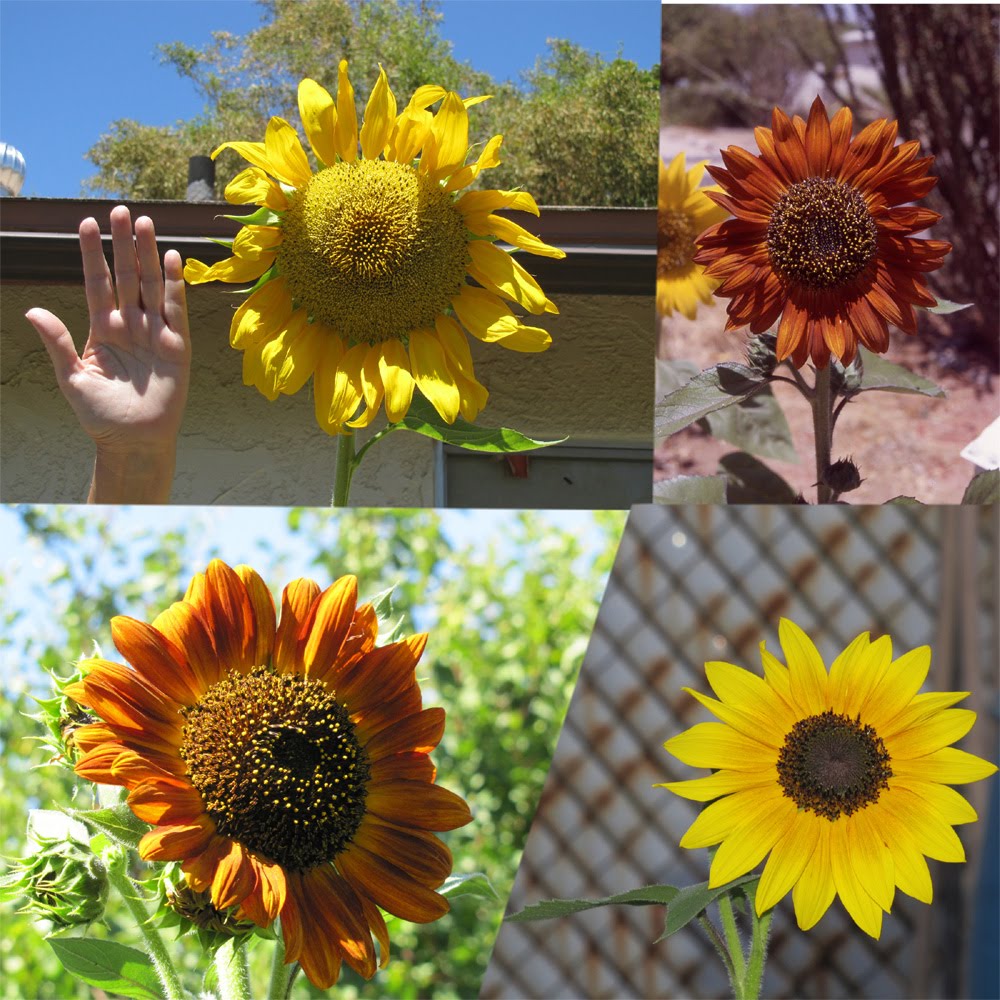
From the wild ones which crop up beside highways and country roads, and even our garden, to the colorful hybrids including the dainty lemon yellow, through the multicolor ranging through oranges and burgundy to the mammoth huge varieties, they all have delighted me for years.

Sunflowers have also been occasional companions for the traditional Native American's three-sisters companion planting, as a 'fourth-sister'.

I've written a long article with a chart on various combinations of the three sisters (also known as a Monsoon Garden) sustainable gardening/farming practice at my newsletter site.

Click here to go to the PDF file.   You can also go to the newsletter site by clicking here.  The three sisters article is under "files".

Here is a brief summary.  The original threes sisters are corn, beans, and squash.  In arid areas where both food and water were precious commodities, the practice of growing 3 complimentary plants (and nutrients) together maximized water use and made caring for the plants easier.   The fact that corn and beans together makes a complete protein and squash provided additional vitamins, minerals and fiber all worked to give the people a very healthy diet.  The soil also benefited because while corn is a heavy feeder, beans put nitrogen back into the soil and the squash covering the ground minimized evaporation and weeds.

Sunflowers as I now know are more edible than previously thought, are a fun option to plant along with sugar peas - one of my favorite 'never-makes-it-into-the-house' garden buffet snacks - and cucumbers.

Read the article for more information and tips.

I'm ready to start sauteeing the large sunflower discs/heads for a fun time in the kitchen!

If you can view video on your computer, you must check out this how to video on braising sunflower heads:

http://how2heroes.com/videos/appetizers/braised-sunflowers

A note for Mac enthusiasts and iPad owners!!!  My "Edible Landscaping in the Desert Southwest: Wheelbarrow to Plate" is now available through the iBookstore app.

Around The Garden.
I just harvested all of my garlic and it is drying now.  I will have some for sale at the farmers market tomorrow.  We cut one of the banana fruit clusters to hang and finish ripening.  I am giving sugarcane a try, and the first sections are starting to sprout.

Bananas, lemon grass, and sugarcane (and palm trees) all a kind grass -- really big grass, so they do need regular watering to maintain them.

DID YOU KNOW fact...the California Fan Palm tree (aka Arizona Fan Palm, Desert Fan Palm, Cotton Fan Palm), Washingtonia filifera is the only native palm tree in the desert USA?  The fruit can be eaten raw, cooked or ground into flour as the Native Americans did.  The tree can live 80 to 250 years!!!

Keep that in the back of your mind when someone tells you palm trees are not native to Arizona.

See more information on this Arizona Native at wikipedia - click here.

July Gardening 
Fall planting season begins July 15th for all seeds of fall edibles.  Get your garden plans together for this heavy sowing time from July 15 through August 15th.  Why???  If you consider that you want pumpkins for instance you need to count backwards from Halloween or Thanksgiving 90 to 120 days.

Have a great weekend, stay hydrated, and support your local businesses and farmers markets,

-- Catherine, The Herb Lady

Tuesday, April 20, 2010

Free Shipping Offer On My Books - Expires May 1st - Hurry!

Dear Folks,

If you have been contemplating purchasing my "Edible Landscaping" or "101+ Recipes" book, my publisher is offering free shipping on a single book purchase (print).

Free shipping always gets my attention, and I do benefit from this of course, but usually free shipping offers require you to buy $25+ to get the freebie, my books start at $12.25.


1) good to any US address
2) good on a single book purchase only, one to a customer**
3) there are 2 versions of each book - standard and a 'trade" version which is a lighter-weight, and less expensive version (I actually like the paper on the trade version better)
4) you must use the code below on check out, until you put the code in it will show the full shipping price.


and here is the big point:
5) GOOD only until 5/1/10 at 11:58 PM - it expires 1 minute before midnight.


** But you can pass the code around to family and friends


CODE:

FREEMAIL305


And here is the site where you can scroll through the books:

http://stores.lulu.com/herbs2u


Have a nice day,

-- Catherine, The Herb Lady

Saturday, February 27, 2010

What really is a LOCAVORE -- Hint: Grandma knew her green grocer and dairyman -- as her neighbors and friends

Dear Folks,

Are you a locavore? Simply put a locavore is someone who makes the conscious decision to purchase goods and produce grown, made or produced within 100 miles of their home.

Why?

A simple answer is that "seasonal" (as opposed to out of season) vegetables, herbs and fruit, for instance, are more nutritious, better tasting and therefore better for you and your family than produce which has to be picked green and transported great distances to your chain market.

But the larger answer is what you are doing for "your" community by supporting locally- owned businesses including farmers.

Tucson author Barbara Kingsolver moved back to her native Appalachia, to go natural and wrote about it in "Animal, Vegetable, Miracle" (HarperCollins) -- I really like a comment she made to a reviewer: "However, for me to go to the store and buy bags of organic spinach that have been shipped here in a truck from California--in a refrigerated truck, I might add--is just burning a lot of gasoline."

I only disagree with Kinsolver on the idea that you can't have a sustainable garden in your backyard here in the valley, you can and yes it does take proper water management, but that is a topic I will address in another blog.

To locate farmers markets in your area the USDA maintains a site - click on the state and a pdf file comes up with markets listed by city.

http://www.ams.usda.gov/farmersmarkets/map.htm

For Arizona only Farmers Markets here is a special link:

http://www.foodconnect.org/farmers_markets/locator.asp

A source for finding other local sources of food is Local Harvest. They have teamed up with the Slow Foods folks.

http://www.localharvest.org

The Slow Foods Movement started to get folks back to the dinner table -- with family -- with real food -- for real family time.

. . .

If you look at the real cost of buying "picked-green, inter state/country transported produce, and taking supplements to make up for nutrient deficiencies," your local farmer and farmers market produce is cheap!

A thought on the nutrition aspect: if your food is seasonal (superior nutrition), and picked ripe as opposed to green (superior nutrition), you and your family will have less or no need for supplements. Something to keep in mind.

Supporting other local businesses also keeps more of YOUR spending dollars in YOUR community. Current analysis shows about .45 cents of every shopping dollar stays in your community when bought from locally owned / locally produced versus only .13 if you buy from the out-of-state-owned chains.

A further thought from the whole concept of 'greening' up your life -- my more recent reading and researching on issues of greening, making more purchasing decisions on the basis of sustainability, less environmental impact, etc. -- has me rethinking my decisions about what and where something is actually produced/grown.

An example is bamboo. I think the many uses of bamboo (it is not the kind that is needed for the endangered panda bears) from furniture to clothing, is fascinating. The plants used can grow 80 feet in 40 days!!!

Amazing, and you think wow, now there is a sustainable product. And then you see a news story about where that product comes from and how it is transported. Most of this bamboo comes from China, and has to be transported, by steam ship, across thousands of miles to reach processing facilities in the US. I have to ask myself, is there real environmental savings here? Can this kind of bamboo be grown in southern areas of the US on land not useful for food crops? I don't have all the answers, just more questions.

Bottom line -- I encourage you to think about making more purchasing decisions based on how close the production source is to you. You support local businesses, keep more of "that" income in your community, and you get to know who produces the things and food you use -- kind of like how Grandma knew her green grocer and dairyman -- as her neighbors and friends.

More Information:

Edible Phoenix is a print magazine, produced quarterly and is part of the edible communities organization.

Find the current issue at your local farmers market or go on line to:

http://www.ediblephoenix.com

To find publications for other areas of the country go to:

http://www.ediblecommunities.com

BUY LOCAL

http://www.localfirstaz.com

Here is the place to start when looking for locally owned businesses. Began as "Arizona Chain Reaction" to focus on locally owned businesses, this non-profit group encourages support of your neighbors and friends who own businesses in Arizona. Check out their site.

. . .


Personalized branding iron for grilling. Here is the perfect custom gift for the hard to please griller in the family. I ordered one for my darling for Christmas and he loved it. Start a tradition and create your own family brand! 480-330-3619

http://www.tbonebrands.com

San Dominique Winery, Arizona's oldest continuously operated family winery, is also home to garlic paradise. Bill Staltari, cellarmaster and chef, is owner and creator of award winning wines and gourmet specialty foods. Visit his website to order the gourmet foods shipped anywhere in the US. Wine is available only at the Winery, located approximately 9 miles north of Cordes Junction. Have a lovely afternoon at San Dominique (the patio has a view of the Bradshaws), sample wines and other goodies, purchase wines and foods to go and have Lunch!
602/549-9787.

http://www.garlicparadise.com/

Another great locally owned and produced Arizona farmer is Kathy Marshall and her goats' milk lotions and soaps made with the milk of her dairy goat herd. You can also find Kathy at the Mesa Farmers market (and other locations). You might even catch her when she has some of her free- range chicken eggs for sale -- but they go fast!

http://www.dbgoatsmilk.com

Neighbors helping neighbors -- support and enhance your community - your purchasing dollar has more power than you think.

Be a good neighbor and friend and buy from your neighbors and friends


-- Catherine, The Herb Lady