Garden, Plant, Cook!

Tuesday, November 02, 2010

Cooking Shows are Not New!

Dear Folks,

As fan of old time radio, I asked Jon over at www.otrcat.com if he had any old shows on cooking or gardening.  I have purchased mp3 shows from Jon for some of my favorite old time detective shows (like "Yours Truly, Johnny Dollar") and with all that is going on now with the economy and renewal of interests in home gardening (aka Victory Gardens) I figured I would ask if Jon had any in his extensive collections.  He said he would check and he did!

He has two small collections of old time cooking shows "Betty Crocker" and "Martha Meade" (known as the Betty Crocker of the West).

I transcribed the recipes from two shows for you below -- I can't wait to try the "Emergency Steak" -- it is a perfect fit for an economical dinner today!  The war time economies required creativity in the kitchen.

A note about old time radio shows.  These shows were made in the 30s and 40s primarily although Jon's collections go from about the 20s through the 50s.  The culture and times were different, think of it as a history lesson. Many of the shows still have their commercials.  As a history lesson it is what it is and the fact that women's roles have significantly changed and evolved in society is an important current event compared to history.

One of the aspects of these cooking shows is how long they pause to give the listener time to write down the instructions -- compare that to today's cooking shows and you have to be a speed typist to write it down.  Although most of the time you can go to a current show's website to find the recipe, many times they are not available at the time of the show, so the pause is helpful :-)

Jon tells me he is working on compiling the gardening shows and hopes to have something in the spring.  I can't wait!  Did you know about 40% of all produce consumed in the country back then was home grown to support the war - Victory Gardens were then and now a great way to bring fresh to the table.  Our local family owned nursery Harpers Nursery was started as a Victory Garden!

Jon has an extensive collection of holiday shows, click here for the main holiday page.  Although Halloween is past Jon has a family friendly selection of halloween shows - comedy and variety - in addition to his scary sampler.  Click here for the variety halloween page.

On each of the main pages, Jon includes a show you can listen to or download to computer.

His collections are inexpensive and many times include a hundred hours or more on each disc.

Okay here are the recipes with a link following for the shows page.  The emphasis was on a lot of vegetables, a point I keep writing about and folks need to pay attention to today - your plate for a meal should be a rainbow of color with 2/3 of it taken up by vegetables and fruits (not including potatoes, pasta or grains).


"Emergency Steak"
Betty Crocker August 10, 1945
Serves 6
1 lb of ground beef or hamburger
1/2 cup milk
1 cup wheaties
1 tsp salt
1/4 tsp pepper
1 Tblsp finely chopped onion
Mix all together, pat the mixture into a 1" thick 'steak shape' on a broiler pan or in a heavy skillet.  Broil 8-15 minutes til desired doneness (med - well).
Serve garnished with parsley and sliced radishes and vegetable side dish (below)
Cut a mixture of carrots, celery and cabbage into equal size pieces to equal 3-5 cups total.  Cook in a pot with 2 tablespoons vegetable oil and 1/4 cup of water in a covered pot. Add a bit of water if needed. All the water should cook out.  Cook only until crisp done (in the 40s they would have been cooked very well done).   Serve the Steak and veggies with a tossed salad.


"Sour Cream Tart"
Martha Meade Society Cooking Show
May 16, 1933
Martha Meade was called the Betty Crocker of the West, sponsored by The Sperry Flour Company, of San Francisco, CA, would eventually become part of General Mills.
The show featured information about the local growers of food products and in this episode the focus was on apples.
6 baked pastry tart shells
2 eggs separated
2 Tblsp flour
6 Tblsp sugar
1/4 tsp salt
1/2 tsp cinnamon*
1/4 tsp nutmeg*
1/4 tsp "pastry spice" but can substitute half and half ground cloves and allspice*
1 cup sour cream (or add a tablespoon of vinegar to 1 cup of cream and let set for a couple of hours)** 
1 cup of unsweetened apple sauce (Show notes to make apple sauce add the juice of 1/2 a lemon to the apples while cooking and then add the rind for flavor - removing before serving -- Catherine notes if you have never made apple sauce it is very easy -- core and dice up apples - I personally leave the peels on - 1-2 tablespoon of water is all you need usually - bring to high simmer, reduce heat, stir, cover and cook on low for about 30-40 minutes depending on how thick you want it.  Stirring occasionally.
Meringue
4 tbls sugar
2 tbls chopped walnuts
*Catherine says you could substitute 1 teaspoon of pumpkin pie spice and achieve a very similar taste.
** Catherine says "I would consider 1 cup of greek style yogurt as an option to the sour cream."
Beat egg yolks until thick and lemon yellow.  Add sugar and beat to incorporate sugar well.  Mix flour, salt and spices together then add to egg mixture, mix.  Then add sour cream and apple sauce and blend thoroughly.  Cook mixture in the top of a double boiler until thickened.  Cool, Pour into pastry shells.
Whip egg whites to peaks, gradually add in 4 tablespoons sugar and 2 tablespoons chopped walnuts, and top each tart with some of the meringue.  Bake in slow oven 300 for approximately 20 minutes. 


-- Catherine, The Herb Lady


Wednesday, October 06, 2010

Question on Assassin Bugs

Dear Folks,

I was sent a comment on my September, 2008 post regarding aphids click here to read that post.

Since I was going to write another post on the "white flies are coming, the white flies are coming" -- the white files being a form of aphid and a real pain in the gardener psyche, I thought I would simplify and give you the link to the older post and respond to the comment.


Doris “anonymous” commented on aphids and the beneficial predatory insects which can help you manage these pests:

I found your page while trying to find out if the little bugs in broccoli are hazardous to ingest. My concern is regarding the use of assassin bugs. From wikipedia: Some assassin bug groups specialize on certain prey groups, such as ants (feather-legged bugs - Holoptilinae), termites, or diplopods (Ectrichodiinae). Some blood-sucking species, particularly Triatoma spp. and other members of the subfamily Triatominae (e.g., Paratriatoma hirsuta) , are also known as kissing bugs due to their habit of biting humans in their sleep on the soft tissue of the lips and eyes; a number of these haematophagous species, located in Central and South America, are able to transmit a potentially fatal trypanosome disease known as Chagas disease (American trypanosomiasis). So, I don't know which brand you are advocating, but surely wouldn't care to encounter the last one!!! Take care, Doris
Doris, first the aphids attacking the broccoli are most likely a type of aphid which is live baring as opposed to the egg baring types, and usually ‘gray’ in color although they can be green or other colors.  The live baring are more prolific in reproducing and can be a serious problem on the cabbage family members like broccoli because they can ‘hide’ in the junctions of the leaves and stems. (See my soap solution remedy below.)
It is unlikely if you ingest aphids that you will become ill unless the plant was sprayed with chemicals recently.  Most people simply do not want to ‘eat’ insects under any circumstances because of the ‘ick’ factor.
As far as the assassin bugs as beneficial insects are concerned, to my knowledge you won’t be able to control which member of that large insect family your pests attract, and, again as far as I know you can’t buy assassin bugs like you can lady bugs or praying mantis egg cases.
Folks, Doris is correct on the subspecies ‘kissing bugs’ being vectors for a serious disease, most of the some 138 species are south of the US border, with 12 of the species ‘native’ to the US.
According to “Kaufman Field Guide to Insects of North America” the USA species are not potential vectors because of the differing behavior patterns of these “American” bugs.  So Doris if you are in the US, you probably do not have to worry about which assassin bugs show up in your garden.
All gardeners should educate themselves and family members to leave the assassin bugs alone, regardless.  They do a good job on the pests but can give you a hard bite, described as excruciating, if you threaten it.  Most of the beneficial insects are capable of biting, so you should always leave them alone to do their job
Soap solution.  Mix an a small amount of something like dawn dish detergent into a quart of water and once every 5 days during the growing period of plants like broccoli or cauliflower, pour about a 1/4 cup of this solution straight down the center area of the plant.  This is like grandma pouring the dish washing basin onto the plants to keep the bugs away.  It works because even the ‘exhausted’ soap suds are enough to kill the pests without harming the plant or soil.  The 5 days is important because the birth cycle of the pests is about 7 days so you want to keep the cycles broken.

-- Catherine, The Herb Lady

Saturday, September 25, 2010

Eco-Friendly Lunch & Snack Options & What is Edible Landscaping?


Dear Folks,


I will get to the question of what is Edible Landscaping below, but first - options to plastic wrapped and bagged lunch and snacks for school or office.


Susan Decker is "Always A Little Behind" crafts and this gal is an amazing one-woman crafter. Pictured here is her newest eco product, reusable and washable snack bags to replace plastic wrap and ziplock bags.  These items are new additions to her lunch products.  


"Lunch Bags are 11”h x 8 ½” w x 3” d, made from 100% cotton fabric, lined with Nylon Ripstop fabric (waterproof and washable), and haveVelcro closures. Take your lunch to work, know which bag is yours and be environmentally friendly all at once!"  The snack bags pictured are small, medium and about half the size of the lunch "box" bag.  The lunch bag is $12 and the 3 smaller ones are $4, $5 and $6 or $13.50 for the set of 3.


Contact Susan at: littlebehind17@yahoo.com
Or call: (480)895-8889


You can see the lunch bag at her etsy site


Greg Peterson of the "Urban Farm" in Phoenix writes about the need to find better eco ways to replace plastic wrap in the current issue of Edible Phoenix.  Greg contemplates the impact of the Gulf Oil spill and all of our tremendous use of petroleum-based products.  He also highlights a Tempe gardener who created a community garden in her back yard -- a superior idea.  A community garden does not have to be a public dedicated lot, it can be as simple or as complex as you and your friends, neighbors or group care to make it. I am currently mentoring a retirement community garden, and an elementary school community garden.  There is no better time in this current economy, and with our primary planting season getting under way, to find ways to garden in your backyard or with friends.


Read more of Greg's article "Jena's Tempe Garden" here:


If you are not familiar with the Edible Phoenix magazine it is available at your favorite farmers market, quarterly, or you can subscribe here:


. . .


WHAT IS Edible Landscaping?


When I say "edible landscaping" to a customer or passer-by at the farmers market I sometimes get a quizzical look - what IS edible landscaping, the look says. Many people take the word landscaping to infer LARGE as in trees and shrubs.

What I mean by edible landscaping is the use of edibles in place of ALL aspects of the garden — opening up the choices of what to use, and where, for texture, form, and fragrance.

In most cases there is an edible plant, which will do well in the desert, to replace strictly ornamental (and often poisonous) plants, making the gardens safer for family and pets, in the long term — and useful as in edible.

Do you like fountain grass?  How about replacing it with lemon grass.

Need to get rid of the oleander, or would like large privacy plantings?  Replace it with bamboo or sugar cane.  The sugar cane grows handsomely like bamboo but is not as invasive and comes in a gorgeous stem color of burgundy called "Pele's Smoke" (an heirloom sugar cane).*   Bamboo shoots (the young sprouts at the base of stalks) ARE the bamboo shoots you buy canned in the Asian section of your grocery store.

If you are worried about the watering requirements of sugar cane or bamboo, once established they take standard vegetable watering — in our gardens now with temperatures still in the 100s the sugarcane is being watered every 4 days.

*Sugar cane has a history in the Valley of the Sun.  It was grown commercially in the late 1800s and early 1900s and again to a lesser degree in the 1950s-70s.  It grows easily and quickly to a nice height of 8 to 12 feet, can be cut back for harvest and re-sprouts.  Because the leaves can be ‘sharp,' sugar cane also makes a good perimeter/privacy hedge.

Need a formal hedge?  Try myrtle, lavender, rosemary, or any of the scented geraniums for your options of low to high hedges, which can be trimmed to form.

Themes and Landscaping ideas from: "Edible Landscaping In The Desert Southwest: Wheelbarrow to Plate"

AGAINST A BLOCK FENCE
Back Row:  Lavender (tolerant of lime leach from blocks and bricks)
Front Row:  Ornamental (and edible) Kales and cabbages

You can find more information on these themes by purchasing the book (the book is now also available for iPad users) or joining the "Edible landscaping subscription service" - see the link in the upper right corner here on the blog.

As mentioned above, now is the beginning of our primary planting time.  Optimal time for perennial plants, trees and shrubs is Oct through Feb.  Oh and cool weather annuals and Garlic!

Have a great time in the garden


-- Catherine, The Herb Lady

Sunday, September 05, 2010

Save These Dates!

Dear Folks,

I have several classes or lectures lined up at the moment.
October 9th
November 20th
January 8, 2011


SALSA 101 Class with Catherine "The Herb Lady"
Saturday, October 9th at 2-4 p.m.
Did you know fruit salsa was not invented by modern chefs? It has been around longer than you think! Come enjoy an afternoon learning about the history and plants that make up salsa, then make your own variations to take home with you! The class is $15 for members, $22.50 for non- members. All supplies are included. Space is Limited. Call 520.689.2723 to register. All proceeds benefit Boyce Thompson Arboretum.

http://arboretum.ag.arizona.edu/

Tofu: Holiday Recipe Ideas! Presentation with Catherine "the Herb Lady"
Saturday, November 20th at 1-3 p.m.
Tofu is the plain sister of healthy foods with a secret — it is a palate for flavor! Tofu is not just for vegetarians and can take your next holiday meal to a whole new level. In this presentation Catherine explains that menu planning for the holidays with vegan or vegetarian family and friends is not the challenge you would think. Take home holiday and casual recipe ideas – and try samples of them too - for entertaining using nutrient dense tofu and edamame (green soy beans) that will please meat eaters and vegetarians alike. This presentation is $10 for members, $17.50 for non-members. Recipes and food samples are included. Space is limited. Call 520.689.2723 to register. All proceeds benefit Boyce Thompson Arboretum.

http://arboretum.ag.arizona.edu/

Edible Landscaping: Vegetable Gardening, Herbs and More
January 8, 2011   1:30 - 4 P.M.
Red Mountain Branch


Presented by:  Greg Morris, Master Gardener, Landscape Designer, and Catherine "The Herb Lady" Crowley

Now you can have your landscape and eat it too! This program will cover the basics for successful vegetable gardening, but will also show how to incorporate edible plants throughout the landscape, and will suggest plant varieties for landscape function and edibility. An interactive 'show-and-smell' with culinary herbs will teach you growing basics and provide cooking suggestions, too.

INFORMATION:
Donna DiFrancesco
Conservation Specialist
Environmental & Sustainability
480.644.3334 (tel):  480.644.4774 (fax)
PO Box 1466
Mesa, AZ 85211-1466
Water Use It Wisely!

. . .

We have had our 'seasonal shift' and now we are entering "spring in the desert" -- for new comers that may be hard to understand.  October is the beginning of the primary planting season for perennials and all cool weather annuals and biennials.

If you have tried and tried to have a garden in the desert southwest and been disappointed in the results one of the primary pieces of information is what to plant and when.  When I write and talk about being able to garden all year long - I mean it -- however you have to plant each plant variety in its own proper season.  October ?  Plant dill, parsley, and cilantro and all the cole (cabbage) family and root vegetables and all the wonderful greens and lettuces.  February?  Plant basil, tomatoes, chives, watermelon, summer squash, and corn.  July?  Yes, late July - early August - plant all the "SEEDS" for the fall plants you want including those pumpkins for Halloween and Thanksgiving.


Think snowsuits in July and Swimsuits in December and you will have a way of understanding when to begin seeds for transplanting and the different seasons in the desert garden.


My easy helper 'reminder service' is just $21 a year for information directly into your email inbox.  Several times a month you will receive simple but detailed information on what to plant and when, when to look at harvesting (and also what is available at your local farmers market), and how to use the bounty of your gardens.  This inexpensive service is made possible by keeping it automated, so I am always happy to answer additional questions for subscribers individual gardens via email.

You can pay through this link:

Paypal payment window

Also for those of you interested in my gardening and/or cooking books, they are now available for your iPad.

Have a great day,


-- Catherine, The Herb Lady

Sunday, August 29, 2010

More Herbs, Less Salt Day

Dear Folks,

August 29th is designated as "More Herbs, Less Salt Day" and usually listed in the "wacky national day of' lists," but it is more than just a "something" to list for August 29th.

(You CAN find ‘something' on just about every day of the year if you are looking for a reason to throw a party.)

First, let me start by saying salt is not the enemy.  We need it to balance water/mineral levels in our bodies and to reduce bitterness in some foods.  Breads and grains would be almost like eating straight flour if you did not add some salt to the baking/cooking methods.

The problem is our tendency as human beings to overindulge in something.  If a little is good a lot must be better.  Given the ‘manufactured food' frenzy which began with the advent of convenience foods and TV dinners more than 5 decades ago, and has not abated at all,  it is no wonder that many of us simply got used to highly salted foods as the means good taste.  (Some health professionals even call it an addiction.)

Happily the "idea" of using herbs and spices has resurrected from almost obscurity (the bottle of really old Italian Seasoning in the back of the cupboard) to the current explosion of food shows and celebrity chefs doing amazing things with flavor-based seasoning.

What is a flavor-based seasoning?  Herbs and spices have a distinctive taste and scent which is imparted to foods cooked or prepared with them via the essential oils in those herbs and spices.  Those essential oils contain some of the common buzz words, "phenolic" "polyphenol"  "antioxidant" — vitamins C and E are types of  Phenolic., along with many other vitamins and minerals — most are considered antioxidant in effect.

If you would like some scientific and interesting history on "phenolic" read:

http://robincheung.info/samples/antioxidants.pdf

If you are familiar (many are by now) with the super antioxidant properties of blueberries it may surprise you to learn that Dark Opal Basil contains some of the same antioxidant properties.

FLAVOR FIRST: Chose, first, to flavor your food with herbs and spices, and then add salt to enhance it.

One of my favor examples are rosemary and lemon with any starchy food.  Traditionally, folks reached for the salt shaker with foods like potatoes or rice, because the flavor is mild to bland.  In experimenting years ago I discovered an natural affinity of rosemary to anything starchy — a perfect compliment of the flavor of the rosemary with foods like potatoes.  (Rosemary bread has become so common at restaurants, many diners expect it.)

When I started "talking up" the idea of rosemary with a baked potato, the usual response was - "it still needs salt."  So I went back to experimenting and discovered a spritz of fresh lemon juice on the hot baked potato with a sprinkle of crushed rosemary was so amazingly good, even my "meat and potatoes guy" had to admit it was just about perfect with just those two ingredients.  He's a salt-shaker guy so he won't give up the shaker, but did thoroughly enjoy that baked potato with out the salt.

Salt is considered a flavor enhancer — really in many cases it is a flavor ‘hider' particularly when the food is not tasty.  I see herbs and spices as being the real flavor enhances.  Things like the rosemary above make the basic flavor of the potato just jump out and sparkle.

Rosemary, garlic and black pepper are a combination which can improve anything on the grill or roasted, and anything starchy.

I don't suggest you throw the salt shaker out, but do suggest as I say to my guy when I've prepared the meal, taste it first because of the herbs and spices I've added and then reach for the shaker if you need it.

If you want to try and cut back on the salt and give your family an option, make your own seasoning salt with your favorite herb/spice blend.  Mix 10:1 parts of (10) seasoning to (1) salt.  If the seasoning is coarse, use kosher salt, if the seasoning is fine, use a fine sea salt.

Use that when experimenting and at the table.

I hope you celebrate not only today, but from now on with the flavor-power of herbs and spices.

A Note About My Books: Both my beginners gardening book and my cookbook are now available through ibookstore for your iPad or similar.

"Edible Landscaping In The Desert Southwest: Wheelbarrow to Plate"
"101+ Recipes From The Herb Lady"


And of course you can still purchase them through your favorite book seller in print.


Lectures Coming Up:

I have two food demo programs coming up at the Boyce Thompson Arboretum.  Details to follow but save the dates — there will be a small fee to attend, which covers materials and benefits the Arboretum.

October 9th, 2010, 2-4 p.m. Learn all about the history of salsas and make your own to take home.

November 20th, 2010 1-3 p.m. Tofu and Soybeans - not just for vegetarians.  Holiday food recipe ideas using tofu and edamame for the vegan, vegetarian and meat lover's vegetarian family and guests.

Check the calendar on the bottom of the blog for more details as we get closer.

Have a great day,

-- Catherine, The Herb Lady

Tuesday, July 13, 2010

Cheap Summer Fun -- The Old Fashioned Way

Dear Folks,

I remember running through the sprinklers when I was a kid, cooling off and working off the excess energy on a hot summer day.  (And I have also enjoyed a run as an adult, when passing commercial properties watering at night with the big industrial sprinklers -- we got good and soaked and it felt wonderful.  We were very careful not to damage or step on any equipment in doing so.)

Grab a glass of homemade lemonade or sun tea, kick back and watch this charming video of babies playing in the sprinkler under mom's watchful eye.

http://www.youtube.com/watch?v=yNy9jTeolUk

What inexpensive ways did you find to have fun in the summer in the backyard with family and friends?

Try to stay cool, and drink water!!!

-- Catherine, The Herb Lady

Saturday, June 26, 2010

Greening - Various Tools to Help You Shop and Live Wisely

Dear Folks,

If you have been following me, you are probably already trying to shop at your local farmers markets, do more cooking at home to control your menu ingredients, enhance your family quality time, and experiment with all those cool recipes you see on cooking shows.

To add to your tools and information sources, I tripped across a couple of sites I found helpful.


http://www.sustainabletable.org/spread/kits


The Sustainable Table site has a variety of kits (in PDF file form) which can be used as teaching or display tools and for your own family information use.

They also have a kit for the Sustainable Dinner Party which can give you some ideas for Supper Groups.
(I have been thinking off and on of potentially setting up 'secret suppers' -- it would require quite a bit of planning, but is fun to contemplate.  I will let you all know if I get serious!)

Another site to visit for information is the Animal Welfare Institute, which certifies humanely raised livestock farms.  They are dedicated to supporting the small-scale and family farm. http://www.awionline.org/


The troubling issues with factory farming continue to, finally, get more and more attention. Even when a farmer wants to do things right if they make the mistake of getting into contracts with large processors -- the real manufacturers when you come down to what you are buying -- they are trapped in unconscionably egregious contracts which leaves them captive to corporate whims or in bankruptcy.


Read what some chicken farmers are up against.
http://www.sustainabletable.org/2010/05/chicken-farmers-describe-a-system-of-extortion-and-economic-slavery/


How can you get more control over what you buy?  I have noticed more and more food manufacturers are getting the message.  I just saw an ad for Hunts Ketchup which loudly proclaimed on the label 'no high fructose corn syrup' -- good start!

They are listening. The real challenge to getting healthier and better quality foods is to make sure you are clear about what you want them to offer to you.

I participate in online consumer surveys.  I am troubled when the elimination questions (I don't have the ability to complain about the questions) are frequently aimed at getting the survey participant to use emotions to explain how they purchase something.  That is not to say there are no questions about what do you purchase - recently I had a survey on dairy and cheese and how much was organic, or natural, or other - that was a good one.

One good thing I noticed about the surveys in the last 6 months are the options in prepared goods or shelf-stable foods which offer more environmental, natural, local, family farm options for selections in answering the survey.

So why might that be a problem?  Because those buzz words can be grabbed by food processors to label something which amounts to bait and switch - "So and so's family farm produces only naturally prepared..."

Back in January, 2010 "Tyson Foods Inc. has agreed to settle a lawsuit that accused the poultry giant of falsely claiming its chickens were "raised without antibiotics."


"In 2007, Tyson began advertising and labeling its poultry products as having been "raised without antibiotics." The following year, the U.S. Department of Agriculture ordered Tyson to remove the labels when it found that the company had injected its chickens with antibiotics before they hatched. Tyson argued the labels were accurate because chickens aren't "raised" until after they're born."


So how do you like that corporate logic?

Isn't that enough to make you want to scream at them!  The quote attributed to Voltaire goes something like "If you wish to converse with me, define your terms."  Don't you wish we could tell corporate food producers they need to define their terms so we know what they are really saying?

What is a consumer to do?  You need to know your suppliers like your grandparents did, your local farmers, meat producers, egg sellers, and cheese makers.

Some of the material on the sustainable table site are sheets of questions to ask sellers of food.

Oh, and on the subject of organic - organic picked green and shipped hundreds or thousands of miles is not a whole lot better for you than "somewhat" regional and non-organic.

Organic and natural are two words used at your local farmers market.  Here is what THEY mean:

Organic means it was grown locally in a USDA certified program, picked local and sold local.

Natural for most of our local small-scale farmers means they grew the foods or produced the foods in much the same way as organic producers but without going through the expense of official certification.

Our farmers market vendors and farmers are happy to tell you all about their foods and origins - they are proud of their products.  Ask them questions.

There is now a "Certified Naturally Grown" label for small-scale farmers and food producers. Check them out at:  http://www.naturallygrown.org/

What is a natural flavor or anything proclaimed natural?


The term natural flavor or natural flavoring means the essential oil, oleoresin, essence or extractive, protein hydrolysate, distillate, or any product of roasting, heating or enzymolysis, which contains the flavoring constituents derived from a spice, fruit or fruit juice, vegetable or vegetable juice, edible yeast, herb, bark, bud, root, leaf or similar plant material, meat, seafood, poultry, eggs, dairy products, or flavoring rather than nutritional...
When a company says it is selling you something based on what they KNOW you want, but if it is in-fact selling you a substitute or inferior product isn’t that bait and switch?
The manufacturers of Splenda were sued for claiming their product is sugar.  It is not and they had to concede that or face losing the lawsuit.
When the high fructose corn syrup producers revved up their protectionist marketing campaign to tell us that it was our own over-eating that was the problem and not their product, they left out the science which shows that consuming foods containing HFCS does not trigger the “you are full” chemical leptin.  And their throw-away tag line “in moderation” is a slap in the face when you look at the sheer volume of foods manufactured with HFCS -- how do you moderate eating something that is in almost every processed or manufactured food and which has no eating cut off command?

Oh, and the FDA does not object to the corn syrup producers calling HFCS ‘natural’ - natural hmm, - HFCS has been found to be toxic to honey bees fed it.  (In cold winter areas bee keepers feed their bees sugar water or even honey to help sustain them through the cold time.)
See my blog on sweeteners:
I have also been concerned about the very useful plant-based Stevia being ‘hijacked’ by the corporate giants.
In looking at labels on packages of some of the newest offerings purporting to be Stevia, most are a combination of stevia and sugar alcohols -- the sugar alcohols being used to add baking capabilities and additional taste.  Not necessarily a bad thing although some people are allergic to some sugar alcohols like sorbitol (I for one am).
What bothers me is when one of the big giants (or two) get into the act and make some part of it proprietary with the disclaimer "trade secret."  Truvia is a partnership of Cargill and Coca Cola, and they have stevia and sugar alcohol listed on their ingredients.  And then they say “natural flavors” but won’t tell you what they are - it is a trade secret.
Remember HFCS can call itself natural. Splenda tried to call itself something it wasn’t.
Bottom line - if you can’t tell what the ingredients really are and you don’t know enough about the company's history in truthful advertising, back away.


AND don't forget about growing some of your own food, raising a couple of chickens for eggs, or even consider having a dairy goat or two (you need to know your areas zoning limitations).

You may wish to join the Phoenix Permaculture Guild forum  - they have groups on different subjects. I am a member of the micro-livestock group and soil culture group.  Nice people, made up of newbies, getting there, experts - who still learn - and all are very helpful with answering questions.

http://www.phoenixpermaculture.org/

If you have an interest in my books, the publishing site is still offering free shipping on orders totaling 19.95 shipped to USA addresses.


And for you Mac iPad, iPod and iPhone users my Edible Landscaping in the Desert Southwest is now available through iBook.

Have a great weekend,

-- Catherine, The Herb Lady

Thursday, June 24, 2010

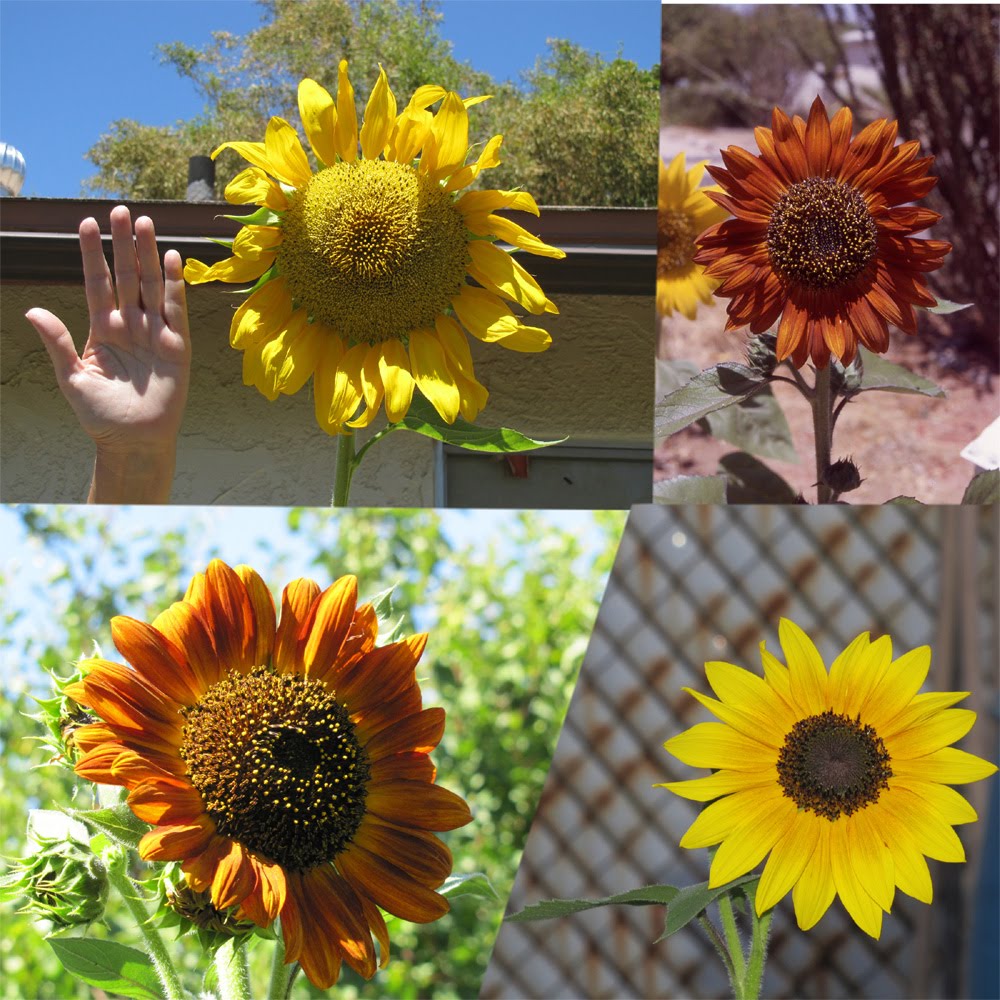
Sunflowers! Companions, Nutrition, Sustainable, Fun!

 Dear Folks,

I love sunflowers!

From the wild ones which crop up beside highways and country roads, and even our garden, to the colorful hybrids including the dainty lemon yellow, through the multicolor ranging through oranges and burgundy to the mammoth huge varieties, they all have delighted me for years.

Sunflowers have also been occasional companions for the traditional Native American's three-sisters companion planting, as a 'fourth-sister'.

I've written a long article with a chart on various combinations of the three sisters (also known as a Monsoon Garden) sustainable gardening/farming practice at my newsletter site.

Click here to go to the PDF file.   You can also go to the newsletter site by clicking here.  The three sisters article is under "files".

Here is a brief summary.  The original threes sisters are corn, beans, and squash.  In arid areas where both food and water were precious commodities, the practice of growing 3 complimentary plants (and nutrients) together maximized water use and made caring for the plants easier.   The fact that corn and beans together makes a complete protein and squash provided additional vitamins, minerals and fiber all worked to give the people a very healthy diet.  The soil also benefited because while corn is a heavy feeder, beans put nitrogen back into the soil and the squash covering the ground minimized evaporation and weeds.

Sunflowers as I now know are more edible than previously thought, are a fun option to plant along with sugar peas - one of my favorite 'never-makes-it-into-the-house' garden buffet snacks - and cucumbers.

Read the article for more information and tips.

I'm ready to start sauteeing the large sunflower discs/heads for a fun time in the kitchen!

If you can view video on your computer, you must check out this how to video on braising sunflower heads:

http://how2heroes.com/videos/appetizers/braised-sunflowers

A note for Mac enthusiasts and iPad owners!!!  My "Edible Landscaping in the Desert Southwest: Wheelbarrow to Plate" is now available through the iBookstore app.

Around The Garden.
I just harvested all of my garlic and it is drying now.  I will have some for sale at the farmers market tomorrow.  We cut one of the banana fruit clusters to hang and finish ripening.  I am giving sugarcane a try, and the first sections are starting to sprout.

Bananas, lemon grass, and sugarcane (and palm trees) all a kind grass -- really big grass, so they do need regular watering to maintain them.

DID YOU KNOW fact...the California Fan Palm tree (aka Arizona Fan Palm, Desert Fan Palm, Cotton Fan Palm), Washingtonia filifera is the only native palm tree in the desert USA?  The fruit can be eaten raw, cooked or ground into flour as the Native Americans did.  The tree can live 80 to 250 years!!!

Keep that in the back of your mind when someone tells you palm trees are not native to Arizona.

See more information on this Arizona Native at wikipedia - click here.

July Gardening 
Fall planting season begins July 15th for all seeds of fall edibles.  Get your garden plans together for this heavy sowing time from July 15 through August 15th.  Why???  If you consider that you want pumpkins for instance you need to count backwards from Halloween or Thanksgiving 90 to 120 days.

Have a great weekend, stay hydrated, and support your local businesses and farmers markets,

-- Catherine, The Herb Lady

Wednesday, May 19, 2010

Creative Container Garden Ideas in the Desert

 Dear Folks,

I just finished up a 3-part workshop preceded by an Edible Flower lecture and it is time for me to get back to serious work in the garden.  I have to harvest my garlic scapes and my new potatoes — I'm thinking a nice garlicky potato salad with a cold glass of green sun tea steeped with lemon verbena and spearmint, yum.


Back to different fun stuff in the garden.

As many of my long-time readers know I always suggest a very large container with a minimum suggestion of 2 ft wide, to maximize your success in the desert when gardening with pots

When you think pot think outside the pot for ideas for containers.  Here are two really cool ideas, one is a recycling gem of an idea, and the other one for those who may have some physical limitations.

What do you do with a 'dead' jacuzzi?

Well if you are a very creative person, you turn it into this fabulous container garden!

Hannelore G. has been a reader for years and asked me if she could make her no-longer-working Jacuzzi into a big container garden.  I asked her a couple of basic questions: sun access/orientation, could she drill holes in the bottom, could she reach the center from all sides (important so you don't have to get up and crawl over the garden to do weeding/maintenance in the center), and what did she want to grow?

I provided her with soil/drainage mixtures information, some suggested plantings for this season and look what she did with it. Awesome!  And her lovely blue door, gives a "Santa Fe" look to the whole visual appeal along with her added garden art work in the "container."

Now that is a container garden!

Next Up:  Discovery Point Retirement Community in East Mesa, is the site of this super "table garden" for residents.

Michon Jablonski and Cherie Scott, the Marketing Director and General Manager respectively, contacted me about participating in their Arbor Day celebration, but also their interest in finding a way to have a community garden for their residents.  I found plans for a table garden designed for those with physical challenges -- you can wheel right up to the table and garden, or stand comfortably -- and their Maintenance Manager, Dustin Beckstead and crew built this hell-for-stout version.  They had a planting celebration day and the garden was blessed, and off and growing!  http://www.discoverypointretirement.com/  480-559-8134

With the heat right around the corner (or tomorrow!), the selections of things to grow in pots or even in the ground gets reduced until August (which is the beginning of fall seeding in time).

I am going to do a whole blog on a variation of the three sisters garden, but here is one to give a try right now.  Sunflower, Edamame (soybean) and summer squash.

Soak the seeds for a few hours first before planting Normally I suggest soaking seeds overnight, but don't soak soybeans longer than 8 hours or they will start to ferment..  Arrange the sunflower seeds so they will be in the ‘back' or north part of the garden or pot — if you are feeling ambitious, you can put one of these pots or garden patches together each week through the first week in June — soybeans come ripe all at once on their bush, so this gives you several crops.  After planting the seeds cover the ground or soil with some dried leaves and watch for slugs — with our abundance of rain this year the slugs and snails have been out in force.  For additional visual attraction, sow impatient wallarana seeds or portulaca (moss rose) along with the Sunflower, et al.

SLUG/SNAIL TIP: Because the slugs were getting my early sunflowers and beans, I cut up paper towel cardboard tubes and toilet paper tubes into 1 inch circles and used them as "collars" around the new planted seeds and seedlings.  Nestle the collar into the soil.  The slugs and snails can't get to the plants.  The collar eventually collapses and deteriorates and you can remove it and toss it into the compost pile.

As mentioned, I will blog more about the three sisters, and in particular about sunflowers, because almost the whole plant is edible. More later :-)

GRILLING TIP: Make basting brushes from stiff herbs.  Rinse and tie woody stems together with cotton twine and bast away for added flavor to the grill.  Fruit Kababobs - try woody rosemary sprigs, soaked for an hour and thread with pineapple or other firm fruit, turn to get some grill marks on the fruit, but don't char.

And another free shipping offer from my publisher's site.  They are offering free shipping with a minimum purchase of 19.95 to any US address.  It is called the FREE summer shipping so it should be active for a while.  The special code appears on checkout, so you do not have to remember a code.  If you change your order so the amount before tax or whatever drops to less than 19.95, the free shipping is removed.  My page at the publisher site.  http://stores.lulu.com/herbs2u

Have a fun time in the garden, kitchen and at the grill!

-- Catherine, The Herb Lady

Tuesday, April 20, 2010

Free Shipping Offer On My Books - Expires May 1st - Hurry!

Dear Folks,

If you have been contemplating purchasing my "Edible Landscaping" or "101+ Recipes" book, my publisher is offering free shipping on a single book purchase (print).

Free shipping always gets my attention, and I do benefit from this of course, but usually free shipping offers require you to buy $25+ to get the freebie, my books start at $12.25.


1) good to any US address
2) good on a single book purchase only, one to a customer**
3) there are 2 versions of each book - standard and a 'trade" version which is a lighter-weight, and less expensive version (I actually like the paper on the trade version better)
4) you must use the code below on check out, until you put the code in it will show the full shipping price.


and here is the big point:
5) GOOD only until 5/1/10 at 11:58 PM - it expires 1 minute before midnight.


** But you can pass the code around to family and friends


CODE:

FREEMAIL305


And here is the site where you can scroll through the books:

http://stores.lulu.com/herbs2u


Have a nice day,

-- Catherine, The Herb Lady

Thursday, April 15, 2010

Grass-Fed Burger Recipe

Grass Fed Beef - Good for the animal, us, and the environment!

Dear Folks,

If you choose to eat beef - choose wisely.  The Mesa Friday Farmers Market is fortunate to have Red Mountain Cattle Company's grass-fed beef. (Red Mountain CC is a division of Tyler Farms, located in North Mesa). For information on Red Mountain click on the link below.
http://www.arizonafarmersmarkets.com/vendorpages/RedMtnCattleCo.htm

DID YOU know that grass fed beef is better for you with higher levels of CLA (Conjugated linoleic acids - a type of ‘isomer' with anti-oxidant and anti-cancer properties)?  According to sources the grass-fed beef contains 300-500% more CLA than grain-fed beef, and the animal is healthier, the environment is healthier and so are you - in the end.

http://en.wikipedia.org/wiki/Conjugated_linoleic_acid

A little history - before factory farming really got going, all or most livestock was ‘range-fed' meaning they foraged naturally on the range and prairie grass and shrubs.  Enter commerce —
 specifically the idea that if you basically force fed cattle grains, while keeping them stationary in feed lots, they gain weight rapidly and produced a lot of what we now call marbling — fat running through their meat.  This ‘self-basting' fatty meat made for tendered, ‘tastier' beef as opposed to the range fed beef -- like TV dinners and fast food got us addicted to salt, marbled beef got us addicted to fatty meat.  There was a serious ‘by-product,' though, of this feed-lot commerce — cattle were not meant to eat a lot of grain, or live (for very long) in too-close quarters - it gives them permanent indigestion, resulting in the need for antibiotics among other chemicals, which lowers their resistance to other diseases — and the domino affect rolls along.

Since most of "that" grain is corn and most of the corn is now genetically modified, choosing grass-fed beef is yet another case of taking something ‘factoried' into a state of almost artificial form and bringing it back full circle to where it started —  as close to natural as possible when managed by humans!

Cooking With Grass-Fed Beef (GFB) requires just a bit of re-education - generally you cook grass-fed beef at slightly lower temperatures and with less time.  I have found everyone's stove or grill is just a little bit different - so figure on carefully watching the first time you cook with GFB

If you have ever cooked with venison (deer or elk) the cooking guidelines are the same.  Marinating steaks is a good way to not only infuse more complimentary flavors but also a way to tenderize it.

Ground GFB is full of great beef flavor, but has almost no fat.  Taking a trick from my Deane, the following recipe uses potato to keep the burger moist and "green" garlic to add great flavor.  All three ingredients can be found at the Mesa Farmers Market on Fridays or at your local farmers market.

GRASS-FED BURGER
1 package (about 1 to 1 1/4 pounds) of ground grass-fed beef
half of un-peeled potato, shredded (if you shred it ahead of time, cover with cool water to keep from darkening)
1 green garlic, minced or put through garlic press (can substitute 1-2 dried garlic cloves)

Mix beef, potato and garlic to incorporate well, but don't over do it or you will loose the texture.  Form into 6 patties, press each one in the center with your thumb (keeps the burger from rising in the center and creating different cooking from edge to center) — I like to use my good old Tupper-ware hamburger press to keep the patties uniform for cooking.

Sear each side on direct heat on the grill.  Cook uncovered turning once or twice - total time 4-5 minutes for medium - 6-7 minutes for well done. Serve with a choice of toppings.

The finished picture shows a side of bacon wrapped asparagus - I usually use basil leaves inside the bacon to give these wonderful grill veggie bundles extra flavor — holding 3-5 stalks of asparagus, wrap several good sized basil leaves around them and cover/wrap with bacon.  Grill watching carefully, over direct heat, turning until each side has some grill marks and the bacon is cooked through.  Even great cold the next day - if you have any left over!

Food choices made with an understanding of all consequences to us, the source, and the environment always equal a win/win/win!

-- Catherine, The Herb Lady

Tuesday, March 23, 2010

How To Drink More Water!

Herb and Infused Waters!

Do you and your family drink enough of plain, clear, unadorned water (no sugar, chemical flavorings etc.)?  I am talking water here, not ice tea, coffee, or juice (although 100% any juice is great with a meal).

Caffeine is an absolute no-no as a source of the water your body needs to balance salt, process food, moisturize your skin, and keep the "plumbing" working well.  Caffeine, in case you do not know this yet - is a diuretic - meaning it causes your body to jettison fluids - fast, decreasing the time the water is in your body to do the things it needs.  The general recommendation still remains at about 8 8-ounce glasses of water a day -- that is 2 quarts of water.  More if it is hot -- hikers, workers and just plain folks can lose up to 2 quarts of liquid in sweat per HOUR, particularly if it is hot.

There is a reason restaurants put a slice of lemon or even mint in the water they serve - it tastes better, but more important it "tastes" like it is more refreshing and thirsty quenching.

Everyone, every where, at any time of year, needs to drink plenty of fresh, pure water.  Most tap water is just fine - if it tastes okay to begin with.  It just may need a little flavor enhancement, and if it looks pretty in a jar or pitcher, you will drink more.

Put some herbs, fruits, vegetables and edible flowers to work to make a beautiful to-look-at and satisfying-to-drink pitcher or jug of flavored water.

General Ideas:  You are just flavoring the water, not making a juice.  If using a pretty clear pitcher, use edible flowers and flowering herbs to make a "picture" at the front of the pitcher.

Technique: You are going to fill the pitched with ice first, in layers, allowing you to place herbs and other edibles attractively, then fill up with water. Let sit for 1 hour before serving.  It will be icy cold and refreshing.

1.  Decide what flavors you want.

Example:  mint and lemon or lime; or, substitute some or all of the mint with basil; cucumber slices and a bit of rosemary; any combination of lemon flavored herbs; if you like a kick, try cinnamon or Thai basil; or other anise flavored herbs. Try some parsley or celery leaves (not a lot, just a little).

Basic Ratio:
1 gallon of water/ice combined
1/4-1/2 cucumber, very thinly sliced (or 1-2 stalks of celery, parsley, or ½ cup of berries
3  5-inch sprigs of herb
half of lemon, lime or orange thinly sliced (or 5-7 kumquats or limequat either cut in two and seeded, or seeded and thinly sliced)
5 - 10 edible flowers or petals

Really, what smells and tastes good to you will work.

2.  Fill pitcher 1/3 full of ice and place ingredients against the glass, using the ice to hold them in position. Place some on top of the ice, repeat 2 more times, finishing with a layer of the ingredients on top.  Fill with water, cover and let sit for 1 hour. Serve and enjoy.  The cucumber waters will only last for about 8 or so hours.  Other waters can be refrigerated and will last about 24 hours.

SOME IDEAS:

It is important to remember you are not trying for a juice taste, but merely a hint of freshness provided by the ingredients.


— Cucumber, rosemary, lemon, lime or orange, Edible Flowers: whole pansies, Dianthus or calendula petals — very pretty if you take the zest of the citrus in one long spiral and wind it around the herb sprig

In a container place 1/3 of ice, and decoratively arrange 1/3 of cucumber, Rosemary and citrus (and flowers if available) between ice and container wall, repeat until container is filled to top. Top off with water. Allow to sit for at least 1 hour before serving.

Other Herb Waters or Ices:
— Lemon or lime, fresh Mint, celery or parsley pieces and flowering Lime Basil sprigs.
— Any berries and Basil, Rosemary or Thyme (berries will give the water a slight blush color - pretty)
— Freeze any of these combinations in ring mold with edible flowers for punch
— Large piece of Lemon Grass or Lemon Verbena, bruised slightly and frozen into tall cup of ice, un-mold into clear pitcher containing lemonade
__Fill glasses with frozen cubes of watermelon and then add the herb water - drink the water and eat the frozen fruit - double the pleasure!

Optional: Floral herbs such as lavender and rose scented geranium, used in small quantities can give a distinctive scent to the water.

A delicious and attractive way to keep hydrated!


-- Catherine, The Herb Lady


Saturday, February 27, 2010

What really is a LOCAVORE -- Hint: Grandma knew her green grocer and dairyman -- as her neighbors and friends

Dear Folks,

Are you a locavore? Simply put a locavore is someone who makes the conscious decision to purchase goods and produce grown, made or produced within 100 miles of their home.

Why?

A simple answer is that "seasonal" (as opposed to out of season) vegetables, herbs and fruit, for instance, are more nutritious, better tasting and therefore better for you and your family than produce which has to be picked green and transported great distances to your chain market.

But the larger answer is what you are doing for "your" community by supporting locally- owned businesses including farmers.

Tucson author Barbara Kingsolver moved back to her native Appalachia, to go natural and wrote about it in "Animal, Vegetable, Miracle" (HarperCollins) -- I really like a comment she made to a reviewer: "However, for me to go to the store and buy bags of organic spinach that have been shipped here in a truck from California--in a refrigerated truck, I might add--is just burning a lot of gasoline."

I only disagree with Kinsolver on the idea that you can't have a sustainable garden in your backyard here in the valley, you can and yes it does take proper water management, but that is a topic I will address in another blog.

To locate farmers markets in your area the USDA maintains a site - click on the state and a pdf file comes up with markets listed by city.

http://www.ams.usda.gov/farmersmarkets/map.htm

For Arizona only Farmers Markets here is a special link:

http://www.foodconnect.org/farmers_markets/locator.asp

A source for finding other local sources of food is Local Harvest. They have teamed up with the Slow Foods folks.

http://www.localharvest.org

The Slow Foods Movement started to get folks back to the dinner table -- with family -- with real food -- for real family time.

. . .

If you look at the real cost of buying "picked-green, inter state/country transported produce, and taking supplements to make up for nutrient deficiencies," your local farmer and farmers market produce is cheap!

A thought on the nutrition aspect: if your food is seasonal (superior nutrition), and picked ripe as opposed to green (superior nutrition), you and your family will have less or no need for supplements. Something to keep in mind.

Supporting other local businesses also keeps more of YOUR spending dollars in YOUR community. Current analysis shows about .45 cents of every shopping dollar stays in your community when bought from locally owned / locally produced versus only .13 if you buy from the out-of-state-owned chains.

A further thought from the whole concept of 'greening' up your life -- my more recent reading and researching on issues of greening, making more purchasing decisions on the basis of sustainability, less environmental impact, etc. -- has me rethinking my decisions about what and where something is actually produced/grown.

An example is bamboo. I think the many uses of bamboo (it is not the kind that is needed for the endangered panda bears) from furniture to clothing, is fascinating. The plants used can grow 80 feet in 40 days!!!

Amazing, and you think wow, now there is a sustainable product. And then you see a news story about where that product comes from and how it is transported. Most of this bamboo comes from China, and has to be transported, by steam ship, across thousands of miles to reach processing facilities in the US. I have to ask myself, is there real environmental savings here? Can this kind of bamboo be grown in southern areas of the US on land not useful for food crops? I don't have all the answers, just more questions.

Bottom line -- I encourage you to think about making more purchasing decisions based on how close the production source is to you. You support local businesses, keep more of "that" income in your community, and you get to know who produces the things and food you use -- kind of like how Grandma knew her green grocer and dairyman -- as her neighbors and friends.

More Information:

Edible Phoenix is a print magazine, produced quarterly and is part of the edible communities organization.

Find the current issue at your local farmers market or go on line to:

http://www.ediblephoenix.com

To find publications for other areas of the country go to:

http://www.ediblecommunities.com

BUY LOCAL

http://www.localfirstaz.com

Here is the place to start when looking for locally owned businesses. Began as "Arizona Chain Reaction" to focus on locally owned businesses, this non-profit group encourages support of your neighbors and friends who own businesses in Arizona. Check out their site.

. . .


Personalized branding iron for grilling. Here is the perfect custom gift for the hard to please griller in the family. I ordered one for my darling for Christmas and he loved it. Start a tradition and create your own family brand! 480-330-3619

http://www.tbonebrands.com

San Dominique Winery, Arizona's oldest continuously operated family winery, is also home to garlic paradise. Bill Staltari, cellarmaster and chef, is owner and creator of award winning wines and gourmet specialty foods. Visit his website to order the gourmet foods shipped anywhere in the US. Wine is available only at the Winery, located approximately 9 miles north of Cordes Junction. Have a lovely afternoon at San Dominique (the patio has a view of the Bradshaws), sample wines and other goodies, purchase wines and foods to go and have Lunch!
602/549-9787.

http://www.garlicparadise.com/

Another great locally owned and produced Arizona farmer is Kathy Marshall and her goats' milk lotions and soaps made with the milk of her dairy goat herd. You can also find Kathy at the Mesa Farmers market (and other locations). You might even catch her when she has some of her free- range chicken eggs for sale -- but they go fast!

http://www.dbgoatsmilk.com

Neighbors helping neighbors -- support and enhance your community - your purchasing dollar has more power than you think.

Be a good neighbor and friend and buy from your neighbors and friends


-- Catherine, The Herb Lady

Tuesday, February 09, 2010

Greening Alert - The USDA ready to deregulate GMO products

Dear Folks,

I received an urgent alert from Center for Food Safety passed on to me by the Organic Dairy, Strauss Family Dairy in California. The cut off date is only several days away February 16th.

Tell the USDA you do not want GMO products, they think consumers do not care! Sign the petition here.

I can't tell you how troubled I am that all consumer and farmer concerns are apparently falling on deaf ears of the USDA and FDA.

Please pass this on to everyone you can think of.

Thank you, we need to have peaceable gardens and safe food,


-- Catherine, The Herb Lady

Monday, January 25, 2010

Greening - Ideas Whose Time Has Come -- Again

Dear Folks,

Greetings from the far east valley where the grass is crunchy and soggy! (After winter rains clear out, you can usually count on clear cold nights, meaning probably light frost.)

We received just under 5 inches in the storms which ‘visited' us this week.

One of the last times I recorded near that amount of rain in a short period of time was a 24 hour period in July 2008, where I measured 3.3 inches of rain from July 10 through the 11th.

Needless to say, you can shut the automatic watering off for about a week right now and save money and your plants. Use the water meter to check when next to start watering again, we are going to be having "intermittent sun" instead of rain for the next couple of weeks, according to the current long range forecasts.

. . .

Back to today's topic

Greening - Ideas Whose Time Has Come -- Again!

--Do What You Do Best!

--Grow a Community, with a Garden!

--What resources do you have in abundance--Use them!


Folks, when times get tough or challenging, history shows us how resourceful people can be. A bad day makes us sit back and take stock of what we have and what we can do. Today's post is a bit lengthy, but I think you will find it interesting and hopefully helpful as you look about for things to do.

First, ponder this bit of wisdom.

Sue McPhail, APR, President, Ideaology
http://www.ideaologists.com/, writes a daily Monday-Friday email ‘idea' using a great/good thought from a famous or popular person, she then expounds on what that thought means and what you can do with it. Although focused on corporate / company ‘culture' for making the companies better, I think this idea from last week is something we can all identify with personally and within our community.

Turning to Farming in Detroit

"The greatest thing is, at any moment, to be willing to give up who we are in order to become what we can be." -- Max Depree

A native of Michigan [Sue writes], I've watched Detroit grapple with its identity for the past 30 years. I believe that the fastest path to success is building a future around what exists in abundance. I've been troubled as the city sought to redefine itself as a center for motion pictures and air travel. The bottom line is simple -- what Detroit has in abundance is water and fertile land.


So, today, we present Ideaology's Good Thinking award to millionaire John Hanz, of Detroit, who has pledged $30 million of his own funds to transform Detroit from an urban wasteland to fertile farmland. Hanz isn't whistling Dixie, he's hiring full-time workers at this very moment to bring his ideas to bear. Have a look for yourself. http://tiny.cc/w9UiO


If you don't think it's viable, look to the east and you'll see Ontario, Canada's fertile crescent where most of that nation's crops are grown. Come on. It's not that hard to envision: vacant, fertile land, great transportation, abundant water, lots of labor. It's good. In fact, if I were back in Michigan, I'd be calling Hanz to see how I can help make this inventive idea reality. You grow, guys.


The most difficult part of this idea is giving up the notion that Detroit is a center of manufacturing; that it is the automobile capitol of the world. Who cares. Imagine it as a Sonoma or Salinas. Could be breathtakingly beautiful, serene, profitable and amazing. All you have to do is give up your vision of factories, abandoned homes and crack houses. Put me in coach, I'm ready to play.


What can Ideaology do? Innovation is not an end product, it's a way of thinking and acting that results in an ongoing flood of uncommon, profitable ideas. Ideaology creates the climate in which ideas flourish. Call 248 879 9129 to engage us.


Sue McPhail, APR, President
Ideaology
http://www.ideaologists.com/


Max Depree is an American writer and former CEO of Herman Miller, a leading manufacturer of office furniture. He is best known for "Leadership is an Art." Named a member of the Fortune Magazine Hall of Fame, Depree also received a Lifetime Achievement Award from the Business Enterprise Trust. In 1996, the Max Depree Center for Leadership was formed in Pasadena, CA.

--What resources do you have in abundance--Use them!

Like John Hanz, can you see what your family, neighborhood, community has in abundance? We may not be millionaires like Mr. Hanz, but we all have something to contribute to our family community.

If your apartment complex, dormitory, street or neighborhood were a mini-village or town, what would each of you have as a product, service or skill that would be useful to everyone? Think of it this way — do you know your neighbors? If there were a major emergency you would turn to each other because they the closest.

--Do you have extra time and like to be outdoors? Check out http://www.phoenixweedwackers.com/ — A non-profit all volunteer organization dedicated to eradicating invasive plants from our desert environs.

--Do you have extra garden produce and not interested in selling it - give it away! To neighbors, senior or crisis centers (call first).

So what will ‘giving' something ‘get' you? Years ago when I volunteered my extra time in the office of a charity, I learned soon-to-be valuable skills which I in turn used in my career choices. I also met many interesting and great people. Networking at its finest!

--Do What You Do Best!

Are you good at organization, details, quietly working behind the scenes. Those who only sit and wait provide an invaluable service and support to the ‘action'. Can you knit, grow tomatoes, cook simple meals - fast?

--Grow a Community, with a Garden!

Nothing is more precious to people and places which are challenged, than food and water.

If you do not have a garden of your own, find a community garden, or start what I like to call a neighborhood garden. If you can't use all the bounty, share it. Learn to can (really easy, and not as scary as you may think) or freeze the extras for later.

A neighborhood garden is a way of developing a mini-community. Each neighbor grows what they are good at, then they get together and share the bounty at each seasonal harvest. (This works for apartment buildings as well as student dormitories - you need a sunny balcony or patio to make it work.)

You can begin with nothing more than a large pot (try for 2 foot wide diameter), good soil mix, lots of sun, proper water and package of seeds. Maintained properly the pot garden can work for you from season to season, all year long here in the valley.

Do you have horrible soil - my friend Kathy has her own dairy goat herd and is more than happy to give away great manure, which can be mixed into poor soil and used in the garden or containers (add some vermiculite or leaf compost to keep the mix loose).

Do you own or know someone who owns empty lots or land? Can it be made into a temporary or permanent garden?

Do you know you can legally use gray water from washing machines and non-contaminated (like toilet) water sources to water fruit and nut trees? It is important to make sure only environmentally safe soaps and cleaners are in the water.

Mesquite trees are an important way to reclaim land using things like gray water. There is a mesquite project whose aim is to reclaim land and also provide a source of food in Arizona. Mesquite is an ancient native plant source of flour from the pods and beans. Mesquite honey and wood are also by-products of growing these desert-adapted trees.

Desert Harvesters promotes the project and can even arrange grinding parties with their huge mill on wheels for those already growing mesquite. http://www.desertharvesters.org/

If you have never tried using mesquite flour - contact or find Arizona Mesquite Company http://www.arizonamesquitecompany.com/ at one of the local farmers markets to try their tasty foods and buy the flour. Desert harvesters also teams up with local farmers to produce special events like a mesquite pancake event with Crooked Sky Farms in Glendale last fall. http://www.crookedskyfarms.com/

NOTE: I have a concept in mind to assist low income home owners to reclaim their back yards for an edible garden beginning with mesquite trees and gray water. The idea would also help provide necessary shade in the summer. Contact me if your organization would like the details.

So folks, what can you do with your own skills and resources to enhance your life and the life of your neighborhood and community?

Happy gardening,

-- Catherine, The Herb Lady

Saturday, January 16, 2010

More on Growing Potatoes

Dear Folks,

I received a question from School_Junque about planting potatoes in stacked tires, after my December 14th posting on planting potatoes on New Year's Day.

I wrote more on that subject of planting potatoes in Arizona on the google group site for my irregular newsletter, which I have been writing for 10 years. You can go to that site at google groups. Click on the page "Question: When do I plant Potatoes in Arizona?" That google group page has a bit more information on planting at different elevations here in Arizona and mentioned staked tire planting.

Stacked tire planting is a nice old fashioned recycling idea to create 'free' gardening containers. My reader's question was: How many "eyes" would I plant in a bed the size of a tire?

A potato cut into pieces for planting or using small seed potatotes is the standard way of growing potatoes. Each section of cut potatoe should have 2-3 eyes. These and seed potatoes should be planted a foot apart or they can be planted closer together. Obviously stacked tire planting will depend completely on the size of the tires -- I've seen a tractor tire wrestled into duty.

My reader is at a 4000 feet elevation but the issue of how hot a stacked tire container will get in the summer in Arizona is still pertinent - hot, meaning the soil temperature will be hotter in the tire container garden then if the plants were grown directly in the ground, a light colored container, or as my December post showed - a raised bed. To some extent the whole idea of using stacked tires was not just to recycle something for another use but exactly because the tires would attract and hold more heat - a good idea for extending the season on either side of winter, but not necessarily for growing during our summer.

If you were at an elevation of 4,500 to 6,000 you could start plants in a stacked tire container a bit before last frost in hopes of creating a 'cold frame' where you would cover the opening at the time with glass or stiff plastic, at night an open it up during the day slightly.

A better idea for the hotter lower areas if you do not want to or can't make a wood frame as I showed in the December post, then get some chicken wire and make a 2-4 foot wide circle or square frame. 18 inches high should be adequate. Just make sure the potatoes are not planted near the edges to avoid exposure of the growing roots to the sun.

For you gardeners in the low desert, you can still get some potatoes in by mid-February.

The rains are coming this week so get some things in the ground today and tomorrow - I would hold off putting any seeds in until after the rains -- from all reports the amount of rain we will see this week is going to be substantial and you don't want things washed away.

You can start all the warm weather seeds like tomato, basil, chives, peppers, eggplant etc. in starter pots - kept warm and protected from frost either inside or in a green house.

TIP: Cheap greenhouse

I use a bakers rack for starting seeds and cuttings.

I created a green house of sorts by draping some plastic material (clear plastic table cloth type stuff) over the bakers rack in a sunny area of the garden. On nice days I take the plastic off completely. Works great - not as fancy as some greenhouses, but equally effective. Most of the time I don't even have to do more than create a canopy of the plastic over the top and not even bother making it come down the sides -- kind of like a clear-top patio cover.

If we get the amount of rain the weather folks think we will - we should have the additional benefit of a lovely wild flower display in early March!

Happy gardening!

-- Catherine, The Herb Lady

Friday, January 01, 2010

What does a Plants of the Bible Tour have to do with Edible Landscaping?

Dear Folks,

Happy New Year!

During this time of the traditional 12 Days of Christmas consider Biblical plants, their many uses, and the fact that you, the desert gardener, can grow most or all of them!

Edible landscaping and plants mentioned in the Bible have a lot in common -- and so does the lower desert area of our valley of the sun with the lands of the Bible. Many of you may be familiar with the fact that the lands of the Bible are very similar in climate to the Phoenix Metro area and surrounding cities, offering hot and dry conditions perfectly suited to the plants native to the Biblical area of the Mediterranean, which is home to three of the major religions of the world.

The Boyce Thompson Arboretum offers a Plants-Of-The-Bible tour on the first Sunday of the month and the third Saturday of the month. I strongly recommend you try to make one of them. Besides the regular beauty of visiting the BTA, this tour will add to your ideas and planning for your edible garden.

Figs, pomegranate, olive, cilantro, mint, and lemon grass are all mentioned in the Bible, along with many others.

Several times in the past I've written about the plants of the Bible and how we can grow them here with great success. Here is a column I wrote for the East Valley Tribune in December 2006. From that article in part I wrote "Plant a biblical theme garden — onions, garlic, leeks, dill, mint, Syrian oregano (called “hyssop” in the Bible), sweet bay, anise, cumin, cilantro (the root of this plant was one of the “bitter herbs”), sage, myrtle, lemon grass, mustard, dandelion, hibiscus, hollyhock, bachelor button, roses, violets, caper, saffron crocus and chicory, are all mentioned in the Bible."

And speaking of the 12 Days of Christmas - use the search box on this blog sidebar to find the 12 days of Christmas blogs I wrote last year. For example today January 1st, is the 8th Day of Christmas.

We have all been challenged by the last year or so, let's take the opportunity to look to options and projects which can comfort us and give us a real sense of connection to our homes, families, friends and communities. I have always believed that gardening offered that and more -- the better if it is edible!


-- Catherine, The Herb Lady