Dear Folks,
I've written about Stevia before, but my plant was looking so gorgeous the other day, I thought it was time to talk about this fascinating herb again.
I took the picture June 2nd and that ruler is a 15 inch one to give you a size reference.
This plant has re-grown for about 5 years and is one of my favorite successes in our desert garden.
Stevia Stevia rebaudiana is a member of the greater sunflower (Asteraceae) family and is native to Paraguay. It was “discovered” by the Europeans about 400 years ago, but has been used by the native people for 1500 years where it is sometimes called the honey herb.
Unlike essential oils which flavor our beloved herbs, Stevioside and Rebaudioside (the glycocides which gives the sweetness to Stevia) are an element and more stable than an essential oil. Dried Stevia remains sweet for years.
It is a subtropical plant and notoriously difficult to grow from seed. In my warmer valley location garden (250 chill hours on average) I have several plants which return from dormancy early March each year, including 2 volunteer seedlings, meaning I now have 1st generation adapted plants for which I am very grateful.
12-20+ times sweeter than sugar, Stevia can be used fresh, dried or as liquid to flavor foods and beverages (steep like tea, refrigerate and use up in 5 days). The commercial processed Stevia is concentrated to increase the sweetness up to 300 times more than sugar, but tends to bring forward a natural back note of licorice and can be bitter to many people. The fresh or dried leaf is not bitter.
The plant grows through the summer and starts to flower in the fall. It will benefit from afternoon shade in the summer.
My Stevia Recipe Notes.
Fresh or dried Stevia leaf is at least 10-12 times sweeter than sugar. This form differs dramatically from the processed form which winds up a powder or liquid. The processing is intended to increase the sweetness ratio, however for many folks it winds up with an aftertaste. This is a shame since one of the attractions of Stevia (beside the fact that it is natural) is its ‘clear’ taste, with no bitter aftertaste such is found in artificial sweetners.
Stevia is stable in hot and cold cooking and is considered safe for diabetics because it is an element, not a sugar, and does not impact the insulin production in the body.
A small piece of leaf is all most people need to sweeten a cup of tea or coffee.
To substitute use the below ratios as a starting point. Each person’s perception of sweet varies so you may need less or more depending.
Ratio: Begin with 1/2 to 1 1/2 tablespoons of the dry leaf substitute per 1 cup of sugar.
Dry Rubs (herb/spice mixes): for grilling meats and vegetables call for sugar--substitute 1/2-3/4 tsp stevia leaf for each tablespoon of sugar, mix or grind well to blend.
Baking: when substituting stevia for sugar, you need to replace the bulk which granular sugar provides in addition to sweetness – try any pure (nothing added) fruit purees such as applesauce, apple butter, prune whip, or yogurt. (Note: if you need to reduce egg or oil in a recipe for health purposes these same ingredients can be substituted.)
Steep the Stevia in the liquid you will use for baking. If you do not want the green “floaties” in your baking, strain and proceed with the recipe — remembering to replace the bulk of sugar as noted above.
Sauces, Salads, and Dressings: If you commonly put a pinch of sugar in your cooking, crumble a bit stevia leaf instead.
Homemade Stevia Liquid Sweetner: Steep 1/2 teaspoon of stevia in 1/2 cup of hot or just boiled water for 30 minutes. Strain and keep the liquid in the refrigerator for up to a week. Use to sweeten beverages or where a little drop of sweet liquid will work (like just made salad dressings). Like a tea bag, Stevia steeped in water can be re-used to make another batch of sweet liquid. It may not be quite as sweet as the first batch, but you can get every drop of sweetness from the leaves, doing a second steeping.
Sun Tea: 1/4 cup of Stevia leaves to a ½ gallon added to whatever mix of herbs and teas you desire.
A word about the Commercial Stevia Sweeteners:
Tru-Via and Pur-Via are adulterated "versions" of Stevia, and they are not the only ones. Not only did they super concentrate the Stevia used, but they added "natural flavors" (they won't tell you what they are).
Rumor has it that these same companies are reportedly preparing to create an Artificial Stevia Genetically Engineered product. Ick!!!
I generally recommend "Sweet Leaf" Stevia powder to those who want to have a handy to-go sweetener when you are out dining. It has only Stevia and the soluble fiber Inulin.
Amazon and other sellers carry my gardening calendar and books. Find links on my website or here on the side bar.
-- Catherine, The Herb Lady
If you enjoyed this post, subscribe in the upper side bar link, to get all my posts!
Disclaimer: Clicking on links on this blog may earn me a small commission if you purchase something. Your price does not change.
Showing posts with label stevia. Show all posts
Wednesday, July 06, 2016
Wednesday, May 25, 2016
What To Make When You Have A LOT of Celery.
Dear Folks,
I grow celery - in the desert garden - and because I let it reseed each year I usually have a LOT of it this time of year. Some of it is going into flower (and I will capture some seed later for my seed bank inventory), but right now I have a lot of fresh leaves.
What to do? Most people do not think of celery as a vegetable, they think in terms of a bit of flavor for soups, stews, sandwich salads (Tuna, etc.).
Over a decade ago I developed a braised celery and cranberry dish for Thanksgiving and it was great. I posted it here on the blog last fall.
However I have not done much with it since (outside of always adding to sandwich salads) except to dry to add to my pantry, and even make it a part of my homemade vegetable bouillon.
But now that I have no lettuce in the garden, and I have a LOT of celery I mulled what I could do with it.
I thought about using it "in place" of lettuce, so our lunch yesterday was a Bacon, Celery, Basil, Tomato sandwich with our apples on the side, on raisin toast :-)
I got to thinking about a celery leaf "pesto" and the Sweet Potato Linguine I have and dinner was now planned. (The pasta is from locally producer DeCio Pasta in Tempe, and I purchased at the Mesa Community Farmers Market. Great products with excellent ingredients.) Also pictured in the last farme, I sauteed up some sliced beets and beet tops (from the garden) for Deane as a side dish for him (he loves them, I'm slightly allergic to them).
Celery Pesto Pasta Primavera
This kind of dish is not about exact ingredient ratios, increase or reduce as you like. I decided on a "raw" sauce created by chopping fresh tomatoes and onion and placing in a bowl, adding the "pesto" a dribble of olive oil, and salt and pepper. Then when the pasta is done, drain quickly and add to bowl, let sit for a minute or two to heat the veggies and then toss.
Handful of celery leaves (substitute parsley or more basil if you do not have celery)
4 small sprigs of basil
2 small sweet peppers, cored and slivered
1-2 small tomatoes or 1 medium size, chopped
Scallion, 2 inch piece, minced
Parmesan Cheese, grated
Chopped walnuts
Linguine or Spaghetti (1-2 servings)
Salt & Pepper to taste
In a bowl, place chopped tomatoes and onion.
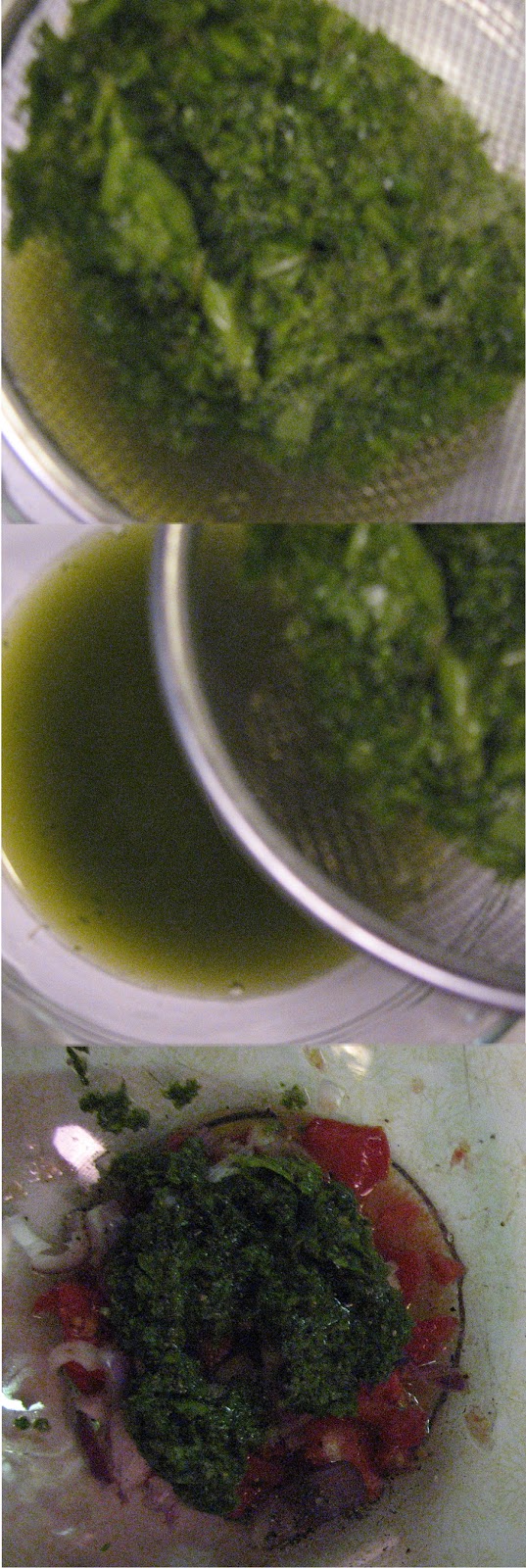
Rinse celery and basil, place in a blender or bullet grinder with a bit of water and buzz until ground up. Drain, catching the water*. Add to bowl, drizzle with a tablespoon or so of olive oil, add cracked black pepper and salt to taste.
Boil pasta according to directions. In the last minute add the slivered peppers, stir to mix with pasta. When done, drain, but leave slightly damp and immediately add to bowl. Let sit for 1-2 minutes to allow the veggies to heat up. Toss, plate up and top with Cheese and Walnuts.
Turned out great. The sweet peppers added a note of sweetness to all the savory elements.
*This "herb" water contains a lot of flavor from the herbs/greens used, so I add it to my stock container in the freezer for the next stock making time.
So, what else can you use fresh celery leaves for? Some nice ideas found on the internet:
Make a celery simple syrup -- ratio is 1/2 to 1 cup of rinsed celery leaves, 1 cup each sugar and water. Bring water and sugar to a boil, stir until well dissolved, add celery and let steep until cool or overnight (to taste). Drain, discard the leaves and store the syrup in the frig for up to 1 week.
-----Use to make celery soda -- 1/4 cup of celery syrup, add 3/4 cup of cold seltzer or sparkling water, stir and enjoy.
-----Use as the simple syrup in any cocktail. Combine with fresh mint for a different Mojito
Use in place of parsley or lettuce in a recipe.
Substitute for Loveage (a celery flavored herb) in recipes. (Loveage is a far stronger flavored celery taste so adjust recipe when using celery.)
What new or old fashioned way have you used celery leaf?
. . .
Next Events Coming Up:
I am speaking at the monthly meeting at the Arizona Herb Association on June 2nd. Topic is Stevia and Syrian Oregano. Their business meeting starts at 7 p.m. and my talk will be approximately 8 p.m. Great organization to join.
June 24, 2016, Friday, 9 a.m. - Noon
FREE Seed Share / Swap
Mesa Farmers Market
June 25, 2016, Saturday, 6 p.m.
Sow! 105? Yes!
Lecture at Mesa Urban Garden (MUG) on sowing in the summer
Free (consider donating to the garden or renting a bed)
. . .
Check out my books and calendar on Amazon.
Follow me on Facebook
-- Catherine, The Herb Lady
If you enjoyed this post, subscribe in the upper side bar link, to get all my posts!
Disclaimer: Clicking on links on this blog may earn me a small commission if you purchase something. Your price does not change.
I grow celery - in the desert garden - and because I let it reseed each year I usually have a LOT of it this time of year. Some of it is going into flower (and I will capture some seed later for my seed bank inventory), but right now I have a lot of fresh leaves.
What to do? Most people do not think of celery as a vegetable, they think in terms of a bit of flavor for soups, stews, sandwich salads (Tuna, etc.).
Over a decade ago I developed a braised celery and cranberry dish for Thanksgiving and it was great. I posted it here on the blog last fall.
However I have not done much with it since (outside of always adding to sandwich salads) except to dry to add to my pantry, and even make it a part of my homemade vegetable bouillon.
But now that I have no lettuce in the garden, and I have a LOT of celery I mulled what I could do with it.I thought about using it "in place" of lettuce, so our lunch yesterday was a Bacon, Celery, Basil, Tomato sandwich with our apples on the side, on raisin toast :-)
I got to thinking about a celery leaf "pesto" and the Sweet Potato Linguine I have and dinner was now planned. (The pasta is from locally producer DeCio Pasta in Tempe, and I purchased at the Mesa Community Farmers Market. Great products with excellent ingredients.) Also pictured in the last farme, I sauteed up some sliced beets and beet tops (from the garden) for Deane as a side dish for him (he loves them, I'm slightly allergic to them).
Celery Pesto Pasta Primavera
This kind of dish is not about exact ingredient ratios, increase or reduce as you like. I decided on a "raw" sauce created by chopping fresh tomatoes and onion and placing in a bowl, adding the "pesto" a dribble of olive oil, and salt and pepper. Then when the pasta is done, drain quickly and add to bowl, let sit for a minute or two to heat the veggies and then toss.
Handful of celery leaves (substitute parsley or more basil if you do not have celery)
4 small sprigs of basil
2 small sweet peppers, cored and slivered
1-2 small tomatoes or 1 medium size, chopped
Scallion, 2 inch piece, minced
Parmesan Cheese, grated
Chopped walnuts
Linguine or Spaghetti (1-2 servings)
Salt & Pepper to taste
In a bowl, place chopped tomatoes and onion.
Rinse celery and basil, place in a blender or bullet grinder with a bit of water and buzz until ground up. Drain, catching the water*. Add to bowl, drizzle with a tablespoon or so of olive oil, add cracked black pepper and salt to taste.
Boil pasta according to directions. In the last minute add the slivered peppers, stir to mix with pasta. When done, drain, but leave slightly damp and immediately add to bowl. Let sit for 1-2 minutes to allow the veggies to heat up. Toss, plate up and top with Cheese and Walnuts.
Turned out great. The sweet peppers added a note of sweetness to all the savory elements.
*This "herb" water contains a lot of flavor from the herbs/greens used, so I add it to my stock container in the freezer for the next stock making time.
So, what else can you use fresh celery leaves for? Some nice ideas found on the internet:
Make a celery simple syrup -- ratio is 1/2 to 1 cup of rinsed celery leaves, 1 cup each sugar and water. Bring water and sugar to a boil, stir until well dissolved, add celery and let steep until cool or overnight (to taste). Drain, discard the leaves and store the syrup in the frig for up to 1 week.
-----Use to make celery soda -- 1/4 cup of celery syrup, add 3/4 cup of cold seltzer or sparkling water, stir and enjoy.
-----Use as the simple syrup in any cocktail. Combine with fresh mint for a different Mojito
Use in place of parsley or lettuce in a recipe.
Substitute for Loveage (a celery flavored herb) in recipes. (Loveage is a far stronger flavored celery taste so adjust recipe when using celery.)
What new or old fashioned way have you used celery leaf?
. . .
Next Events Coming Up:
I am speaking at the monthly meeting at the Arizona Herb Association on June 2nd. Topic is Stevia and Syrian Oregano. Their business meeting starts at 7 p.m. and my talk will be approximately 8 p.m. Great organization to join.
June 24, 2016, Friday, 9 a.m. - Noon
FREE Seed Share / Swap
Mesa Farmers Market
June 25, 2016, Saturday, 6 p.m.
Sow! 105? Yes!
Lecture at Mesa Urban Garden (MUG) on sowing in the summer
Free (consider donating to the garden or renting a bed)
. . .
Check out my books and calendar on Amazon.
Follow me on Facebook
-- Catherine, The Herb Lady
If you enjoyed this post, subscribe in the upper side bar link, to get all my posts!
Disclaimer: Clicking on links on this blog may earn me a small commission if you purchase something. Your price does not change.
Friday, September 19, 2008
Homemade Sodas, Sorbets and What About Sweeteners
Getting the kids off (or never starting them on) commercials sodas and sweets can be a challenge. Here are two simple ideas using concentrated frozen fruit juices — the ones with no sugar added, just the natural sweetness of the fruit. If, for instance, your son likes orange soda and your daughter likes berries, orange juice concentrate or kiwi/strawberry concentrate can make great tasting sodas in which you control the contents. See my discussion on natural sweeteners vs. unnatural or unhealthy ones below.HOMEMADE SODA:
1 part juice concentrate, thawed but chilled
3 parts chilled sparkling water, seltzer or club soda of choice (club soda has added sodium)
Optional berries
Berries can be added for fun, a couple of blueberries for instance can bounce around in the bubbles.
Mix 1/4 cup concentrate and 3/4 cup of sparkling water in a tall glass, add ice, berries and a straw.
For adults you can infuse or add herbs like spearmint, basil or cilantro to make cocktail mixers.
Fruit and herb combinations:
Berries (all) — basil, rosemary, thyme or lavender
Orange — rosemary, thyme or savory
HOMEMADE SORBET or GRANITA
If using a ice cream mixer be sure to have the tumbler frozen ahead of time or whatever the manufacturer's recommendations are. Frozen juices taste less sweet than when drunk as a beverage. The sugar/honey addition should be done to taste. Hint: try 1/4 cup of sugar or honey to 3 cups reconstituted juice. It is fun to experiment with different juices, cut up fruit, and different natural sweeteners.
6 ounces juice concentrate
18 ounces cold water
Optional sweetener of choice*
Optional half cup minced fruit (cutting the fruit in small bits makes it easier for the machine to do its mixing/freezing)
WITH SWEETENER
Sweetener must be fully dissolved in liquid - bring 4 ounces of the water to just a high simmer, remove from heat and stir in 1/4 cup of granulated sugar, or 3 tablespoons honey or agave nectar, or 2 tablespoons of molasses, stir to completely dissolve. Cool slightly then add to rest of water, stir, add juice and chill.
WITHOUT SWEETENER
Mix juice concentrate and water, stir to combine well and chill.
TO FREEZE
If using an ice cream maker, start mixer and slowly pour in the liquid, wait about 5 minutes to let the freezing get going well, then add fruit. These makers do not freeze the mix solid, 3 cups of liquid will make 4 cups of sorbet. Remove, pack into a 32 ounce container, cover and freeze.
If no ice cream maker, pour liquid in a pan big enough to keep the liquid at a depth of no more than 1 inch. Freeze for 2 hours, remove and scrap lightly with a fork to break up crystals. Re-freeze for 1 hour, repeat scrap and add fruit. Continue to re-freeze, and scrap every hour until the sorbet resembles shaved ice. Remove and place loosely in covered container and freeze.
TO SERVE:
When serving allow to sit at room temperature about 10 minutes to soften. Serve with more fruit if desired. A fun option is sorbet sparklers (photo). Place a generous scoop of sorbet in pretty clear glass, like a wine goblet. Top with sparkling apple cider or sparkling water (Adults can use a sparkling wine.)
ABOUT SWEETENERS:
FIRST No High-Fructose Corn Syrup. The studies are showing not only problems with the way our bodies deal with HFCS (links to childhood obesity and early onset diabetes), but also what appears to be an addictive factor. See "Why No HFCS" below.
Karo Syrup — the one grandmom and mom have used since 1902 for baking has different ingredients depending on which version you are using. Karo Dark does not contain HFCS. Karo Light does. Karo "Lite" has no HFCS but has splenda (sucralose). I suggested to their customer care person they find a replacement for sucralose and I would be happy to use the "lite" version for light uses.
Sugar, honey, agave nectar, molasses, stevia are all traditional, old and mostly natural sweetening agents (even honey is technically manufactured by the bees).
Stevia and agave nectar are considered safe for most diabetics (be sure to check with your doctor). Agave nectar is used in the same proportions as honey (3/4 volume of cane sugar). Stevia (used as a fresh or dry leaf - not powder or liquid), can be infused as one would make tea steeping to the desired strength and strained out if you like. Start with approximately 2 tablespoons dried leaf replacing 1 cup of sugar. Steep for 20 minutes in hot liquid, taste and if needed steep 5-10 minutes longer. Stevia leaf is so naturally sweet that when used only in water — as making the sweet liquid above, it can be reused one more time to make tea or sweeten other beverages.
Every time I read how the ‘new' products (meant to control ‘a problem') are now showing to be biochemically worse (look at the literature about margarine vs. butter) I can't help but go back to the old ways. Certainly not every old way is a better way, but I would rather use real sugar, honey, etc. and real butter or olive oil than the chemically-created alternatives.
One of the reasons I became so passionate about herbs and spices was the idea of bringing out the real flavor of food before adding all the salt and fat generations since WWII got into because they were eating more and more manufactured food instead of what is referred to as "scratch' cooking. Herbs and spices ‘lift' the food taste and satisfaction by enhancing the natural flavor. Rosemary for instance brings out the best taste in any starchy food like rice, pasta or potatoes.
One of the taste sensors of our tongue is sweet. It was put there for a reason! And sweeteners have their long-respected places in our diets. They give us a satisfaction which, before humans figured out how bake, they could only get from fruits and raiding bee hives.
As with all food choices, we have a responsibility to use wisdom with not only our own eating habits but also any children over whom we have a responsibility to care for. As Barbara Kingsolver commented in her book Animal, Vegetable Miracle — what is being accomplished by "picking up junk food on the way to the soccer game?"
Oh, just in case you are thinking About Splenda? In a lawsuit against the manufacturer of Splenda, "the Sugar Association claims that sucralose, the sweetening ingredient in Splenda, is a man-made chlorocarbon and that a complex process is required to first convert sucrose (sugar) into a number of different intermediary chemicals before using "phosgene gas - a deadly weapon used during World War II - as the chlorinating agent to yield sucralose." Trial is set for January 6, 2009
WHY NO HFCS!
A recent commercial from the manufactures association of HFCS' is obviously trying to dispel fears, but I thought it was interesting that the very quiet final comment was ‘in moderation' by the actress.
Soda and food manufactures moved to HFCS because it was cheaper. I think it is also interesting that Coke's plants in Mexico use good old fashioned cane sugar as a sweetener because our southern neighbors do not like the taste of the HFCS. Remember when the Coke folks got such flack when they first introduced the ‘new' and improved version of Coke back in the 80s with the new sweetener, they had to bring back the "classic?" They just waited until folks got used to the taste of the ‘new' stuff and apparently quietly took the classic off the market.
The site for processors of HFCS has this statistic: "According to the USDA, high fructose corn syrup accounts for roughly 41% of all caloric (nutritive) sweeteners consumed in the U.S." — sweetsurprise.com.
Well that's no surprise is it? According to the Center For Disease and Control: "two NHANES surveys (1976–1980 and 2003–2004) show that the prevalence of overweight is increasing: for children aged 2–5 years, prevalence increased from 5.0% to 13.9%; for those aged 6–11 years, prevalence increased from 6.5% to 18.8%; and for those aged 12–19 years, prevalence increased from 5.0% to 17.4%"
And as a general population increase: "In 2007, only one state (Colorado) had a prevalence of obesity less than 20%. Thirty states had a prevalence equal to or greater than 25%; three of these states (Alabama, Mississippi and Tennessee) had a prevalence of obesity equal to or greater than 30%." — http://www.cdc.gov
Moderation? Who are they kidding? The HFCS producers have been so successful at selling the cheapness of their product that more and more food processors are hopping on the HFCS band-wagon. How do you moderate something which is now gradually replacing other sugars in manufactured products to the extent that pretty soon you will not have an option?
"According to a commentary in the April 2004 issue of the American Journal of Clinical Nutrition, between 1970 and 1990, the consumption of HFCS increased over 1,000 percent." — http://www.diabeteshealth.com and because HFCS does not trigger the chemical Leptin which tells your body you are full, it easy much easier to overeat. — http://www.diabeteshealth.com/read/2005/05/01/4274.html
Other references:
High-fructose corn syrup's dangers:
-- LS Gross, Amer J Clin Nutr 2004;79:774-9.
-- Bray, George A. Am J Clin Nutr 2004;79:537-43
I recommend that you do your own research and not just take my word for it.
-- Catherine, The Herb Lady
Subscribe to:
Posts (Atom)