Garden, Plant, Cook!

Saturday, June 26, 2010

Greening - Various Tools to Help You Shop and Live Wisely

Dear Folks,

If you have been following me, you are probably already trying to shop at your local farmers markets, do more cooking at home to control your menu ingredients, enhance your family quality time, and experiment with all those cool recipes you see on cooking shows.

To add to your tools and information sources, I tripped across a couple of sites I found helpful.


http://www.sustainabletable.org/spread/kits


The Sustainable Table site has a variety of kits (in PDF file form) which can be used as teaching or display tools and for your own family information use.

They also have a kit for the Sustainable Dinner Party which can give you some ideas for Supper Groups.
(I have been thinking off and on of potentially setting up 'secret suppers' -- it would require quite a bit of planning, but is fun to contemplate.  I will let you all know if I get serious!)

Another site to visit for information is the Animal Welfare Institute, which certifies humanely raised livestock farms.  They are dedicated to supporting the small-scale and family farm. http://www.awionline.org/


The troubling issues with factory farming continue to, finally, get more and more attention. Even when a farmer wants to do things right if they make the mistake of getting into contracts with large processors -- the real manufacturers when you come down to what you are buying -- they are trapped in unconscionably egregious contracts which leaves them captive to corporate whims or in bankruptcy.


Read what some chicken farmers are up against.
http://www.sustainabletable.org/2010/05/chicken-farmers-describe-a-system-of-extortion-and-economic-slavery/


How can you get more control over what you buy?  I have noticed more and more food manufacturers are getting the message.  I just saw an ad for Hunts Ketchup which loudly proclaimed on the label 'no high fructose corn syrup' -- good start!

They are listening. The real challenge to getting healthier and better quality foods is to make sure you are clear about what you want them to offer to you.

I participate in online consumer surveys.  I am troubled when the elimination questions (I don't have the ability to complain about the questions) are frequently aimed at getting the survey participant to use emotions to explain how they purchase something.  That is not to say there are no questions about what do you purchase - recently I had a survey on dairy and cheese and how much was organic, or natural, or other - that was a good one.

One good thing I noticed about the surveys in the last 6 months are the options in prepared goods or shelf-stable foods which offer more environmental, natural, local, family farm options for selections in answering the survey.

So why might that be a problem?  Because those buzz words can be grabbed by food processors to label something which amounts to bait and switch - "So and so's family farm produces only naturally prepared..."

Back in January, 2010 "Tyson Foods Inc. has agreed to settle a lawsuit that accused the poultry giant of falsely claiming its chickens were "raised without antibiotics."


"In 2007, Tyson began advertising and labeling its poultry products as having been "raised without antibiotics." The following year, the U.S. Department of Agriculture ordered Tyson to remove the labels when it found that the company had injected its chickens with antibiotics before they hatched. Tyson argued the labels were accurate because chickens aren't "raised" until after they're born."


So how do you like that corporate logic?

Isn't that enough to make you want to scream at them!  The quote attributed to Voltaire goes something like "If you wish to converse with me, define your terms."  Don't you wish we could tell corporate food producers they need to define their terms so we know what they are really saying?

What is a consumer to do?  You need to know your suppliers like your grandparents did, your local farmers, meat producers, egg sellers, and cheese makers.

Some of the material on the sustainable table site are sheets of questions to ask sellers of food.

Oh, and on the subject of organic - organic picked green and shipped hundreds or thousands of miles is not a whole lot better for you than "somewhat" regional and non-organic.

Organic and natural are two words used at your local farmers market.  Here is what THEY mean:

Organic means it was grown locally in a USDA certified program, picked local and sold local.

Natural for most of our local small-scale farmers means they grew the foods or produced the foods in much the same way as organic producers but without going through the expense of official certification.

Our farmers market vendors and farmers are happy to tell you all about their foods and origins - they are proud of their products.  Ask them questions.

There is now a "Certified Naturally Grown" label for small-scale farmers and food producers. Check them out at:  http://www.naturallygrown.org/

What is a natural flavor or anything proclaimed natural?


The term natural flavor or natural flavoring means the essential oil, oleoresin, essence or extractive, protein hydrolysate, distillate, or any product of roasting, heating or enzymolysis, which contains the flavoring constituents derived from a spice, fruit or fruit juice, vegetable or vegetable juice, edible yeast, herb, bark, bud, root, leaf or similar plant material, meat, seafood, poultry, eggs, dairy products, or flavoring rather than nutritional...
When a company says it is selling you something based on what they KNOW you want, but if it is in-fact selling you a substitute or inferior product isn’t that bait and switch?
The manufacturers of Splenda were sued for claiming their product is sugar.  It is not and they had to concede that or face losing the lawsuit.
When the high fructose corn syrup producers revved up their protectionist marketing campaign to tell us that it was our own over-eating that was the problem and not their product, they left out the science which shows that consuming foods containing HFCS does not trigger the “you are full” chemical leptin.  And their throw-away tag line “in moderation” is a slap in the face when you look at the sheer volume of foods manufactured with HFCS -- how do you moderate eating something that is in almost every processed or manufactured food and which has no eating cut off command?

Oh, and the FDA does not object to the corn syrup producers calling HFCS ‘natural’ - natural hmm, - HFCS has been found to be toxic to honey bees fed it.  (In cold winter areas bee keepers feed their bees sugar water or even honey to help sustain them through the cold time.)
See my blog on sweeteners:
I have also been concerned about the very useful plant-based Stevia being ‘hijacked’ by the corporate giants.
In looking at labels on packages of some of the newest offerings purporting to be Stevia, most are a combination of stevia and sugar alcohols -- the sugar alcohols being used to add baking capabilities and additional taste.  Not necessarily a bad thing although some people are allergic to some sugar alcohols like sorbitol (I for one am).
What bothers me is when one of the big giants (or two) get into the act and make some part of it proprietary with the disclaimer "trade secret."  Truvia is a partnership of Cargill and Coca Cola, and they have stevia and sugar alcohol listed on their ingredients.  And then they say “natural flavors” but won’t tell you what they are - it is a trade secret.
Remember HFCS can call itself natural. Splenda tried to call itself something it wasn’t.
Bottom line - if you can’t tell what the ingredients really are and you don’t know enough about the company's history in truthful advertising, back away.


AND don't forget about growing some of your own food, raising a couple of chickens for eggs, or even consider having a dairy goat or two (you need to know your areas zoning limitations).

You may wish to join the Phoenix Permaculture Guild forum  - they have groups on different subjects. I am a member of the micro-livestock group and soil culture group.  Nice people, made up of newbies, getting there, experts - who still learn - and all are very helpful with answering questions.

http://www.phoenixpermaculture.org/

If you have an interest in my books, the publishing site is still offering free shipping on orders totaling 19.95 shipped to USA addresses.


And for you Mac iPad, iPod and iPhone users my Edible Landscaping in the Desert Southwest is now available through iBook.

Have a great weekend,

-- Catherine, The Herb Lady

Thursday, June 24, 2010

Sunflowers! Companions, Nutrition, Sustainable, Fun!

 Dear Folks,

I love sunflowers!

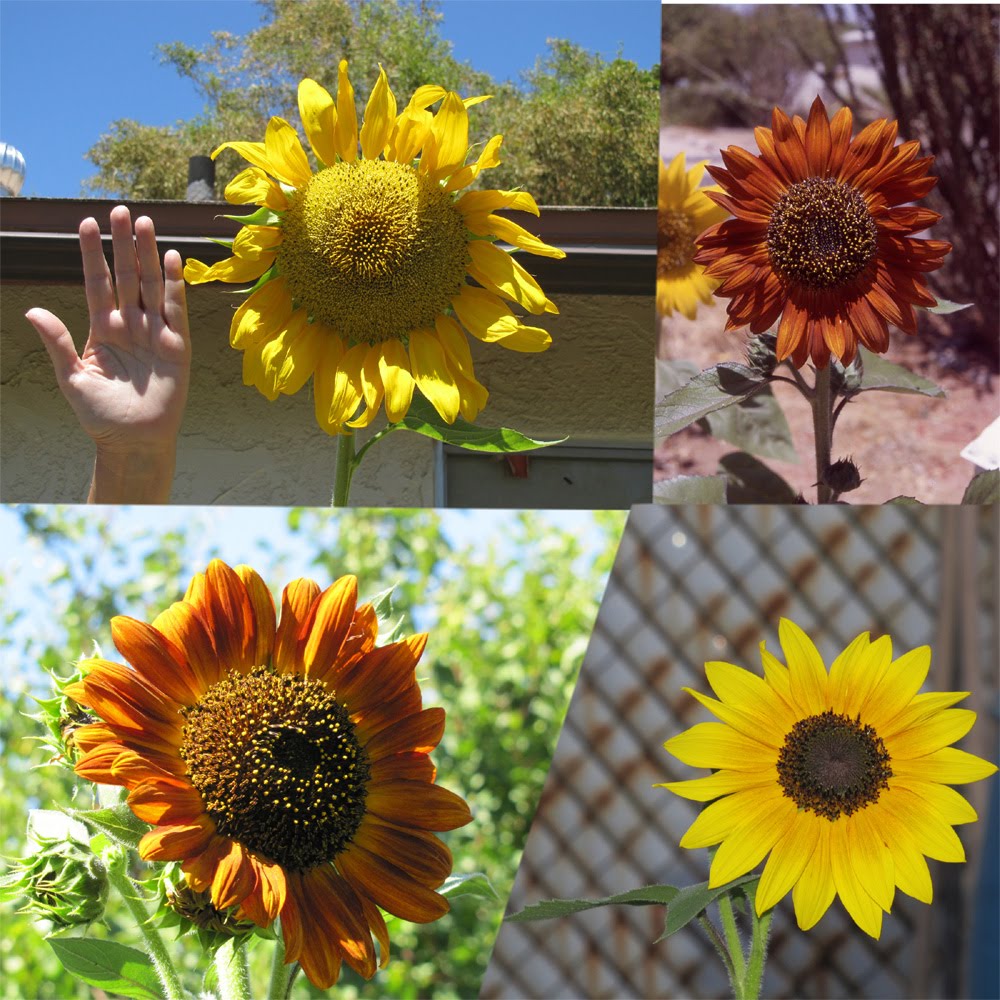
From the wild ones which crop up beside highways and country roads, and even our garden, to the colorful hybrids including the dainty lemon yellow, through the multicolor ranging through oranges and burgundy to the mammoth huge varieties, they all have delighted me for years.

Sunflowers have also been occasional companions for the traditional Native American's three-sisters companion planting, as a 'fourth-sister'.

I've written a long article with a chart on various combinations of the three sisters (also known as a Monsoon Garden) sustainable gardening/farming practice at my newsletter site.

Click here to go to the PDF file.   You can also go to the newsletter site by clicking here.  The three sisters article is under "files".

Here is a brief summary.  The original threes sisters are corn, beans, and squash.  In arid areas where both food and water were precious commodities, the practice of growing 3 complimentary plants (and nutrients) together maximized water use and made caring for the plants easier.   The fact that corn and beans together makes a complete protein and squash provided additional vitamins, minerals and fiber all worked to give the people a very healthy diet.  The soil also benefited because while corn is a heavy feeder, beans put nitrogen back into the soil and the squash covering the ground minimized evaporation and weeds.

Sunflowers as I now know are more edible than previously thought, are a fun option to plant along with sugar peas - one of my favorite 'never-makes-it-into-the-house' garden buffet snacks - and cucumbers.

Read the article for more information and tips.

I'm ready to start sauteeing the large sunflower discs/heads for a fun time in the kitchen!

If you can view video on your computer, you must check out this how to video on braising sunflower heads:

http://how2heroes.com/videos/appetizers/braised-sunflowers

A note for Mac enthusiasts and iPad owners!!!  My "Edible Landscaping in the Desert Southwest: Wheelbarrow to Plate" is now available through the iBookstore app.

Around The Garden.
I just harvested all of my garlic and it is drying now.  I will have some for sale at the farmers market tomorrow.  We cut one of the banana fruit clusters to hang and finish ripening.  I am giving sugarcane a try, and the first sections are starting to sprout.

Bananas, lemon grass, and sugarcane (and palm trees) all a kind grass -- really big grass, so they do need regular watering to maintain them.

DID YOU KNOW fact...the California Fan Palm tree (aka Arizona Fan Palm, Desert Fan Palm, Cotton Fan Palm), Washingtonia filifera is the only native palm tree in the desert USA?  The fruit can be eaten raw, cooked or ground into flour as the Native Americans did.  The tree can live 80 to 250 years!!!

Keep that in the back of your mind when someone tells you palm trees are not native to Arizona.

See more information on this Arizona Native at wikipedia - click here.

July Gardening 
Fall planting season begins July 15th for all seeds of fall edibles.  Get your garden plans together for this heavy sowing time from July 15 through August 15th.  Why???  If you consider that you want pumpkins for instance you need to count backwards from Halloween or Thanksgiving 90 to 120 days.

Have a great weekend, stay hydrated, and support your local businesses and farmers markets,

-- Catherine, The Herb Lady

Wednesday, May 19, 2010

Creative Container Garden Ideas in the Desert

 Dear Folks,

I just finished up a 3-part workshop preceded by an Edible Flower lecture and it is time for me to get back to serious work in the garden.  I have to harvest my garlic scapes and my new potatoes — I'm thinking a nice garlicky potato salad with a cold glass of green sun tea steeped with lemon verbena and spearmint, yum.


Back to different fun stuff in the garden.

As many of my long-time readers know I always suggest a very large container with a minimum suggestion of 2 ft wide, to maximize your success in the desert when gardening with pots

When you think pot think outside the pot for ideas for containers.  Here are two really cool ideas, one is a recycling gem of an idea, and the other one for those who may have some physical limitations.

What do you do with a 'dead' jacuzzi?

Well if you are a very creative person, you turn it into this fabulous container garden!

Hannelore G. has been a reader for years and asked me if she could make her no-longer-working Jacuzzi into a big container garden.  I asked her a couple of basic questions: sun access/orientation, could she drill holes in the bottom, could she reach the center from all sides (important so you don't have to get up and crawl over the garden to do weeding/maintenance in the center), and what did she want to grow?

I provided her with soil/drainage mixtures information, some suggested plantings for this season and look what she did with it. Awesome!  And her lovely blue door, gives a "Santa Fe" look to the whole visual appeal along with her added garden art work in the "container."

Now that is a container garden!

Next Up:  Discovery Point Retirement Community in East Mesa, is the site of this super "table garden" for residents.

Michon Jablonski and Cherie Scott, the Marketing Director and General Manager respectively, contacted me about participating in their Arbor Day celebration, but also their interest in finding a way to have a community garden for their residents.  I found plans for a table garden designed for those with physical challenges -- you can wheel right up to the table and garden, or stand comfortably -- and their Maintenance Manager, Dustin Beckstead and crew built this hell-for-stout version.  They had a planting celebration day and the garden was blessed, and off and growing!  http://www.discoverypointretirement.com/  480-559-8134

With the heat right around the corner (or tomorrow!), the selections of things to grow in pots or even in the ground gets reduced until August (which is the beginning of fall seeding in time).

I am going to do a whole blog on a variation of the three sisters garden, but here is one to give a try right now.  Sunflower, Edamame (soybean) and summer squash.

Soak the seeds for a few hours first before planting Normally I suggest soaking seeds overnight, but don't soak soybeans longer than 8 hours or they will start to ferment..  Arrange the sunflower seeds so they will be in the ‘back' or north part of the garden or pot — if you are feeling ambitious, you can put one of these pots or garden patches together each week through the first week in June — soybeans come ripe all at once on their bush, so this gives you several crops.  After planting the seeds cover the ground or soil with some dried leaves and watch for slugs — with our abundance of rain this year the slugs and snails have been out in force.  For additional visual attraction, sow impatient wallarana seeds or portulaca (moss rose) along with the Sunflower, et al.

SLUG/SNAIL TIP: Because the slugs were getting my early sunflowers and beans, I cut up paper towel cardboard tubes and toilet paper tubes into 1 inch circles and used them as "collars" around the new planted seeds and seedlings.  Nestle the collar into the soil.  The slugs and snails can't get to the plants.  The collar eventually collapses and deteriorates and you can remove it and toss it into the compost pile.

As mentioned, I will blog more about the three sisters, and in particular about sunflowers, because almost the whole plant is edible. More later :-)

GRILLING TIP: Make basting brushes from stiff herbs.  Rinse and tie woody stems together with cotton twine and bast away for added flavor to the grill.  Fruit Kababobs - try woody rosemary sprigs, soaked for an hour and thread with pineapple or other firm fruit, turn to get some grill marks on the fruit, but don't char.

And another free shipping offer from my publisher's site.  They are offering free shipping with a minimum purchase of 19.95 to any US address.  It is called the FREE summer shipping so it should be active for a while.  The special code appears on checkout, so you do not have to remember a code.  If you change your order so the amount before tax or whatever drops to less than 19.95, the free shipping is removed.  My page at the publisher site.  http://stores.lulu.com/herbs2u

Have a fun time in the garden, kitchen and at the grill!

-- Catherine, The Herb Lady

Tuesday, April 20, 2010

Free Shipping Offer On My Books - Expires May 1st - Hurry!

Dear Folks,

If you have been contemplating purchasing my "Edible Landscaping" or "101+ Recipes" book, my publisher is offering free shipping on a single book purchase (print).

Free shipping always gets my attention, and I do benefit from this of course, but usually free shipping offers require you to buy $25+ to get the freebie, my books start at $12.25.


1) good to any US address
2) good on a single book purchase only, one to a customer**
3) there are 2 versions of each book - standard and a 'trade" version which is a lighter-weight, and less expensive version (I actually like the paper on the trade version better)
4) you must use the code below on check out, until you put the code in it will show the full shipping price.


and here is the big point:
5) GOOD only until 5/1/10 at 11:58 PM - it expires 1 minute before midnight.


** But you can pass the code around to family and friends


CODE:

FREEMAIL305


And here is the site where you can scroll through the books:

http://stores.lulu.com/herbs2u


Have a nice day,

-- Catherine, The Herb Lady

Thursday, April 15, 2010

Grass-Fed Burger Recipe

Grass Fed Beef - Good for the animal, us, and the environment!

Dear Folks,

If you choose to eat beef - choose wisely.  The Mesa Friday Farmers Market is fortunate to have Red Mountain Cattle Company's grass-fed beef. (Red Mountain CC is a division of Tyler Farms, located in North Mesa). For information on Red Mountain click on the link below.
http://www.arizonafarmersmarkets.com/vendorpages/RedMtnCattleCo.htm

DID YOU know that grass fed beef is better for you with higher levels of CLA (Conjugated linoleic acids - a type of ‘isomer' with anti-oxidant and anti-cancer properties)?  According to sources the grass-fed beef contains 300-500% more CLA than grain-fed beef, and the animal is healthier, the environment is healthier and so are you - in the end.

http://en.wikipedia.org/wiki/Conjugated_linoleic_acid

A little history - before factory farming really got going, all or most livestock was ‘range-fed' meaning they foraged naturally on the range and prairie grass and shrubs.  Enter commerce —
 specifically the idea that if you basically force fed cattle grains, while keeping them stationary in feed lots, they gain weight rapidly and produced a lot of what we now call marbling — fat running through their meat.  This ‘self-basting' fatty meat made for tendered, ‘tastier' beef as opposed to the range fed beef -- like TV dinners and fast food got us addicted to salt, marbled beef got us addicted to fatty meat.  There was a serious ‘by-product,' though, of this feed-lot commerce — cattle were not meant to eat a lot of grain, or live (for very long) in too-close quarters - it gives them permanent indigestion, resulting in the need for antibiotics among other chemicals, which lowers their resistance to other diseases — and the domino affect rolls along.

Since most of "that" grain is corn and most of the corn is now genetically modified, choosing grass-fed beef is yet another case of taking something ‘factoried' into a state of almost artificial form and bringing it back full circle to where it started —  as close to natural as possible when managed by humans!

Cooking With Grass-Fed Beef (GFB) requires just a bit of re-education - generally you cook grass-fed beef at slightly lower temperatures and with less time.  I have found everyone's stove or grill is just a little bit different - so figure on carefully watching the first time you cook with GFB

If you have ever cooked with venison (deer or elk) the cooking guidelines are the same.  Marinating steaks is a good way to not only infuse more complimentary flavors but also a way to tenderize it.

Ground GFB is full of great beef flavor, but has almost no fat.  Taking a trick from my Deane, the following recipe uses potato to keep the burger moist and "green" garlic to add great flavor.  All three ingredients can be found at the Mesa Farmers Market on Fridays or at your local farmers market.

GRASS-FED BURGER
1 package (about 1 to 1 1/4 pounds) of ground grass-fed beef
half of un-peeled potato, shredded (if you shred it ahead of time, cover with cool water to keep from darkening)
1 green garlic, minced or put through garlic press (can substitute 1-2 dried garlic cloves)

Mix beef, potato and garlic to incorporate well, but don't over do it or you will loose the texture.  Form into 6 patties, press each one in the center with your thumb (keeps the burger from rising in the center and creating different cooking from edge to center) — I like to use my good old Tupper-ware hamburger press to keep the patties uniform for cooking.

Sear each side on direct heat on the grill.  Cook uncovered turning once or twice - total time 4-5 minutes for medium - 6-7 minutes for well done. Serve with a choice of toppings.

The finished picture shows a side of bacon wrapped asparagus - I usually use basil leaves inside the bacon to give these wonderful grill veggie bundles extra flavor — holding 3-5 stalks of asparagus, wrap several good sized basil leaves around them and cover/wrap with bacon.  Grill watching carefully, over direct heat, turning until each side has some grill marks and the bacon is cooked through.  Even great cold the next day - if you have any left over!

Food choices made with an understanding of all consequences to us, the source, and the environment always equal a win/win/win!

-- Catherine, The Herb Lady

Tuesday, March 23, 2010

How To Drink More Water!

Herb and Infused Waters!

Do you and your family drink enough of plain, clear, unadorned water (no sugar, chemical flavorings etc.)?  I am talking water here, not ice tea, coffee, or juice (although 100% any juice is great with a meal).

Caffeine is an absolute no-no as a source of the water your body needs to balance salt, process food, moisturize your skin, and keep the "plumbing" working well.  Caffeine, in case you do not know this yet - is a diuretic - meaning it causes your body to jettison fluids - fast, decreasing the time the water is in your body to do the things it needs.  The general recommendation still remains at about 8 8-ounce glasses of water a day -- that is 2 quarts of water.  More if it is hot -- hikers, workers and just plain folks can lose up to 2 quarts of liquid in sweat per HOUR, particularly if it is hot.

There is a reason restaurants put a slice of lemon or even mint in the water they serve - it tastes better, but more important it "tastes" like it is more refreshing and thirsty quenching.

Everyone, every where, at any time of year, needs to drink plenty of fresh, pure water.  Most tap water is just fine - if it tastes okay to begin with.  It just may need a little flavor enhancement, and if it looks pretty in a jar or pitcher, you will drink more.

Put some herbs, fruits, vegetables and edible flowers to work to make a beautiful to-look-at and satisfying-to-drink pitcher or jug of flavored water.

General Ideas:  You are just flavoring the water, not making a juice.  If using a pretty clear pitcher, use edible flowers and flowering herbs to make a "picture" at the front of the pitcher.

Technique: You are going to fill the pitched with ice first, in layers, allowing you to place herbs and other edibles attractively, then fill up with water. Let sit for 1 hour before serving.  It will be icy cold and refreshing.

1.  Decide what flavors you want.

Example:  mint and lemon or lime; or, substitute some or all of the mint with basil; cucumber slices and a bit of rosemary; any combination of lemon flavored herbs; if you like a kick, try cinnamon or Thai basil; or other anise flavored herbs. Try some parsley or celery leaves (not a lot, just a little).

Basic Ratio:
1 gallon of water/ice combined
1/4-1/2 cucumber, very thinly sliced (or 1-2 stalks of celery, parsley, or ½ cup of berries
3  5-inch sprigs of herb
half of lemon, lime or orange thinly sliced (or 5-7 kumquats or limequat either cut in two and seeded, or seeded and thinly sliced)
5 - 10 edible flowers or petals

Really, what smells and tastes good to you will work.

2.  Fill pitcher 1/3 full of ice and place ingredients against the glass, using the ice to hold them in position. Place some on top of the ice, repeat 2 more times, finishing with a layer of the ingredients on top.  Fill with water, cover and let sit for 1 hour. Serve and enjoy.  The cucumber waters will only last for about 8 or so hours.  Other waters can be refrigerated and will last about 24 hours.

SOME IDEAS:

It is important to remember you are not trying for a juice taste, but merely a hint of freshness provided by the ingredients.


— Cucumber, rosemary, lemon, lime or orange, Edible Flowers: whole pansies, Dianthus or calendula petals — very pretty if you take the zest of the citrus in one long spiral and wind it around the herb sprig

In a container place 1/3 of ice, and decoratively arrange 1/3 of cucumber, Rosemary and citrus (and flowers if available) between ice and container wall, repeat until container is filled to top. Top off with water. Allow to sit for at least 1 hour before serving.

Other Herb Waters or Ices:
— Lemon or lime, fresh Mint, celery or parsley pieces and flowering Lime Basil sprigs.
— Any berries and Basil, Rosemary or Thyme (berries will give the water a slight blush color - pretty)
— Freeze any of these combinations in ring mold with edible flowers for punch
— Large piece of Lemon Grass or Lemon Verbena, bruised slightly and frozen into tall cup of ice, un-mold into clear pitcher containing lemonade
__Fill glasses with frozen cubes of watermelon and then add the herb water - drink the water and eat the frozen fruit - double the pleasure!

Optional: Floral herbs such as lavender and rose scented geranium, used in small quantities can give a distinctive scent to the water.

A delicious and attractive way to keep hydrated!


-- Catherine, The Herb Lady


Saturday, February 27, 2010

What really is a LOCAVORE -- Hint: Grandma knew her green grocer and dairyman -- as her neighbors and friends

Dear Folks,

Are you a locavore? Simply put a locavore is someone who makes the conscious decision to purchase goods and produce grown, made or produced within 100 miles of their home.

Why?

A simple answer is that "seasonal" (as opposed to out of season) vegetables, herbs and fruit, for instance, are more nutritious, better tasting and therefore better for you and your family than produce which has to be picked green and transported great distances to your chain market.

But the larger answer is what you are doing for "your" community by supporting locally- owned businesses including farmers.

Tucson author Barbara Kingsolver moved back to her native Appalachia, to go natural and wrote about it in "Animal, Vegetable, Miracle" (HarperCollins) -- I really like a comment she made to a reviewer: "However, for me to go to the store and buy bags of organic spinach that have been shipped here in a truck from California--in a refrigerated truck, I might add--is just burning a lot of gasoline."

I only disagree with Kinsolver on the idea that you can't have a sustainable garden in your backyard here in the valley, you can and yes it does take proper water management, but that is a topic I will address in another blog.

To locate farmers markets in your area the USDA maintains a site - click on the state and a pdf file comes up with markets listed by city.

http://www.ams.usda.gov/farmersmarkets/map.htm

For Arizona only Farmers Markets here is a special link:

http://www.foodconnect.org/farmers_markets/locator.asp

A source for finding other local sources of food is Local Harvest. They have teamed up with the Slow Foods folks.

http://www.localharvest.org

The Slow Foods Movement started to get folks back to the dinner table -- with family -- with real food -- for real family time.

. . .

If you look at the real cost of buying "picked-green, inter state/country transported produce, and taking supplements to make up for nutrient deficiencies," your local farmer and farmers market produce is cheap!

A thought on the nutrition aspect: if your food is seasonal (superior nutrition), and picked ripe as opposed to green (superior nutrition), you and your family will have less or no need for supplements. Something to keep in mind.

Supporting other local businesses also keeps more of YOUR spending dollars in YOUR community. Current analysis shows about .45 cents of every shopping dollar stays in your community when bought from locally owned / locally produced versus only .13 if you buy from the out-of-state-owned chains.

A further thought from the whole concept of 'greening' up your life -- my more recent reading and researching on issues of greening, making more purchasing decisions on the basis of sustainability, less environmental impact, etc. -- has me rethinking my decisions about what and where something is actually produced/grown.

An example is bamboo. I think the many uses of bamboo (it is not the kind that is needed for the endangered panda bears) from furniture to clothing, is fascinating. The plants used can grow 80 feet in 40 days!!!

Amazing, and you think wow, now there is a sustainable product. And then you see a news story about where that product comes from and how it is transported. Most of this bamboo comes from China, and has to be transported, by steam ship, across thousands of miles to reach processing facilities in the US. I have to ask myself, is there real environmental savings here? Can this kind of bamboo be grown in southern areas of the US on land not useful for food crops? I don't have all the answers, just more questions.

Bottom line -- I encourage you to think about making more purchasing decisions based on how close the production source is to you. You support local businesses, keep more of "that" income in your community, and you get to know who produces the things and food you use -- kind of like how Grandma knew her green grocer and dairyman -- as her neighbors and friends.

More Information:

Edible Phoenix is a print magazine, produced quarterly and is part of the edible communities organization.

Find the current issue at your local farmers market or go on line to:

http://www.ediblephoenix.com

To find publications for other areas of the country go to:

http://www.ediblecommunities.com

BUY LOCAL

http://www.localfirstaz.com

Here is the place to start when looking for locally owned businesses. Began as "Arizona Chain Reaction" to focus on locally owned businesses, this non-profit group encourages support of your neighbors and friends who own businesses in Arizona. Check out their site.

. . .


Personalized branding iron for grilling. Here is the perfect custom gift for the hard to please griller in the family. I ordered one for my darling for Christmas and he loved it. Start a tradition and create your own family brand! 480-330-3619

http://www.tbonebrands.com

San Dominique Winery, Arizona's oldest continuously operated family winery, is also home to garlic paradise. Bill Staltari, cellarmaster and chef, is owner and creator of award winning wines and gourmet specialty foods. Visit his website to order the gourmet foods shipped anywhere in the US. Wine is available only at the Winery, located approximately 9 miles north of Cordes Junction. Have a lovely afternoon at San Dominique (the patio has a view of the Bradshaws), sample wines and other goodies, purchase wines and foods to go and have Lunch!
602/549-9787.

http://www.garlicparadise.com/

Another great locally owned and produced Arizona farmer is Kathy Marshall and her goats' milk lotions and soaps made with the milk of her dairy goat herd. You can also find Kathy at the Mesa Farmers market (and other locations). You might even catch her when she has some of her free- range chicken eggs for sale -- but they go fast!

http://www.dbgoatsmilk.com

Neighbors helping neighbors -- support and enhance your community - your purchasing dollar has more power than you think.

Be a good neighbor and friend and buy from your neighbors and friends


-- Catherine, The Herb Lady

Tuesday, February 09, 2010

Greening Alert - The USDA ready to deregulate GMO products

Dear Folks,

I received an urgent alert from Center for Food Safety passed on to me by the Organic Dairy, Strauss Family Dairy in California. The cut off date is only several days away February 16th.

Tell the USDA you do not want GMO products, they think consumers do not care! Sign the petition here.

I can't tell you how troubled I am that all consumer and farmer concerns are apparently falling on deaf ears of the USDA and FDA.

Please pass this on to everyone you can think of.

Thank you, we need to have peaceable gardens and safe food,


-- Catherine, The Herb Lady

Monday, January 25, 2010

Greening - Ideas Whose Time Has Come -- Again

Dear Folks,

Greetings from the far east valley where the grass is crunchy and soggy! (After winter rains clear out, you can usually count on clear cold nights, meaning probably light frost.)

We received just under 5 inches in the storms which ‘visited' us this week.

One of the last times I recorded near that amount of rain in a short period of time was a 24 hour period in July 2008, where I measured 3.3 inches of rain from July 10 through the 11th.

Needless to say, you can shut the automatic watering off for about a week right now and save money and your plants. Use the water meter to check when next to start watering again, we are going to be having "intermittent sun" instead of rain for the next couple of weeks, according to the current long range forecasts.

. . .

Back to today's topic

Greening - Ideas Whose Time Has Come -- Again!

--Do What You Do Best!

--Grow a Community, with a Garden!

--What resources do you have in abundance--Use them!


Folks, when times get tough or challenging, history shows us how resourceful people can be. A bad day makes us sit back and take stock of what we have and what we can do. Today's post is a bit lengthy, but I think you will find it interesting and hopefully helpful as you look about for things to do.

First, ponder this bit of wisdom.

Sue McPhail, APR, President, Ideaology
http://www.ideaologists.com/, writes a daily Monday-Friday email ‘idea' using a great/good thought from a famous or popular person, she then expounds on what that thought means and what you can do with it. Although focused on corporate / company ‘culture' for making the companies better, I think this idea from last week is something we can all identify with personally and within our community.

Turning to Farming in Detroit

"The greatest thing is, at any moment, to be willing to give up who we are in order to become what we can be." -- Max Depree

A native of Michigan [Sue writes], I've watched Detroit grapple with its identity for the past 30 years. I believe that the fastest path to success is building a future around what exists in abundance. I've been troubled as the city sought to redefine itself as a center for motion pictures and air travel. The bottom line is simple -- what Detroit has in abundance is water and fertile land.


So, today, we present Ideaology's Good Thinking award to millionaire John Hanz, of Detroit, who has pledged $30 million of his own funds to transform Detroit from an urban wasteland to fertile farmland. Hanz isn't whistling Dixie, he's hiring full-time workers at this very moment to bring his ideas to bear. Have a look for yourself. http://tiny.cc/w9UiO


If you don't think it's viable, look to the east and you'll see Ontario, Canada's fertile crescent where most of that nation's crops are grown. Come on. It's not that hard to envision: vacant, fertile land, great transportation, abundant water, lots of labor. It's good. In fact, if I were back in Michigan, I'd be calling Hanz to see how I can help make this inventive idea reality. You grow, guys.


The most difficult part of this idea is giving up the notion that Detroit is a center of manufacturing; that it is the automobile capitol of the world. Who cares. Imagine it as a Sonoma or Salinas. Could be breathtakingly beautiful, serene, profitable and amazing. All you have to do is give up your vision of factories, abandoned homes and crack houses. Put me in coach, I'm ready to play.


What can Ideaology do? Innovation is not an end product, it's a way of thinking and acting that results in an ongoing flood of uncommon, profitable ideas. Ideaology creates the climate in which ideas flourish. Call 248 879 9129 to engage us.


Sue McPhail, APR, President
Ideaology
http://www.ideaologists.com/


Max Depree is an American writer and former CEO of Herman Miller, a leading manufacturer of office furniture. He is best known for "Leadership is an Art." Named a member of the Fortune Magazine Hall of Fame, Depree also received a Lifetime Achievement Award from the Business Enterprise Trust. In 1996, the Max Depree Center for Leadership was formed in Pasadena, CA.

--What resources do you have in abundance--Use them!

Like John Hanz, can you see what your family, neighborhood, community has in abundance? We may not be millionaires like Mr. Hanz, but we all have something to contribute to our family community.

If your apartment complex, dormitory, street or neighborhood were a mini-village or town, what would each of you have as a product, service or skill that would be useful to everyone? Think of it this way — do you know your neighbors? If there were a major emergency you would turn to each other because they the closest.

--Do you have extra time and like to be outdoors? Check out http://www.phoenixweedwackers.com/ — A non-profit all volunteer organization dedicated to eradicating invasive plants from our desert environs.

--Do you have extra garden produce and not interested in selling it - give it away! To neighbors, senior or crisis centers (call first).

So what will ‘giving' something ‘get' you? Years ago when I volunteered my extra time in the office of a charity, I learned soon-to-be valuable skills which I in turn used in my career choices. I also met many interesting and great people. Networking at its finest!

--Do What You Do Best!

Are you good at organization, details, quietly working behind the scenes. Those who only sit and wait provide an invaluable service and support to the ‘action'. Can you knit, grow tomatoes, cook simple meals - fast?

--Grow a Community, with a Garden!

Nothing is more precious to people and places which are challenged, than food and water.

If you do not have a garden of your own, find a community garden, or start what I like to call a neighborhood garden. If you can't use all the bounty, share it. Learn to can (really easy, and not as scary as you may think) or freeze the extras for later.

A neighborhood garden is a way of developing a mini-community. Each neighbor grows what they are good at, then they get together and share the bounty at each seasonal harvest. (This works for apartment buildings as well as student dormitories - you need a sunny balcony or patio to make it work.)

You can begin with nothing more than a large pot (try for 2 foot wide diameter), good soil mix, lots of sun, proper water and package of seeds. Maintained properly the pot garden can work for you from season to season, all year long here in the valley.

Do you have horrible soil - my friend Kathy has her own dairy goat herd and is more than happy to give away great manure, which can be mixed into poor soil and used in the garden or containers (add some vermiculite or leaf compost to keep the mix loose).

Do you own or know someone who owns empty lots or land? Can it be made into a temporary or permanent garden?

Do you know you can legally use gray water from washing machines and non-contaminated (like toilet) water sources to water fruit and nut trees? It is important to make sure only environmentally safe soaps and cleaners are in the water.

Mesquite trees are an important way to reclaim land using things like gray water. There is a mesquite project whose aim is to reclaim land and also provide a source of food in Arizona. Mesquite is an ancient native plant source of flour from the pods and beans. Mesquite honey and wood are also by-products of growing these desert-adapted trees.

Desert Harvesters promotes the project and can even arrange grinding parties with their huge mill on wheels for those already growing mesquite. http://www.desertharvesters.org/

If you have never tried using mesquite flour - contact or find Arizona Mesquite Company http://www.arizonamesquitecompany.com/ at one of the local farmers markets to try their tasty foods and buy the flour. Desert harvesters also teams up with local farmers to produce special events like a mesquite pancake event with Crooked Sky Farms in Glendale last fall. http://www.crookedskyfarms.com/

NOTE: I have a concept in mind to assist low income home owners to reclaim their back yards for an edible garden beginning with mesquite trees and gray water. The idea would also help provide necessary shade in the summer. Contact me if your organization would like the details.

So folks, what can you do with your own skills and resources to enhance your life and the life of your neighborhood and community?

Happy gardening,

-- Catherine, The Herb Lady

Saturday, January 16, 2010

More on Growing Potatoes

Dear Folks,

I received a question from School_Junque about planting potatoes in stacked tires, after my December 14th posting on planting potatoes on New Year's Day.

I wrote more on that subject of planting potatoes in Arizona on the google group site for my irregular newsletter, which I have been writing for 10 years. You can go to that site at google groups. Click on the page "Question: When do I plant Potatoes in Arizona?" That google group page has a bit more information on planting at different elevations here in Arizona and mentioned staked tire planting.

Stacked tire planting is a nice old fashioned recycling idea to create 'free' gardening containers. My reader's question was: How many "eyes" would I plant in a bed the size of a tire?

A potato cut into pieces for planting or using small seed potatotes is the standard way of growing potatoes. Each section of cut potatoe should have 2-3 eyes. These and seed potatoes should be planted a foot apart or they can be planted closer together. Obviously stacked tire planting will depend completely on the size of the tires -- I've seen a tractor tire wrestled into duty.

My reader is at a 4000 feet elevation but the issue of how hot a stacked tire container will get in the summer in Arizona is still pertinent - hot, meaning the soil temperature will be hotter in the tire container garden then if the plants were grown directly in the ground, a light colored container, or as my December post showed - a raised bed. To some extent the whole idea of using stacked tires was not just to recycle something for another use but exactly because the tires would attract and hold more heat - a good idea for extending the season on either side of winter, but not necessarily for growing during our summer.

If you were at an elevation of 4,500 to 6,000 you could start plants in a stacked tire container a bit before last frost in hopes of creating a 'cold frame' where you would cover the opening at the time with glass or stiff plastic, at night an open it up during the day slightly.

A better idea for the hotter lower areas if you do not want to or can't make a wood frame as I showed in the December post, then get some chicken wire and make a 2-4 foot wide circle or square frame. 18 inches high should be adequate. Just make sure the potatoes are not planted near the edges to avoid exposure of the growing roots to the sun.

For you gardeners in the low desert, you can still get some potatoes in by mid-February.

The rains are coming this week so get some things in the ground today and tomorrow - I would hold off putting any seeds in until after the rains -- from all reports the amount of rain we will see this week is going to be substantial and you don't want things washed away.

You can start all the warm weather seeds like tomato, basil, chives, peppers, eggplant etc. in starter pots - kept warm and protected from frost either inside or in a green house.

TIP: Cheap greenhouse

I use a bakers rack for starting seeds and cuttings.

I created a green house of sorts by draping some plastic material (clear plastic table cloth type stuff) over the bakers rack in a sunny area of the garden. On nice days I take the plastic off completely. Works great - not as fancy as some greenhouses, but equally effective. Most of the time I don't even have to do more than create a canopy of the plastic over the top and not even bother making it come down the sides -- kind of like a clear-top patio cover.

If we get the amount of rain the weather folks think we will - we should have the additional benefit of a lovely wild flower display in early March!

Happy gardening!

-- Catherine, The Herb Lady

Friday, January 01, 2010

What does a Plants of the Bible Tour have to do with Edible Landscaping?

Dear Folks,

Happy New Year!

During this time of the traditional 12 Days of Christmas consider Biblical plants, their many uses, and the fact that you, the desert gardener, can grow most or all of them!

Edible landscaping and plants mentioned in the Bible have a lot in common -- and so does the lower desert area of our valley of the sun with the lands of the Bible. Many of you may be familiar with the fact that the lands of the Bible are very similar in climate to the Phoenix Metro area and surrounding cities, offering hot and dry conditions perfectly suited to the plants native to the Biblical area of the Mediterranean, which is home to three of the major religions of the world.

The Boyce Thompson Arboretum offers a Plants-Of-The-Bible tour on the first Sunday of the month and the third Saturday of the month. I strongly recommend you try to make one of them. Besides the regular beauty of visiting the BTA, this tour will add to your ideas and planning for your edible garden.

Figs, pomegranate, olive, cilantro, mint, and lemon grass are all mentioned in the Bible, along with many others.

Several times in the past I've written about the plants of the Bible and how we can grow them here with great success. Here is a column I wrote for the East Valley Tribune in December 2006. From that article in part I wrote "Plant a biblical theme garden — onions, garlic, leeks, dill, mint, Syrian oregano (called “hyssop” in the Bible), sweet bay, anise, cumin, cilantro (the root of this plant was one of the “bitter herbs”), sage, myrtle, lemon grass, mustard, dandelion, hibiscus, hollyhock, bachelor button, roses, violets, caper, saffron crocus and chicory, are all mentioned in the Bible."

And speaking of the 12 Days of Christmas - use the search box on this blog sidebar to find the 12 days of Christmas blogs I wrote last year. For example today January 1st, is the 8th Day of Christmas.

We have all been challenged by the last year or so, let's take the opportunity to look to options and projects which can comfort us and give us a real sense of connection to our homes, families, friends and communities. I have always believed that gardening offered that and more -- the better if it is edible!


-- Catherine, The Herb Lady

Thursday, December 24, 2009

Last Minute Dessert, Candy or Gift Ideas!


Dear Folks,

Here are some last minute ideas to whip up in less than 30 minutes, maybe even 15 for some of them. (See near the bottom also for a fun site to visit before January 1st).

What takes less than 2 or 3 ingredients, only about 20 minutes and is really tasty?

Right down to the last minute of holiday dinners, entertaining or even gifts I have some easy candy ideas using either ‘melting chocolate' or semi-sweet chocolate chips. Maybe some of you have created similar treats but some ideas might be new to you. Chocolate dipped pretzels are a surprising treat because of the combination of the saltiness with the chocolate flavor.

First some do's and don'ts.

Do use a good quality chip if you can (I know the economy is taking its toll on many, but it produces a better tasting treat).

Do use it all up! — one or more of the ideas below are for using up the last bits of the melted chocolate.

Do use only oil based flavorings or coloring agents--and only food grade of course.

Don't get water in the chocolate - you will ruin it.

Don't use water or alcohol based flavoring or coloring agents - the chocolate will ‘seize' and be unworkable.

Don't dip the entire fruit or pretzel or candy cane in the chocolate - they are more attractive (and it is easier to keep ‘you' clean while dipping) if you just dip about 1/3 to half of the food in the chocolate.

"Colored" melts or ‘colored candy molding chocolates' are not real chocolate and get their texture from a combination of oils and fats. These are fun to use on a limited basis only because they are not as ‘workable' as real chocolate (some very inexpensive ‘melts' contain no chocolate at all even if chocolate colored or flavored and have the same problem.)

I prefer to use Wilton Dark Cocoa melts or Ghiradelli 60% cocoa chocolate chips for these candies. Nestles or Hershey's chips are a good quality, just that the Ghiradelli is a superior, minimal ingredient chocolate. Wilton offers a variety of colors and white — as noted they are fun for some use but they are not as loose flowing for dipping etc. as the dark chocolate.

Flavors can be added to any of these chocolates but you must use oil based flavors which were designed to be used with chocolate. Your regular food coloring will ruin the chocolate.

Premise: If it is large it can be dipped; if it is small you can create ‘stacks' or clusters from a combination of tasty things you may have handy in the cupboard or pantry.

The basic idea for cluster-type was presented in a blog I posted (on Thanksgiving 2009) to create a healthier candy treat for the holidays. I used Jean Carper's (Stop Aging Now) basic recipe to illustrate with my own take on it.
Ideas: http://edibleherbsandflowers.blogspot.com/2009/11/220-years-ago-today-first-official.html

How to melt the chocolate:

Lots of options:

Do not overheat the chocolate or it will ‘burn' or ‘seize' up on you and will not be useable. You want the chocolate to be almost thin syrup in consistency - less loose than water, but not as thick as honey.

Microwave: In a heat proof glass jar or Pyrex measuring cup - microwave in 20 second bursts stirring between each. Begin with only a half filled jar or cup, add more chips once the first portion is melted to the amount you will need - but I don't like to have a jar or cup more than 3/4's filled when melted.

Stove top - single pot - measure the water height in the pot so it is no higher than 3/4 of the way up the sides of the container (glass jar like mason jar or Pyrex measuring cup). Place an old but clean dishcloth, or wash cloth in the bottom and heat the water to just steaming, turn the heat down to a very low simmer - there should be no bubbles in the water or very few - place the half filled jar in the water and it will start to soften, stir occasionally until the thin consistency is achieved and all the chips have melted.

Stove top - a double boiler was designed for this kind of project, keep the water in the lower pot a the same light simmer.

You are now ready to make candy!

Dipping:

Pretzels
Candy Canes
Dried Fruit — any kind -- we love apricots are wonderful
Fresh fruit — orange or tangerine sections - peel and section the fruit carefully and be careful that you do not ‘break' the section so juice comes out - it will ruin the chocolate (chocolate dipped tangerine or orange sections are a gourmet delight)

Lay on a cookie sheet or tray and place in the freezer for about 10 minutes or the refrigerator for 20-30 minutes

Clusters/ Bark:

Raisins
Dried cranberries, blueberries or cherries
Nuts
Coffee Beans
Pop corn (no butter or salt on it for this)

Mix your preferred ingredients into enough chocolate to liberally coat everything thickly. Either drop by spoonfuls on a cookie sheet or aluminum foil cover tray, or spread in a thick slab on the tray. Freeze for 15 minutes and remove to covered containers. The ‘slab' can be broken into small or large pieces like ‘bark'.


Hay Stacks:

When you are down to the last bit of chocolate or you want to make these anyway, mixing double the amount of chocolate to a combination of unsweetened coconut and chopped walnuts will give you clusters as above for the clusters. Traditionally called haystacks because the coconut looks like straw sticking out of the chocolate. I made some with less chocolate and wound up with small pieces we call ‘crumbs' - good for grabbing just a few small pieces (in the picture above, that is the funny - but really tasty pile, to the side of the candy cane and pretzel).

One last fun thing to dip is a plastic spoon! If you have coffee or hot chocolate loving friends and family, dipping the "bowl" of a plastic spoon in the melted chocolate is another gourmet delight. Stirred into the hot beverage it imparts a very distinctive chocolate flavor. Some of the fancy plastic spoons like silver or gold are particularly attractive - wrap each chocolate cover spoon in a piece of colored plastic wrap and tie with a bit of ribbon.

Everything except the fresh dipped fruit can be stored at room temperature for a couple of weeks. The fresh fruit dipped ones should be refrigerated and eaten within one week.

Have Fun!

Have a Merry Christmas and a safe and wonderful Holiday,

And for all those of you who enjoy (or have enjoyed) owning goats -- this site puts up a goats singing animation (Carol of The Goat Bells) every holiday season. I believe it stays up until about January 1 each year www.goatbiology.com


-- Catherine, The Herb Lady

Friday, December 18, 2009

Greening - Arizona State Parks Face Closure..

...due to budget cuts

Dear Folks,

We all have our pet or favored public services. One of the top reasons for living in Arizona are the state parks - it wouldn't be as lovely a place to get out of the house or take the family to see nature in some of its best areas without our state park system.

The current budget crisis in Arizona may disproportionately cut the state parks budget to non-existence. This is not - they-won't-be-open-for-a-year type of cut, but one which would necessitate the selling off of state park land to the highest bidder

Can you just imagine a McDonald's corner eatery in a residential development in place of Boyce Thompson Arboretum? Or, the formerly-public-state-park Kartchner Caverns State as the centerpiece to a gated community? Or a Wal-Mart and strip center in your most favored camping area?

Go to the advocacy page of the Arizona State Parks Foundation page for information.

The http://arizonastateparksfoundation.org/index.html is a charitable group supporting the Arizona State Parks system.

Do what you can to keep the legislature from cutting the Arizona State Parks out of the picture, now and forever.

-- Catherine, The Herb Lady

Tuesday, December 15, 2009

Greening: Your 32 Cents Worth of Choices!

Dear Folks,

You can't talk to a friend or family member, read the newspaper, or watch nightly news without sad economic facts: lost jobs, people losing homes, cuts in government budgets, which affect everything from library hours and locations to food programs, to police, fire and child care services to name just a few examples.

Human nature being what it is we want to blame someone for the mess, but who? Well we all have some responsibility in it by how and where we choose to spend our money.

"We have met the enemy and he is us". Pogo (comic strip) author, Walt Kelly, first used the quote on a poster for Earth Day in 1970.

32 Cents is the difference between how much of your hard earned dollar goes into the local economy versus "somewhere else." The national average (according to the bean counters) shows that for every dollar spent at a big chain store, 13 cents stays in the local economy funding public programs (via taxes) and paying your neighbor's grocery bill (via jobs) (and the other 32 cents goes "somewhere else"), while 45 cents stays in your local economy when you shop at locally owned and locally sourced stores.

When interviewed recently many shoppers had similar thoughts..."it's a nice idea but not practical"..."I need the convenience and better prices."

Keep that in mind when discussing who is no longer employed, when so and so can't find a job, and why there are now 10% less police or fire personnel around. Keep that in mind when the government is thinking about raising taxes to compensate for the reduced taxes into the government coffers.

Do you know where a large portion of the ‘somewhere else' that your shopping dollars goes when sent through the big chain stream? How about Asia, and overseas in general.

Take a few minutes on your computer and really do some price comparisons. You will find that your local farmers market food supplier or your neighborhood dress shop have comparable prices and great customer service.

If we are part of the problem than we cannot point fingers at ‘someone else' when we have some control over choices.

Recently Mayor Gordon of Phoenix had a request of the citizens. Pledge to try to do one-third of your shopping at locally owned and locally sourced stores. Can you do that? Can you make a difference in your community? 32 cents worth? Yes you can!

The money adds up — even if you are on a really tight budget and you spend $20 dollars at locally owned and sourced stores - do some math 20 x .32 = $6.40. How many people in your city here in the valley? Phoenix? Mesa?

Some recent (2007 or 2008) real estate estimates put the population of Phoenix at around 1,429,637 with approximately 481,000 households. Mesa at around 478,014 population and 170,023 households.

Some more math:

$6.40 x Mesa households 170,023 = $1,088,147 = if that household spent that same amount of money each month the figure would be $13,057,766 per year.

How about Phoenix with 481,000 households x $6.40 = $3,078,400 - and if that amount is spent locally each month the figure for one year would be $36,940,800.

That is a lot of jobs and employment whether working for a company or self-employed (like a store owner), or the services of police, fire and library, or education and child care. It is the difference between something as simple as a city parade or Christmas lights or something more serious and needed like support for child care and domestic violence centers, or whether your neighborhood park can be kept up, and jobs!

All from spending 32 cents differently!

First google Locavore for your community, then also search for "local first" for your community.

According to Kimber Laning, founder of www.localfirstaz.com you can also look up two other organizations nationwide for locally owned businesses in your area.

Business Alliance of Local Living Economies (BALLE) www.livingeconomies.org
American Independent Business Alliance (AMIBA) www.amiba.net

Find and support local farmers, restaurants, service suppliers, and stores.

If you are an independent store or service owner find your local business support group and join them -- today!

If we and our shopping choices are part of the problem, we can also be part of the solution. How can you make your 32 cents work better for your community, neighborhood and ultimately, you and your family?! Isn't making more local purchases a 'stimulus plan' with immediate impact?

While going through your holiday and New Year's preparations, don't forget to donate to some of the local charities - any amount is always welcome and helps your neighbors, friends, family and ultimately your community. I also have a list of some of my favorite national charities in the side bar here on the blog.

I will be blogging more but for the best wishes of the season, I like KEZ 99.9's humorous holiday greeting airing on the radio now during their Christmas music programming:

"Have a Merry Christmas, a Happy Chanukah, a Krazy Kwanzaa, a Tip Top Tet, and a solemn, dignified Ramadan"

And a very Healthy and Happy New Year to you all!


-- Catherine, The Herb Lady

P.S. Last Year I did the 12 days of Christmas which actually begins with Christmas Day, and this year it was my intention to re-post links to them leading up to Christmas, but I ran out of time! You can find them by going to the search bar on the blog here - Enjoy!

Monday, December 14, 2009

New Year's Day - Plant Potatoes!

Dear Folks,

My New Year's Day tradition is to plant potatoes, below is a collage of how we set this up in a raised bed.


This is the easiest way to plant potatoes for easy harvesting. Some folks have also used chicken wire tubes or old tires. Any of these concepts work okay.

You can try your hand at potato growing with store bought potatoes which are trying to sprout or have 'eyes' projecting out. Cut the potato into sections with 2-3 eyes per section, let dry on the counter for a couple of days and plant on January 1st. (In the picture you are seeing the 'seed potatoes' I save in my crisper drawer from the prior season growing.)

The most important thing to understand is that the growing potatoes must be covered at all times. Solanine is a toxic chemical reaction to sun light turning the skin of potatoes green and it CANNOT be cooked out.

Continue covering the potatoes as they grow to the depth of the raised container. Plan on harvesting in late Spring.

-- Catherine, The Herb Lady

Achieve greater success with edible landscaping in the desert with my reminder subscription service - just $21/year gives you very detailed planting, harvesting and using tips several times a month, including more information about planting potatoes as above and other edibles.


Friday, November 27, 2009

Correction to Yesterday's Recipe

Hi Folks,

I did not catch that the 1/2 cup symbol came through as a ? mark. Sorry about that - I sure hope it didn't frustrate anyone.

Here are the corrected recipes.

Jean Carper's GOOD-for You Candy
Chocolate Cherry Clusters

2 cups bittersweet chocolate chips
1 1/2 cups cheerios cereal
1 cup dried cherries
1/2 cup walnut pieces

Melt the chocolate in the top of a double boiler or microwave. Quickly stir in the cereal, cherries and nuts until well coated. Use tablespoon to drop clusters on baking sheet. Freeze for 15 minutes or refrigerate for 2 hours until no longer sticky. Makes about 24 clusters 137 calories, 2 grams Protein and 2 grams of fiber.

Catherine's Version of Chocolate Cheerio Candy
(The 60% cocoa is a better option for maximum dark chocolate health benefit - any dried red or blue fruit will work for the antioxidant helper.)
3 cups Ghiradelli 60% cocoa chips
1 cup dried cranberries
1 cup of walnut pieces
1 1/2 cups of Cheerios

Still a fun recipe for any holiday or anytime you want to treat yourself to something tasty and has some good things in it too!

Have a safe Black Friday and weekend,

-- Catherine, The Herb Lady
Thursday, November 26, 2009

220 Years ago Today, the First Official Thanksgiving...

. . . was celebrated as a national public day of prayer and thanks by a grateful nation.

Dear Folks,

First a recipe for that last minute take-with for today's meal or to quickly make a dessert that is a nice healthy option.

Jean Carper of "Stop Aging Now" published this recipe several years ago in the Sunday magazine section of the newspaper. I am printing it here now and also with my version of it.

Jean Carper's GOOD-for You Candy
Chocolate Cherry Clusters

2 cups bittersweet chocolate chips
1 ½ cups cheerios cereal
1 cup dried cherries
½ cup walnut pieces

Melt the chocolate in the top of a double boiler or microwave. Quickly stir in the cereal, cherries and nuts until well coated. Use tablespoon to drop clusters on baking sheet. Freeze for 15 minutes or refrigerate for 2 hours until no longer sticky. Makes about 24 clusters 137 calories, 2 grams Protein and 2 grams of fiber.

Catherine's Version of Chocolate Cheerio Candy
(The 60% cocoa is a better option for maximum dark chocolate health benefit - any dried red or blue fruit will work for the antioxidant helper.)
3 cups Ghiradelli 60% cocoa chips
1 cup dried cranberries
1 cup of walnut pieces
1 ½ cups of Cheerios

On October 3, 1789 President George Washington proclaimed that November 26, 1789 would be a public day of prayer and thanksgiving by a grateful nation for what they accomplished and what they stood for.

I am thankful for all my family and friends and for the many people who share my passion for gardening and cooking well.

Happy Thanksgiving,

-- Catherine, The Herb Lady

. . .

First Official Thanksgiving

October 3, 1789

President George Washington proclaimed the 1st national Thanksgiving Day to be Nov 26

Whereas it is the duty of all nations to acknowledge the providence of Almighty God, to obey His will, to be grateful for His benefits, and humbly to implore His protection and favor; and Whereas both Houses of Congress have, by their joint committee, requested me to

"recommend to the people of the United States a day of public thanksgiving and prayer, to be observed by acknowledging with grateful hearts the many and signal favors of Almighty God, especially by affording them an opportunity peaceably to establish a form of government for their safety and happiness:"

Now, therefore, I do recommend and assign Thursday, the 26th day of November next, to be devoted by the people of these States to the service of that great and glorious Being who is the beneficent author of all the good that was, that is, or that will be; that we may then all unite in rendering unto Him our sincere and humble thanks for His kind care and protection of the people of this country previous to their becoming a nation; for the signal and manifold mercies and the favorable interpositions of His providence in the course and conclusion of the late war; for the great degree of tranquility, union, and plenty which we have since enjoyed; for the peaceable and rational manner in which we have been enable to establish constitutions of government for our safety and happiness, and particularly the national one now lately instituted for the civil and religious liberty with which we are blessed, and the means we have of acquiring and diffusing useful knowledge; and, in general, for all the great and various favors which He has been pleased to confer upon us. And also that we may then unite in most humbly offering our prayers and supplications to the great Lord and Ruler of Nations and beseech Him to pardon our national and other transgressions; to enable us all, whether in public or private stations, to perform our several and relative duties properly and punctually; to render our National Government a blessing to all the people by constantly being a Government of wise, just, and constitutional laws, discreetly and faithfully executed and obeyed; to protect and guide all sovereigns and nations (especially such as have shown kindness to us), and to bless them with good governments, peace, and concord; to promote the knowledge and practice of true religion and virtue, and the increase of science among them and us; and, generally to grant unto all mankind such a degree of temporal prosperity as He alone knows to be best.

In 1863 President Lincoln designated the last Thursday of November as Thanksgiving Day.

Tuesday, November 24, 2009

Thanksgiving Dinner on The Table, Old Shows On the Computer

Dear folks,

I hope you will be having a great, peaceful and comforting Thanksgiving dinner with family and friends. If you have a computer, instead of the TV or video games, go to the Old Time Radio site and listen (free) to a fun selection of Thanksgiving related shows from the likes of Jack Benny, George and Gracie Allen and others. You can download the shows too.

Otrcat.com

Jon Hall over at OTR cat has an incredible collection of shows from the golden days of radio, every genre, thousands of programs, and historically interesting as many of the commercials are still in the programs.

Have a wonderful and safe Thanksgiving,

-- Catherine, The Herb Lady

Monday, November 09, 2009

Got a pumpkin? I have a neat recipe

Hi Folks,

The holidays are always both a time to enjoy traditional family recipes and to also try some new ones. I have a fun one for a pumpkin.

First though, in case you were having problems with the sidebar link here to my podcast show - they figured out the problem. One hand did not tell the other hand they changed the way they shake hands! Sigh. Oh well that's the way the internet works.

Now for the recipe -- you need a whole pumpkin in good condition which will fit in your oven. An option is you have a really large one is the cut it two equal halves.

First the photo showing the general principle and then instructions. This can be a vegetarian/vegan feast or an excellent side dish for the traditional Thanksgiving table.


This original recipe first appeared in my cookbook "101+ Recipes from The Herb Lady." You can purchase the book through the link(s) on the side bar or through your favorite book seller for more recipes featuring real food flavored with herbs and spices.

I vary the ingredients slightly for the particular meal I'm preparing. Essentially you can use your favorite stuffing recipe (some folks call it 'dressing') which you would use on Thanksgiving.

I wanted something with a lot of the flavors of Thanksgiving -- bread, celery, onion, cranberries, apples, and poultry seasoning. (If celery and onions sauteing in butter and seasoning was a room freshener mist I might buy it!)

Here is my basic ingredient list, and directions.

1 small pumpkin about 6 + pounds (wide rather than tall).
2 cups each diced celery and onion
3 cups dried bread, cubed
2 tablespoons each olive oil and butter, unsalted (can use all olive oil)
2 tablespoons mixed herbs, minced finely (Ex: sage, rosemary, thyme, oregano, parsley), or 1 teaspoon poultry seasoning (I frequently double or triple the herbs, but that is my preference.)
1/2 - 1 cup warm water (use broth for more flavor, if you like)
1/2 cup fresh cranberries cut in half
1/4 cup dried cranberries
1 small apple diced (I put cut apple pieces in lemon water to prevent discoloration)
Salt to taste (but taste first)

Optional for Vegetarian Thanksgiving:
1 cup frozen green soybeans "Edamame" (shucked), thawed to room temperature

Optional for meat eaters, 1 cup of crumbled sausage pre-cooked.

Directions:

Cut pumpkin top off at angle (so it won't slip in while baking), remove all seeds and strings. (Don't forget to save some of the seeds for replanting and roast the rest for a snack.)

Pre-bake pumpkin for 30-40 minutes at 350 -it should still be firm, but a knife will pierce easily. Keep hot.

While pumpkin is baking heat oil, butter and add herbs or poultry seasoning, add celery and onion, cover and simmer for approximately 25 minutes until onion and celery is cooked, stirring occasionally.

Mix fresh and dried cranberries, apple, soybeans and bread into celery mixture. Add enough warm water to moisten, it should not be soggy.

Remove pumpkin from oven, carefully pack with stuffing, replace top of pumpkin. Raise oven temperature to 375 and bake for additional 30-40 minutes. Pumpkin will be soft, but should not collapse. Remove carefully.

Serve making sure to cut some pumpkin into stuffing mixture.

Additional options: The nice thing about this dish is you can add or subtract an ingredient to your taste.

For some more fun ideas for a Vegan Thanksgiving, Geraldine at The Questing Feast has a nice page on the subject, along with many ideas for a more traditional Thanksgiving. click here


-- Catherine, The Herb Lady

Tuesday, October 27, 2009

My Ginger Project

Dear Folks,

I love using ginger and several times I've tried to grow it, and failed - another of my trowel and error experiments from which I hope to benefit and pass the lessons learned on to you.

Exactly one month ago I planted ginger in 3 places in the garden. Pictured here is one of the plants coming up -- I took the picture this morning.

As a tropical herb, ginger root is actually the rhizome of the plant Zingiber officinale. (The botanical plate here is from Kohler's Medicinal Plants, published in 1887 by Franz Eugen Köhler. (Tumeric and cardamon and galangal are also members of the zingiberaceae family.)

I have tried several times to grow ginger and I did not pay enough attention to what it needed to germinate from the rhizome "roots" - they need warm soil to germinate. Next year I'm going to get the ginger pieces in the ground in August, to ensure enough warm soil growth because I am not sure at this point that the current plants will have enough root growth on them to get them through the winter cooler soil and air temps -- but we will see.

As with my garlic experiment I would like to have my own local supply of ginger rather than purchasing the chain-store Asian imported varieties. According to the general growing information on ginger it requires an even longer growing season than garlic - about 10 months, so I figure that my best possible harvesting time will be in June or July.

Ginger is an amazing food plant with many health benefits on top of the great taste. Growing up my mother "dosed" us with ginger ale or mint tea any time we had tummy aches. True ginger ale sold commercially (many are artificially flavored) still is good for tummy problems for most people. Ginger tea or ginger added to chicken broth is also good for sore throats and respiratory-related ills like colds and allergies. And some folks like candied ginger for headaches.

I adapted a recipe from Ming Tsai for making my own candied ginger and resulting ginger syrup to make home made ginger ale.

You need equal parts of peeled and sliced ginger, granulated sugar and water - example 1 cup of peeled and sliced ginger - make slices the same size 1/8 to 1/4 inch thick - choose firm unblemished ginger, 1 cup each sugar and water. In a pot heat to dissolve sugar in water (I like to use an organic granulated sugar*) add ginger and simmer until the syrup is reduced by about 1/3 to 1/2 - thicker syrup is much stronger.

Have a plate on which you have sprinkled more sugar. Using tongs, take the ginger pieces out, drain over the pot and lay on the sugar, single layer. Turn the syrup off. Turn the ginger slices to coat the other side. Ready a cookie sheet lined with aluminum foil and preheat oven to 225. Dry candied ginger in the oven for 2-3 hours until they are leathery, but not brittle.

Shake off excess sugar into the syrup pot, and store candied ginger in glass jar - does not have to be refrigerated. Add a bit more water to the syrup pot and bring back to a boil (I like to capture every drop of the ginger/sugar). Remove from heat and pour into a sterile bottle. Cap and refrigerate - will last about a month.

To make ginger ale, mix 1/4 cup of syrup with 3/4 cup of cold sparkling water of choice (seltzer, club soda, Perrier etc.) Optional slice of lemon and/or a sprig of mint completes a very refreshing drink which just happens to be good for you too.

* If you want to try making the candied ginger with honey or agave nectar reduce the proportion from 1 cup of sugar to 3/4 cup of honey or agave nectar.

. . .

I added a gift subscription option to the reminder gardening service. Click here for information.

-- Catherine, The Herb Lady

Sunday, October 11, 2009

Greening - Some Fun If You Are Having One of "Those" Days.

Dear folks,

Have you seen the t-shirts, mugs and signs for sale with the notation:

"I'll have a Caffe Mocha Vodka Valium Latte, to go please!" — and you know exactly the feeling behind it!

Deane once gave one of his daughter's ten feet of bubble wrap for her birthday - a family tradition is no bubble wrap goes un-popped. When I can, if he has one of "those" days I lay the bubble wrap out on the entry floor area so when he comes home he can stamp to his heart's content.

Well in the interest of a cleaner environment but with the continuing need to strangle someone, ah, ‘er — let go of some of that frustration life seems to hand out on a more or less regular basis, some very creative people have crafted a wonderful site.

The website you need — Virtual Bubble Wrap!

Tech stuff - the site uses shockwave flashplayer - if your system does not have it (most do) it is a free download.

Go there and have a popping blast.

Take two pages and have a nice restful night and you won't need to call anyone in the morning!

Have a nice Sunday!

-- Catherine, The Herb Lady

Wednesday, October 07, 2009

Greening - Locavore Sightings for October

Dear Folks,

Can you fall in love with a winery? Well if it is Kief-Joshua Vineyards in Elgin/Sonita area (520.455.5582) - it is perfectly possible. First, it is not enough to have the gorgeous ambiance of the hills of Elgin/Sonita and a building borrowed from Tuscany or Provence, or that the grapes are raised in a holistic manner and tended by hand, or that heritage sheep are used for weed control, nor that natural controls via hawks and owls are used -- the wine has to be outstanding — and it is.

In any wine tasting I've been to - and no, I do not get to many - but I am a huge fan of good wine - there are at least one or two wines which do not ‘grab me.' Not so with the current offerings at Kief-Joshua Vineyards -- each was great in its own way.

Chenin Blanc (good with spicy food, grilled fish or light dessert).
Vognier "vee-on-yea" (fresh fruit, pork, chicken, light salad or Thanksgiving Turkey).
Cabernet Franc (fish, chicken, beef or pork or Thanksgiving Turkey).
Syrah (beef, game, grilled meat or barbecue).
Nebbiolo (red meats, tomato based sauces or heavier chicken dishes)
Cabernet Sauvignon (red meats, tomato based sauces or sharp cheeses)

The Thanksgiving Turkey note above for the Vognier and Cabernet Franc are my own - either of these, a white or a light red, would perfectly compliment the turkey whether roasted, grilled or deep fried. If you are serving tamales - try the Vognier.

I was on a tour with some folks, and had no prior knowledge of Kief-Joshua except that they practiced holistic viticulture (the science and tradition of growing grapes for wine) and used a heritage sheep known as Baby Doll (not to be confused with the dahl sheep variety) as some of the weed control in the vineyard. Well as a current "natural" gardener/farmer and a former owner of miniature goats, I was looking forward to seeing and experiencing the winery/vineyard. (FYI if you are not familiar with the distinction - a winery is where the wines are produced from the grapes and bottled and a vineyard is where they are grown — both are not necessarily at the same location. In the case of Kief-Joshua Vineyard they are both.)

So when we arrived at the beautiful building and vineyard, and the very nice young man who looked to be about 19 and half to these older eyes, proceeded to politely and knowledgeable disburse the samples of the wine, I was surprised and impressed to learn we were speaking to Kief-Joshua. He then gave us the highlights of the wine making area.

I highly recommend a trip to the Kief-Joshua Vineyard, but if you can't make it down just yet, their wines are available at retail locations around the state click here for their website/retail page.

They also have a Sunday Omelet Brunch, and are going to be exhibiting at the Tempe Art and Wine Festival December 4-6, 2009. Open seven days a week from 11 am to 5 p.m. (520.455.5582) Website
. . .

FRESH the movie October 8th at Madcap Theaters in Tempe - $7 presented by Edible Phoenix Magazine -- Celebrates the farmers, thinkers and business people across America who are re-inventing our food system.

. . .

Boyce Thompson Arboretum events:

October 9th -- Opening day of the Annual Fall Plant Sale, you find me giving a lecture and Thrillin Grillin food demo from 11 am to about 1:30 p.m. This is a members only sale (for the discounts) — and by the way membership is reasonable and the park is dog-friendly — the lecture and food demo are open to all visitors with admission to the park. The plant sale is open to the public from October 10th through the 25th.

Also at the BTA on October 16th Cedar Flute Musician Joseph Leal provides entertainment for an outdoor evening of enjoyment (4 p.m. to 6 p.m. - bring a picnic or grab some friends and make your own pot-luck).

If you enjoy music at the BTA make sure you check the same link for the upcoming Folk Festival November 14th, which has always been a real treat to listen to a variety of entertainers in different areas of the arboretum.

. . .

Desert Botanical Garden events:

Fall Plant Sale - October 16-18th - To shop the plant sale you do not need to pay to get into the Garden (Friday Oct 16 is members only, though), but you may want to shop then go into the garden for the annual Monarch Butterfly exhibit (an extra fee to the admission price to see the butterflies - well worth it).

. . .

Schnepf Farms annual October Chili - Pumpkin festival 480-987-3100.

. . .

Coming up in November - something to check out and mark your calendars.

Short subject presentations in a new type of forum TEDxPhoenix November 6th at the Mesa Arts Center, $5 tickets. (TED stands for Technolgy, Entertainment, Design) this program is a series of short (18 minutes) presentations by a variety of speakers. Similar to ignite-phoenix , this event includes Greg Peterson, green lifestyle expert from the Urban Farm. with others offering mini lectures on a variety of interesting and/or timely subjects -- it is a way to engage you, the audience, in sharing of ideas and networking. Greg is a regular contributor to Edible Phoenix Magazine.

The magazine is available with a subscription or at one of the sponsoring farmers markets check out http://www.foodconnect.org/ where you can find Arizona farmers markets.

For farmers markets in other areas click here and to find an "Edible" magazine for your community click here .

Support your local businesses!

-- Catherine, The Herb Lady