Garden, Plant, Cook!

Showing posts with label iPad. Show all posts

Sunday, February 08, 2015

New! MOBILE "Desert Gardening Perpetual Calendar"

Dear Folks,

Many of you know and have purchased (thank you!) my brand new Wall Calendar designed specifically for gardening with edibles in the desert.

With all of the "mobility" tech devices out there, I thought a downloadable version of the calendar would be helpful.

While the calendar is for 2015, all of the month-by-month planting information, gardening maintenance, and tips don't change. The planting and "To-Do" chores are the same next February as this February.

I do plan on bringing out a new Wall Calendar each year with new pictures from our gardens and any additional tips I can pass on to you, however both the wall calendar and the digital calendar can be treated as a PERPETUAL calendar.

So, I created a PDF version of the calendar.


See information below on PDF readers.

WHY purchase a digital edition?

Convenience!  That is the primary reason everyone has a smart phone or eReader handy.

Let's say you are out shopping and think:  "Now what plants / seeds did I need to get this month?"  Check the calendar on your device.

You are discussing things you would like to do in the garden with friends or family and you are away from home - check the calendar on your device!

Your friend or relative knows you garden and asks what to can they plant?   Check the calendar on your device!

The PDF file is $6 (the wall calendar is $16.96 plus shipping).  I think my wall calendar is beautiful and useful (and so do many of you), but something that is even more convenient for you and if it will get you growing more of your own food, I don't mind one bit if you go the less expensive way, plus have a calendar that will work from year to year.  (There is a preview under the picture on the site.)

Desert Gardening Success - Perpetual Calendar


PDFs can be read on any device which has a PDF reader, Adobe supplies these all free as a download.  You can also store the file on all of your devices: phone, ereader and computer

Here is a link for Adobe's free mobile app for smart phones and iPad

http://www.adobe.com/products/reader-mobile.html

Adopbe has a free "digital editions" app for certain other eReaders

http://www.adobe.com/solutions/ebook/digital-editions.html

And, if you do not the Adobe PDF reader on your computer or laptop, you can get it free here.

http://www.adobe.com/products/reader.html

Mac version of the Adobe PDF reader

http://www.adobe.com/support/downloads/product.jsp?platform=macintosh&product=10


If you would like the wall calendar here is the link for it.

You may wish to check out the PDF version of my cookbook 101+ Recipes from The Herb Lady

There is also a preview under the cover picture.


Helping you grow more of our own food, successfully!

Have a great day in the desert garden,


-- Catherine, The Herb Lady

Sunday, June 05, 2011

More on Drying Herbs, Some "Neighbors", & Seasonal Tips

Dear Folks,

I have been drying more herbs in the sun and have more information for you, but first some Seasonal Tips and "neighbors" for and in the garden.

Seasonal Tips in The Garden

Established fruit trees should be fed 3 times a year. Memorial, Labor, and Valentine's days are traditionally used as markers here in the desert.  Young fruit trees should not be fertilized the first year.

Harvest seed for sowing later.  Plants like arugula, cilantro, and the radishes and carrots are going or will be going to flower and seed if they have not already.  Catch the seeds for sowing later on in the fall -- recycling at its best!  Store in paper envelopes in a cool dry place and they will be viable for a couple of years.  Mark the date you harvest on the envelopes.

Speaking of seeds -- did you know the nasturtium seed is edible?  The fresh green seed after the flowers die off are a great bite of horseradish.  Just don't eat too many at once.  3-5 crushed and added to a dressing is good.  They can be pickled like capers.  They contain oxalic acid, which binds with minerals like calcium and make it unavailable to your body when eaten in large quantities.  Many of the foods good for you, like spinach and other dark green leafy veggies have the same caution.  Too much of a good thing, can be a problem.

I let many of the nasturtium seeds drop where they may, harvesting some seeds so I can fill in later next fall/winter where I need more color.  This year's freezes killed the first 2 crops of "nastys" but there were many more seeds in the ground that just needed the opportunity to pop up, so our fruit tree wells had lovely hems of brilliant colors and the textures of the exotic leaf shapes.

There is still time to plant sunflowers, soybeans and summer squash, cantaloupe and Armenian cucumber.  One of my recommended variations on the "three sisters" companion planting.  For more color, plant moss rose flowers (portulaca) - they love the heat.

Neighbors

We encourage the birds by putting out seed for them, but not all of them need the seed.  The Lesser Goldfinch is one of the acrobats of our feathered neighbors and a hoot to watch on our sunflowers.

Look closely at the photo on your visual right and you will see the male hanging upside down.  I always thought they were only after the seed, but a reading several years ago said they are after the tiny bugs which frequent sunflowers, as well as nibbling on other parts of the sunflowers.

I found out about the bugs one year when something I could not see bit me, and I tried to find out about what the heck it was.  One of the types of bugs found on sunflowers are thrips an annoying insect which has a nasty bit for such a small thing.  Healthy plants do not need our help to maintain vigor with these pests and having finches helps keep the bug population under some control.

One of our shy neighbors is the Cardinal.  I caught this handsome guy just before he flew away - I am usually not good with the camera, but this did not turn out too bad.  Deane is the photography expert who's pictures I use for this blog, but he was snoozing early the other morning and I only had about a minute to try and snap a picture.

It is also rare for us to see them on the ground.  They usually prefer to be "up."

We have been blessed this year to have the Gamble Quail come regularly to the feeders. For the last few years, they have not been around as much -- too much development going on we think.  Some years ago, Deane moved a large piece of lumber stored in the back drive and discovered a quail nest. He gently eased the wood back in place.  Later, we were treated to mom and dad taking the "eggs - with - legs" hatchlings back and forth through the yard for a week or two.

Drying Herbs

I have posted a couple of notes about sun drying some herbs while I was drying our apricots and apples.  As a general rule I prefer drying my herbs in the refrigerator, on a tray, paper towel or plate.  Why?  Because the modern refrigerator mimics the commercial freeze-drying process by constantly removing the moisture from the air (outside of the crisper).  This results in a greater color and essential oil retention.

But it is easier and faster to take advantage of our hot weather to dry them quickly, and in larger amounts.  I'm drying my garlic chives right now as I write this post and they will be done today, it has been so hot and dry.

You will notice from prior posts and also from the picture here that I dry them whole.  Using the picture I want to point out some tips about drying herbs for you.  The picture shows fresh then dried - it took about 3 days.

First, what you are looking at is one combination of Herbes de Provence.  From your visual left to right I have:  French Tarragon, Conehead Thyme, English Lavender, and Greek Oregano.  Next batch I'm going to add Rosemary to more closely align with the dried HDP blend recipe I developed some years ago*.

If you have dried herbs before, have you tried making your own blends?  You should try it.

Second, I leave them whole after giving them a good rinse.  Here is why:  have you noticed your ground spices and herbs don't keep their aroma and flavor as long as those that are whole?  Crushing or grinding the herbs and spices releases and "dissipates" all the essential oils.  That is a good thing when you are adding them to your food, but a bad thing if they are only going to sit in a jar or can after crushing.  All the wonderful essence goes away.  So I leave them whole -- and on the stem.

COVER -- you must provide some kind of screen to keep insects and birds off of your drying herbs.  I like the picnic mesh food covers, but netting from a fabric store will work too.

Once dried, store in a dry, cool. dark place. You can freeze them if you prefer, but they will store well in glass, if you can, or a ziplock bag in your dark pantry.  They can be stored in the refrigerator if you like.  The enemy of herbs, spices, coffee, tea, nuts, seeds and flours are:  air, light and humidity.   Cool - dry - dark.  Remember that.

Once you are ready to use these dried blends, or even single herb bunches, you merely have to tap or press to release a shower of dried leaves.  Our Italian heritage families grew up keeping a big bunch of oregano handy and just showering some oregano from the bunch over the sauce pot when they wanted to flavor.

The stems - use them for flavoring stews, soups and sauces.  Tied with cotton string or just placed in the pot while cooking imparts all that wonderful flavor and then you remove them before serving in the same way you remove a bay leaf.  (One of Deane's funnier observations of my string-tied herb bunches in sauces several years ago was my "herbs on a leash" -- kind of makes sense, took them for a 'walk' in the stew then pulled them back.)

About making blends of herbs.  Start with thyme.  If you have ever looked at the ingredients of many of the most loved herb/spice blends, many of them have thyme in them.  It is considered an "anchor" herb for blends.

Back to my Herbes de Provence blend above.  Traditionally HDP is made with Marjoram and not Oregano.  The flavor of Marjoram is more subtle because it lacks the carvacol essential oil which gives some of the hardiness flavor to Oregano and to a lessor degree in thyme and savory.  Marjoram has a citrus back-note prized by the chefs of Provence and Tuscany.

I just do not have any Marjoram growing right now, and I should remedy that!

I am trying one more drying experiment -- a variety of vegetables:  onion, sweet pepper and zucchini.  I read recently about drying zucchini as one method to 'use up the bounty' and decided to try for a vegetable blend which I will grind up and use as a thickening/flavoring agent in sauces - I will let you know how that turns out.


*Many of you have asked if I am going to bring back my signature dried herb blends.  I had to let them go out of stock as I could not maintain the level of freshness I desired for my customers due to time constraints of care-giving and related issues.  I can only state that if things can stay calm - I would like to begin return to offering some of the blends for sale again, probably in late fall.  I will let you know when that happens.

In the meantime, as usual I offer fresh cut herbs from the gardens at the Mesa Farmers Market on Friday mornings (Center south of University).  You can pick some up and use or dry for later use with my drying tips.


Remember - my books give more seasonal gardening information (Edible Landscaping in the Desert Southwest...) and lots of recipes in the cookbook (101+ Recipes from The Herb Lady).  The books are available in print and e-book for iPad and Kindle type readers.

Catherine's Publisher Site

Have a great Sunday!

-- Catherine, The Herb Lady

Tuesday, May 24, 2011

A Funny Thing Happened On The Way To Spring!

Dear Folks,

I harvested my garlic yesterday (May 23, 2011).

The typical planting season for growing head garlic is October 1 - October 31.  This past planting season, I was so far behind and did not get a new order of fresh garlic to plant, I used my last season garlic - stored as I typically do in the crisper of the refrigerator.  Because I really did not think I would have enough for a full crop (the prior year I harvested over 90 heads, but sold or used most of them) I planted 12 cloves near the end of the planting time, and reserved the rest of what I had left, still storing in the crisper, for successive planting of 'green garlic'.  (The green garlic is harvested when the cloves swell slightly and are more like a scallion and do not form a head.)

To grow head garlic you need the full winter cool cycle - about 6 months.

So to grow my green garlic I planted successive sets about every 2-4 weeks apart beginning in early December.

Theoretically all the ones planted for green garlic should not produce flowers or go to 'head' stage because they are not in the ground long enough, or get cold enough.

Well..... remember our freezes this year?

We got cold enough over a long enough period of time (Deep freezing in early February and near freezing temperatures off and on through early April) that all the unharvested green garlic began to show flower buds (called scapes) the beginning of May!  When growing the head garlic you cut the scape off then pull the plants several weeks later.  I cut the intended head crop scapes on schedule and looked back down the green garlic plants and low and behold - scapes!

So I harvested everything yesterday, I have a whole bunch more head garlic to hang and dry then I originally planned. Not a problem certainly but one of Mother Nature's whimsical jokes.

When you look at the picture here of what I harvested yesterday, you will see a great size difference in the heads.  The ones on the right are the intended 'head' crop.  The ones on the left are the intended "green garlic" crop and the one in the middle was a hold over from last year and set connected, good sized heads in one clump.  Sometimes I will miss a plant when harvesting and it will stay un-noticed until the next spring because the top growth dies back completely in the heat of the summer.

I love to garden, don't you!

Don't let anyone tell you what you can not grow here in the desert.

Have a great day in the garden.


-- Catherine, The Herb Lady

Get the beginners guide to successful edible landscaping in the desert  http://stores.lulu.com/herbs2u

Available in print or as an ebook for iPad, Kindle and other e-readers

Friday, April 01, 2011

e-Books, e-Readers and Trying to Figure Them Out!

Dear Folks,

Do you know the ins and outs of eReaders and eBooks?  I'm still trying to figure it out myself.  Since I have had questions from customers as to whether my books can be downloaded into Kindle or similar devices, I thought I better get more information for my own use and for any of you who wish to purchase ebook versions of my books.

Before iPad and Kindle exploded the market for ebooks (digital files of published books) there was PDF, a file format which has been around for decades and was one of the first "ebook" formats - meaning you could get a book in a file form you could download onto your PC or Mac.

Some of the initial concern with PDFs was the ability of 'some' folks to pirate the files and avoid paying the author/publisher not only their monetary value, but also their copyrights.

Both of my main books have been available as PDF options for purchase for several years now.

Then iPad galloped onto the scene and everyone, it seemed, wanted not only to own one for its multi-tasking capabilities, but every author and publishing house wanted to get their work into iBookstore.  Me included --
both my books are now available for iPad.

So we now have not only all the one-function eReaders like Kindle (it is REALLY difficult to do more than download and read books on it), but in addition to iPad we now have reader/tablets (tablet is the name for those devices which are the size of a paperback or slightly larger unit) like NookColor and more that, offer websurfing, email checking in addition to being able to read a book on the device.

I'm considering the NookColor for those capabilities so I don't have to turn on the computer to check my email and look up something quickly.

Back to your "reader" or the one you are considering.  I LOVE books and have a library of favorite fiction along with my research books on cooking, gardening and herbs.  I also enjoy some selected magazines -- which have turned into a library of their own and I'm now seeing the benefit of having books and magazines on either my computer (more on that below - it is an option to the tablet) or a tablet - tablet being the generic term for these iPad and ereaders.  Those magazines I've accumulated over the years?  The problem is I have to remember where in what magazine I saw the article, reference or recipe I want -- practically impossible.

So now I can really see the benefit of having my books and magazines as a digital and searchable file.  Now that is worth looking into!

I will not ever, most likely, get rid of my books, but the magazines can be either recycled in the recycling centers or donated to Senior Centers.  I also may not stop buying my fiction books (I am fond of 'cozy' mysteries with a food or gardening theme).

So now you may be thinking more of buying a reader or maybe using your computer for the digital books.

USING THE COMPUTER

You can, in fact, download free software to read the modern file format of ePUB on your computer.  Here's the challenge - long periods of reading are not going to be physically comfortable. Think about the last time you spent an hour or two working on the computer, and translate that into sitting and reading a book or magazine and you can see why the technical engineers developed a hand-held device that physically mimics holding a book.

If you merely want to search for something you can certainly use your computer for that within the book or magazine, so you have the 'right' to store your purchases or free downloads on both your computer and your reading device.   Best of both worlds.

To Read ePUB files you need to have software to do that.  Favorite digital content giant Adobe has a free program called

Adobe Digital Editions - reading software for computers and tablets http://www.adobe.com/products/digitaleditions/

OR,

Another software developed also offers a free download of reading software specifically aimed at the iPad, iPod Touch, and iPhone.

Stanza - reading software for iPhone, iPad, and iPod Touch http://www.lexcycle.com/

Back to the original digital file format PDF

At $500 give or take bells and whistles the iPad is out of reach for many people.  With Kindle and Sony preceding the launch of the iPad, PDF files were in the forefront of the eReading revolution.

Some options are:

Sony readers can take either ePub or PDF

Kindle takes PDF and Amazon's proprietary publishing format

NookColor and Nook can use either ePub, PDF or PDB

Some of the other-than-iPad readers/tablets can also play music, video and view pictures.

The variety of bells and whistles depends on the device.  You really should consider going to a physical store and trying the device(s) you are interested in.  (Also if you can support your local economy by purchasing locally.)

Back to my customer's Kindle question - yes my books can be purchased as a PDF.  I asked my friend to download my book into her kindle (I actually did the work, because I also wanted to know the procedure).

The easiest way was to download it into her computer first and transfer the book to her Kindle via USB cable.  Why?  The kindle's limited keyboard is a bear to deal with when surfing on the web.  The keyboard is letters only - to add a numerical digit or a character like "1" or @ you have to switch to a different 'mode' - it was a pain and the reason why she says she would have now known to choose a different or more flexible reader.

BUT if you only want to download from Amazon and just use the device for reading - Kindle is easy and inexpensive for the one-function only needs.

I am personally a person who wants my devices to do more than one thing unless that one thing is so specialized that nothing else compares to it.  E-Readers don't fall into that category for me. I want more out of my hundred(s) dollar purchase.


New to reading ebooks? Find your device and the compatible formats here - they keep coming out with more devices, but this is gives some of the most popular - Nook is not on it but I looked up the information note above for compatibility.

http://connect.lulu.com/t5/Digital-Media-eBook-Downloading/What-devices-can-I-view-my-eBook-on/ta-p/31639


To sum up, below I give you links to the various forms of my books in either ePub or PDF format.


101+ Recipes From The Herb Lady


EPUB format


http://www.lulu.com/product/ebook/101%2b-recipes-from-the-herb-lady/12287998
 
PDF format

http://www.lulu.com/product/file-download/101%2b-recipes-from-the-herb-lady/3908953


Edible Landscaping in The Desert Southwest: Wheelbarrow To Plate


EPUB Format

http://www.lulu.com/product/ebook/edible-landscaping-in-the-desert-southwest-wheelbarrow-to-plate/12289103

PDF Format

http://www.lulu.com/product/file-download/edible-landscaping-in-the-desert-southwest-wheelbarrow-to-plate/3908941


What's A Chill Hour? Help In Choosing Fruit Trees in The Desert Southwest

PDF Format (only not available as ePub)

http://www.lulu.com/product/file-download/whats-a-chill-hour-help-in-choosing-fruit-trees-in-the-desert-southwest/2519906

If you want to just browse, go to my publisher store site -- there when it says "ebook" it means the ePUB version and when it says "download" it means the PDF version.


http://stores.lulu.com/herbs2u


Hope that is helpful to you all considering not only my books but any other publications.  We live in interesting times, and sometimes the interests are good :-)

-- Catherine, The Herb Lady

Tuesday, December 28, 2010

Fall Leaves or Leaf Fall - Pruning Conundrum

Dear Folks,

One of the things that is both amusing and frustrating to Deane is pruning the deciduous trees.

But first make sure you take precautions with the coming hard frost here in the valley.  See my google letter to readers for tips and information.

Click here.


Back to pruning the trees.  The key to pruning the trees is first you look for all the leaves to fall which indicates the sap has stop running and you want to get the pruning done before the new flower-future fruit buds form.  Except here in the valley where you are supposed to go out and talk to the trees and find out when they are going to drop their leaves.

The fig tree after a cool couple of nights and days decided around December 7th to drop all of its leaves in 3 days!  Sitting in the little outdoor breakfast nook, I commented that we needed to eat in a hurry so we would not be buried in the leaves.

The peaches and the apricots, on the other hand, like to hang on to all of their leaves, or at least most of them well into mid to late December or even January all the while happily putting out new flower buds.

The thought of cutting off all of that potential fruit is enough to make an rancher/orchardist like Deane cry, but as we lost 3 trees this year, most likely to old age, a deep pruning was called for and he girded his loins (actually getting into old sweats) and proceeded to remonstrate the trees for clues on the best branches to take off.

The result was a pruned tree still holding onto its leaves!

Oh and all that pruned wood?  The trailer ready to go to the landfill where they transform the branches and twigs into mulch was a masterpiece worthy of a peasant of good sturdy stock and his hard work.

Tips For Pruning:

1) Most pruning of stone fruit trees should be completed before the first of the year, so as to minimize cutting out potential fruit.
2) Most experts recommend a 'vase' shaped configuration, removing crossing branches and opening the center of the trees to allow maximum air flow and light.
3) Citrus while evergreen can occasionally use a pruning, mostly to remove dead limbs, HOWEVER, many commercial citrus growers will allow dead limbs - if not a safety issue, to stay on the tree to support fruit-bearing branches.  Prune Citrus before late January/early February flowering.
4) When pruning try for a downward facing cut so that rain and moisture cannot collect on the cut edges.

Fruit Thinning:

It is a bit early for this tip but you should have the information handy.  The reality of thinning stone fruits is while it seems wasteful to pick off every 2 or 3 young fruit, you will protect the tree in the long run.  We have once or twice not gotten the fruit thinned and the result was broken branches from the weight of all the moisture ladened fruit.  Also the resulting fruit is very small.

The general recommendation is about 6 inches between remaining fruit.  If that is too much for you to deal with, try picking out all but 1 peach out of each cluster,  but do watch the weight of the branches. It is not uncommon to see heavy branches supported with a 2 by 4.

Have a safe and Happy New Year, keep warm, take care of the plants, family and pets, and I will have more information to you next year!

-- Catherine, The Herb Lady

Find my books on gardening or cooking in print or ebook.  www.lulu.com/herbs2u

Friday, December 10, 2010

Free Upcoming Event and Free Shipping Offer - Ends soon!

Dear Folks,

See the free shipping offer from my publisher below - Ends December 12, 2010.

FREE Lecture January 8, 2011.

The City of Mesa Hosts a monthly series of "Living Green" lectures and I am co-lecturer at the one for January.

Mesa Sustainability site here

Greg Morris and I will be discussing edible landscaping for the backyard gardener.

Greg is a Certified Professional Landscape Designer with a focus on sustainable landscaping, and of course Edible Landscaping is the ultimate sustainable gardening. Click here for Greg's blog.

The lecture is free but it is a good idea to call and let them know you plan to attend (contact info on the City site).

FREE SHIPPING OFFER

If you have been interested in my books but waiting for a good opportunity, you have one now with a free shipping offer -- the offer ENDS December 12, 2010.  (SPECIAL NOTE: the free shipping may not guarantee delivery in time for Christmas - I don't want you or your giftee to be disappointed.)

Go to my publisher's page for my books.  Enter the following code when prompted at check out -- the offer has a maximum of $45 in free shipping charges -- HOLIDAY305.

Catherine Book Site

The offer is for print copies, of course, but you can order your copy of my two main books as ebooks - with a version available for iPad at the same link.

I will be posting current gardening tips next blog!

Have a wonderful weekend!


-- Catherine, The Herb Lady

Monday, November 29, 2010

Herb Teas for what ails ya!

Dear Folks,

I hope you all had a sweet and comfortable Thanksgiving with friends and family.

Susan Wittig-Albert writes the wonderful herb shop mysteries I enjoy so much and is herself an excellent source of knowledge on herbs and their uses.  Her weekly e-newsletter, which arrives every Monday morning, has 3 herbal tea recipes for soothing symptoms of colds and headaches.  Check out the newsletter with other information:

http://www.abouthyme.com/dayletters/101129.html

If you are a mystery lover and have not read any of Susan's books, you are in for a treat.  To get an introduction to the series which is quickly approaching the high teens in numbers, buy a copy of her short story compilation.  You get an introduction to her characters in a charming series of shorts that satisfy.

One of the key points of my writing and lectures is using culinary herbs for their medicinal properties.  Unless you want to get into your own serious study of medicinal herbs, culinary herbs as a basis for health choices is a generally safer beginning.  CAUTION:  always know the sensitivities and allergies of you and your family.  Even culinary herbs can cause reactions in some folks.

One of Susan's recipes using ginger is similar to what I referred to as my "Good for you Broth"


GOOD FOR YOU BROTH
aka nature's "penicillin"
The holidays can bring illness due to stress. Here is a fragrant, soothing, and healthy broth for whatever ails you. This recipe can be doubled or tripled easily
1 cup chicken broth
¼ inch slice of fresh Ginger Root (peel can be left on)
1/8 cup fresh cilantro (whatever you do - do not use dried!)
1 lemon or lime juice, zested, and juiced (divide juice)
Soup Option: Sliced carrots and scallions for extra flavor
Place broth, ginger, Cilantro, zest and half of the juice in pot, cover and bring to simmer for 10 minutes. Strain, add remaining juice and drink while hot (don't burn yourself!). The heat of the broth is one of the helpful elements to making it work well for you. If you want to make some to keep refrigerated and then microwave it later by the cup, reserve the rest of the juice (or squeeze some fresh as needed), and add after re-heating (a lot of the vitamin c is lost in heat - that is the reason for adding the reserved juice just before drinking).

FOR A SOUP, cook noodles in a separate pot - add carrots to the same cooking water, cook until desired done-ness, drain and set aside. If you are feeling creative, slices of carrots can be cut to resemble flowers - pretty effect in the soup. Have herb flowers and finely chopped fresh scallions for garnish ready.

After making the broth, strain, add rest of juice. Divide noodles and carrots into soup bowls, top with broth, and float herb flowers if desired.

for the full post go to:

http://edibleherbsandflowers.blogspot.com/2008/12/hot-sip-for-cold-weather.html

Don't forget my books are now available as e-books with a version for iPad.

http://stores.lulu.com/herbs2u

Have a great week and keep comfortable!

-- Catherine, The Herb Lady

Sunday, November 14, 2010

Potato Soup with Garden Herbs

Dear Folks,

I've had an urge for potato soup - must be our chilling weather!  Anyway, I think I've come close in flavor to my mom's potato soup of 5 decades ago, but of course I had to add herbs for additional flavor.

Homey, warming and tasty.

I've been having fun with the sorrel from my garden (I've been adding to grain salads for sparkle), we always have fresh parsley too, and I got the arugula from one of our Farmers at the Mesa Farmers Market 'cause my arugula is not up yet, darn :-)

You can easily make this vegan friendly if you desire.

Catherine's Potato Soup with Garden Herbs

2 tablespoons of butter
1/4 of white onion minced

Melt butter in 2 quart stock pot, saute the onion in the melted butter while you clean and cut of potatoes, add a tablespoon of olive oil if it looks like the onions need more liquid.

1 tablespoons of olive oil

3-4 cups of diced potatoes (I leave the peels on and I used red new potatoes)
2 cups of milk
1 1/2 cups of finely minced herbs (I used a mix of parsley, sorrel, arugula)

salt and pepper (about 1/2 tsp of salt and several good grounds of the pepper grinder will usually do it)

Add milk to onions and bring just to boil, stir in potatoes, reduce heat, cover, and cook until tender - about 15 minutes, season with S&P.

Croutons:  (I toasted 12 grain bread, spread butter/canola mix on and very lightly sprinkled with garlic powder and cubed.)

When the potatoes are fork tender, mash leaving some pieces for texture.

Serve with minced herbs and croutons.

Optional:  Crumbled fresh cooked bacon /
Vegan Options: try rice milk instead of the cows milk and some firm cubed tofu can be added just before mashing to increase protein content, use all olive oil for saute.

Enjoy!


-- Catherine, The Herb Lady

My books are available as ebooks and a version for iPad in addition to print
www.lulu.com/herbs2u

Sunday, November 07, 2010

Yes! We have some bananas!

Dear Folks,

Well after many lost opportunities - we missed some ripening times when we were out of town, or the fruit simply was not mature enough when frosts hit, we have our special banana fruit!

On Wednesday the 3rd we noticed some of the fruit beginning to yellow and cut the whole stalk on Thursday - (we thought - although yesterday Deane noticed there is still a large 'hand' of fruit on the plant which we will leave there until it begins to yellow).

We have been enjoying the ripening fruit ever since.


This is a "Blue Java" or "Ice Cream" banana (Musa acuminata ss. Java Blue( Moo-suh)(ah-kew-min-AH-tuh) is reported to be the best tasting banana and to have a vanilla ice cream taste.

I purchased the original plant about 8 or 9 years ago at a Home Depot in town, and transported the potted plant around until about 2 years ago and then waited, and waited - the first bunch a year ago came out so late we cut the stalk at first frost to keep it going and it did ripen in our back room but the fruit while banana like in flavor was not inspiring.

Over the next year or so we had the hit or miss with subsequent bunches until this one.  It took right at 4 months to go from first flower sighting to this pre-ripe stage.

So was it worth the wait - yep!

First let me tell you these are not large bananas - they average about 3 inches long.  4 of us did the first taste tests - we all agree the flavor is more pronounced than the store bought kind, sweeter, creamy, and with 'something' additional in the flavor.  1 of us said "vanilla"

So it was worth it.

Okay on what some of the challenges were that I can discuss now.  That first year's bunch was off the first plant which grew to about 10 feet tall.  Subsequent plants were taller.  When they would get really going in the warm weather they would put out a new leaf about every 8-10 days.  It appeared the subsequent fruit bunches even when not robust were larger and more 'hands' developed.

Over the last two years I identified some important aspects of growing them here in the valley:

1) the large root mass grows substantially once you put it in the ground from a potted plant.  Subsequent plants are more robust and put out fruit earlier - most likely because of the enlarging root mass.

2) your success with the fruit is going depend a lot on when the flower comes out after the plant has been in the ground about a year, meaning after the initial plant is in the ground a year, the subsequent 'baby' plants will be more robust, grow faster and reach flowering stage a little sooner.  If the fruit in optimal growing time takes 4 months to go from first flower sighting to ready to harvest the stalk then your prime crop will be available before first frost.

-- we have our last large bunch on another plant (each plant produces one bunch then dies back and you need to cut it out) is just now getting go good size and unfortunately needs another 2 months to get to prime harvest state.  We will watch and cut it at first frost.

-- in a very cold winter your banana plants may go to the ground if we get sustained killing frosts (not common) but they will come back up as soon as the soil warms in the spring, even sooner if the subsequent winter is mild.

3) bananas are a large piece of grass - kind of - creating photosynthesis from all green parts.  One of the complaints of 'orderly gardeners' is that the wind can shred the large leaves and it does, but do not cut any of the leaves off unless they have gone completely brown. If you need to contain it some you can cut the bent-over tips some to keep them from trailing on the ground.

4) they will require a bit more water than some other fruiting kinds, but not excessively.  During the hottest part of the summer we watered for about 10 minutes between the same kind of watering we gave our tomatoes, other fruit trees and herbs.

Recommendations from other banana growers are to try and keep no more than a few plants in the same area (root mass) at a time, to encourage good growth and fruiting.  I don't know that my cutting out some of the baby plants for re-sale did any of that but the remaining plants were very large in girth.  I did need to keep the babies cut out anyway so I could control how wide the spread of the mass was by selectively choosing which baby plants came out.  Worked for us.

Other useable qualities of the banana plant are the leaves and flowers are edible.  While you don't want to chow down on the leaf they make great steaming envelopes for food, imparting a fruity quality to the cooked food.  The banana flowers are also edible but I have not wanted to sacrifice future fruit by trying some of the recipes. Now that I know how good the fruit is when it ripens at the right time, if a flower comes out too late for successful fruit production I will give the recipes for banana flower a try -- maybe next year. (If you are really energetic the fibers of the stalks have been used in weaving.)

We were almost considering giving up on the major plant area (I had started another small one to have at least for using the leaves), and we are both glad we didn't pull the plants -- the fruit is that good.

Next I will be updating on my ginger project.

Have a great time in the garden!


-- Catherine, The Herb Lady

My books are available as ebooks with a version for ipad as well as in print copies

http://stores.lulu.com/herbs2u

Saturday, September 25, 2010

Eco-Friendly Lunch & Snack Options & What is Edible Landscaping?


Dear Folks,


I will get to the question of what is Edible Landscaping below, but first - options to plastic wrapped and bagged lunch and snacks for school or office.


Susan Decker is "Always A Little Behind" crafts and this gal is an amazing one-woman crafter. Pictured here is her newest eco product, reusable and washable snack bags to replace plastic wrap and ziplock bags.  These items are new additions to her lunch products.  


"Lunch Bags are 11”h x 8 ½” w x 3” d, made from 100% cotton fabric, lined with Nylon Ripstop fabric (waterproof and washable), and haveVelcro closures. Take your lunch to work, know which bag is yours and be environmentally friendly all at once!"  The snack bags pictured are small, medium and about half the size of the lunch "box" bag.  The lunch bag is $12 and the 3 smaller ones are $4, $5 and $6 or $13.50 for the set of 3.


Contact Susan at: littlebehind17@yahoo.com
Or call: (480)895-8889


You can see the lunch bag at her etsy site


Greg Peterson of the "Urban Farm" in Phoenix writes about the need to find better eco ways to replace plastic wrap in the current issue of Edible Phoenix.  Greg contemplates the impact of the Gulf Oil spill and all of our tremendous use of petroleum-based products.  He also highlights a Tempe gardener who created a community garden in her back yard -- a superior idea.  A community garden does not have to be a public dedicated lot, it can be as simple or as complex as you and your friends, neighbors or group care to make it. I am currently mentoring a retirement community garden, and an elementary school community garden.  There is no better time in this current economy, and with our primary planting season getting under way, to find ways to garden in your backyard or with friends.


Read more of Greg's article "Jena's Tempe Garden" here:


If you are not familiar with the Edible Phoenix magazine it is available at your favorite farmers market, quarterly, or you can subscribe here:


. . .


WHAT IS Edible Landscaping?


When I say "edible landscaping" to a customer or passer-by at the farmers market I sometimes get a quizzical look - what IS edible landscaping, the look says. Many people take the word landscaping to infer LARGE as in trees and shrubs.

What I mean by edible landscaping is the use of edibles in place of ALL aspects of the garden — opening up the choices of what to use, and where, for texture, form, and fragrance.

In most cases there is an edible plant, which will do well in the desert, to replace strictly ornamental (and often poisonous) plants, making the gardens safer for family and pets, in the long term — and useful as in edible.

Do you like fountain grass?  How about replacing it with lemon grass.

Need to get rid of the oleander, or would like large privacy plantings?  Replace it with bamboo or sugar cane.  The sugar cane grows handsomely like bamboo but is not as invasive and comes in a gorgeous stem color of burgundy called "Pele's Smoke" (an heirloom sugar cane).*   Bamboo shoots (the young sprouts at the base of stalks) ARE the bamboo shoots you buy canned in the Asian section of your grocery store.

If you are worried about the watering requirements of sugar cane or bamboo, once established they take standard vegetable watering — in our gardens now with temperatures still in the 100s the sugarcane is being watered every 4 days.

*Sugar cane has a history in the Valley of the Sun.  It was grown commercially in the late 1800s and early 1900s and again to a lesser degree in the 1950s-70s.  It grows easily and quickly to a nice height of 8 to 12 feet, can be cut back for harvest and re-sprouts.  Because the leaves can be ‘sharp,' sugar cane also makes a good perimeter/privacy hedge.

Need a formal hedge?  Try myrtle, lavender, rosemary, or any of the scented geraniums for your options of low to high hedges, which can be trimmed to form.

Themes and Landscaping ideas from: "Edible Landscaping In The Desert Southwest: Wheelbarrow to Plate"

AGAINST A BLOCK FENCE
Back Row:  Lavender (tolerant of lime leach from blocks and bricks)
Front Row:  Ornamental (and edible) Kales and cabbages

You can find more information on these themes by purchasing the book (the book is now also available for iPad users) or joining the "Edible landscaping subscription service" - see the link in the upper right corner here on the blog.

As mentioned above, now is the beginning of our primary planting time.  Optimal time for perennial plants, trees and shrubs is Oct through Feb.  Oh and cool weather annuals and Garlic!

Have a great time in the garden


-- Catherine, The Herb Lady

Sunday, September 05, 2010

Save These Dates!

Dear Folks,

I have several classes or lectures lined up at the moment.
October 9th
November 20th
January 8, 2011


SALSA 101 Class with Catherine "The Herb Lady"
Saturday, October 9th at 2-4 p.m.
Did you know fruit salsa was not invented by modern chefs? It has been around longer than you think! Come enjoy an afternoon learning about the history and plants that make up salsa, then make your own variations to take home with you! The class is $15 for members, $22.50 for non- members. All supplies are included. Space is Limited. Call 520.689.2723 to register. All proceeds benefit Boyce Thompson Arboretum.

http://arboretum.ag.arizona.edu/

Tofu: Holiday Recipe Ideas! Presentation with Catherine "the Herb Lady"
Saturday, November 20th at 1-3 p.m.
Tofu is the plain sister of healthy foods with a secret — it is a palate for flavor! Tofu is not just for vegetarians and can take your next holiday meal to a whole new level. In this presentation Catherine explains that menu planning for the holidays with vegan or vegetarian family and friends is not the challenge you would think. Take home holiday and casual recipe ideas – and try samples of them too - for entertaining using nutrient dense tofu and edamame (green soy beans) that will please meat eaters and vegetarians alike. This presentation is $10 for members, $17.50 for non-members. Recipes and food samples are included. Space is limited. Call 520.689.2723 to register. All proceeds benefit Boyce Thompson Arboretum.

http://arboretum.ag.arizona.edu/

Edible Landscaping: Vegetable Gardening, Herbs and More
January 8, 2011   1:30 - 4 P.M.
Red Mountain Branch


Presented by:  Greg Morris, Master Gardener, Landscape Designer, and Catherine "The Herb Lady" Crowley

Now you can have your landscape and eat it too! This program will cover the basics for successful vegetable gardening, but will also show how to incorporate edible plants throughout the landscape, and will suggest plant varieties for landscape function and edibility. An interactive 'show-and-smell' with culinary herbs will teach you growing basics and provide cooking suggestions, too.

INFORMATION:
Donna DiFrancesco
Conservation Specialist
Environmental & Sustainability
480.644.3334 (tel):  480.644.4774 (fax)
PO Box 1466
Mesa, AZ 85211-1466
Water Use It Wisely!

. . .

We have had our 'seasonal shift' and now we are entering "spring in the desert" -- for new comers that may be hard to understand.  October is the beginning of the primary planting season for perennials and all cool weather annuals and biennials.

If you have tried and tried to have a garden in the desert southwest and been disappointed in the results one of the primary pieces of information is what to plant and when.  When I write and talk about being able to garden all year long - I mean it -- however you have to plant each plant variety in its own proper season.  October ?  Plant dill, parsley, and cilantro and all the cole (cabbage) family and root vegetables and all the wonderful greens and lettuces.  February?  Plant basil, tomatoes, chives, watermelon, summer squash, and corn.  July?  Yes, late July - early August - plant all the "SEEDS" for the fall plants you want including those pumpkins for Halloween and Thanksgiving.


Think snowsuits in July and Swimsuits in December and you will have a way of understanding when to begin seeds for transplanting and the different seasons in the desert garden.


My easy helper 'reminder service' is just $21 a year for information directly into your email inbox.  Several times a month you will receive simple but detailed information on what to plant and when, when to look at harvesting (and also what is available at your local farmers market), and how to use the bounty of your gardens.  This inexpensive service is made possible by keeping it automated, so I am always happy to answer additional questions for subscribers individual gardens via email.

You can pay through this link:

Paypal payment window

Also for those of you interested in my gardening and/or cooking books, they are now available for your iPad.

Have a great day,


-- Catherine, The Herb Lady

Sunday, August 29, 2010

More Herbs, Less Salt Day

Dear Folks,

August 29th is designated as "More Herbs, Less Salt Day" and usually listed in the "wacky national day of' lists," but it is more than just a "something" to list for August 29th.

(You CAN find ‘something' on just about every day of the year if you are looking for a reason to throw a party.)

First, let me start by saying salt is not the enemy.  We need it to balance water/mineral levels in our bodies and to reduce bitterness in some foods.  Breads and grains would be almost like eating straight flour if you did not add some salt to the baking/cooking methods.

The problem is our tendency as human beings to overindulge in something.  If a little is good a lot must be better.  Given the ‘manufactured food' frenzy which began with the advent of convenience foods and TV dinners more than 5 decades ago, and has not abated at all,  it is no wonder that many of us simply got used to highly salted foods as the means good taste.  (Some health professionals even call it an addiction.)

Happily the "idea" of using herbs and spices has resurrected from almost obscurity (the bottle of really old Italian Seasoning in the back of the cupboard) to the current explosion of food shows and celebrity chefs doing amazing things with flavor-based seasoning.

What is a flavor-based seasoning?  Herbs and spices have a distinctive taste and scent which is imparted to foods cooked or prepared with them via the essential oils in those herbs and spices.  Those essential oils contain some of the common buzz words, "phenolic" "polyphenol"  "antioxidant" — vitamins C and E are types of  Phenolic., along with many other vitamins and minerals — most are considered antioxidant in effect.

If you would like some scientific and interesting history on "phenolic" read:

http://robincheung.info/samples/antioxidants.pdf

If you are familiar (many are by now) with the super antioxidant properties of blueberries it may surprise you to learn that Dark Opal Basil contains some of the same antioxidant properties.

FLAVOR FIRST: Chose, first, to flavor your food with herbs and spices, and then add salt to enhance it.

One of my favor examples are rosemary and lemon with any starchy food.  Traditionally, folks reached for the salt shaker with foods like potatoes or rice, because the flavor is mild to bland.  In experimenting years ago I discovered an natural affinity of rosemary to anything starchy — a perfect compliment of the flavor of the rosemary with foods like potatoes.  (Rosemary bread has become so common at restaurants, many diners expect it.)

When I started "talking up" the idea of rosemary with a baked potato, the usual response was - "it still needs salt."  So I went back to experimenting and discovered a spritz of fresh lemon juice on the hot baked potato with a sprinkle of crushed rosemary was so amazingly good, even my "meat and potatoes guy" had to admit it was just about perfect with just those two ingredients.  He's a salt-shaker guy so he won't give up the shaker, but did thoroughly enjoy that baked potato with out the salt.

Salt is considered a flavor enhancer — really in many cases it is a flavor ‘hider' particularly when the food is not tasty.  I see herbs and spices as being the real flavor enhances.  Things like the rosemary above make the basic flavor of the potato just jump out and sparkle.

Rosemary, garlic and black pepper are a combination which can improve anything on the grill or roasted, and anything starchy.

I don't suggest you throw the salt shaker out, but do suggest as I say to my guy when I've prepared the meal, taste it first because of the herbs and spices I've added and then reach for the shaker if you need it.

If you want to try and cut back on the salt and give your family an option, make your own seasoning salt with your favorite herb/spice blend.  Mix 10:1 parts of (10) seasoning to (1) salt.  If the seasoning is coarse, use kosher salt, if the seasoning is fine, use a fine sea salt.

Use that when experimenting and at the table.

I hope you celebrate not only today, but from now on with the flavor-power of herbs and spices.

A Note About My Books: Both my beginners gardening book and my cookbook are now available through ibookstore for your iPad or similar.

"Edible Landscaping In The Desert Southwest: Wheelbarrow to Plate"
"101+ Recipes From The Herb Lady"


And of course you can still purchase them through your favorite book seller in print.


Lectures Coming Up:

I have two food demo programs coming up at the Boyce Thompson Arboretum.  Details to follow but save the dates — there will be a small fee to attend, which covers materials and benefits the Arboretum.

October 9th, 2010, 2-4 p.m. Learn all about the history of salsas and make your own to take home.

November 20th, 2010 1-3 p.m. Tofu and Soybeans - not just for vegetarians.  Holiday food recipe ideas using tofu and edamame for the vegan, vegetarian and meat lover's vegetarian family and guests.

Check the calendar on the bottom of the blog for more details as we get closer.

Have a great day,

-- Catherine, The Herb Lady

Thursday, June 24, 2010

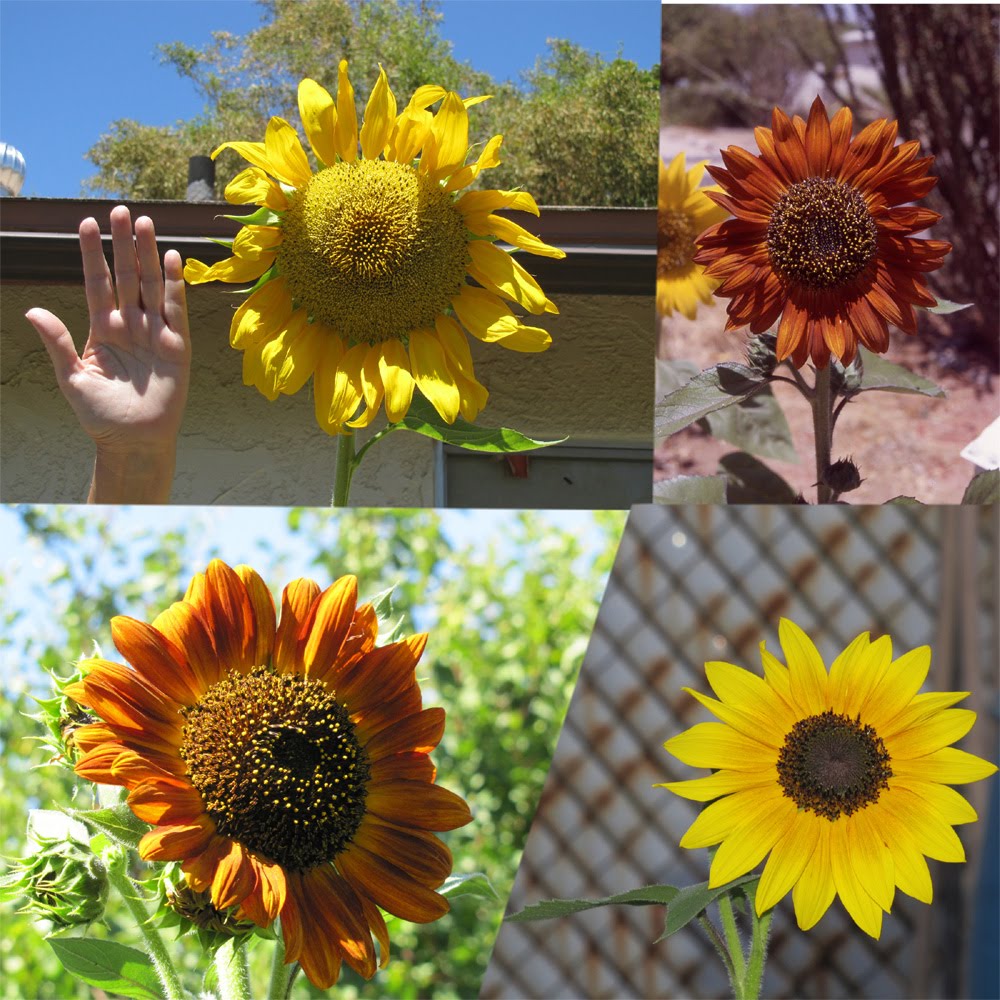
Sunflowers! Companions, Nutrition, Sustainable, Fun!

 Dear Folks,

I love sunflowers!

From the wild ones which crop up beside highways and country roads, and even our garden, to the colorful hybrids including the dainty lemon yellow, through the multicolor ranging through oranges and burgundy to the mammoth huge varieties, they all have delighted me for years.

Sunflowers have also been occasional companions for the traditional Native American's three-sisters companion planting, as a 'fourth-sister'.

I've written a long article with a chart on various combinations of the three sisters (also known as a Monsoon Garden) sustainable gardening/farming practice at my newsletter site.

Click here to go to the PDF file.   You can also go to the newsletter site by clicking here.  The three sisters article is under "files".

Here is a brief summary.  The original threes sisters are corn, beans, and squash.  In arid areas where both food and water were precious commodities, the practice of growing 3 complimentary plants (and nutrients) together maximized water use and made caring for the plants easier.   The fact that corn and beans together makes a complete protein and squash provided additional vitamins, minerals and fiber all worked to give the people a very healthy diet.  The soil also benefited because while corn is a heavy feeder, beans put nitrogen back into the soil and the squash covering the ground minimized evaporation and weeds.

Sunflowers as I now know are more edible than previously thought, are a fun option to plant along with sugar peas - one of my favorite 'never-makes-it-into-the-house' garden buffet snacks - and cucumbers.

Read the article for more information and tips.

I'm ready to start sauteeing the large sunflower discs/heads for a fun time in the kitchen!

If you can view video on your computer, you must check out this how to video on braising sunflower heads:

http://how2heroes.com/videos/appetizers/braised-sunflowers

A note for Mac enthusiasts and iPad owners!!!  My "Edible Landscaping in the Desert Southwest: Wheelbarrow to Plate" is now available through the iBookstore app.

Around The Garden.
I just harvested all of my garlic and it is drying now.  I will have some for sale at the farmers market tomorrow.  We cut one of the banana fruit clusters to hang and finish ripening.  I am giving sugarcane a try, and the first sections are starting to sprout.

Bananas, lemon grass, and sugarcane (and palm trees) all a kind grass -- really big grass, so they do need regular watering to maintain them.

DID YOU KNOW fact...the California Fan Palm tree (aka Arizona Fan Palm, Desert Fan Palm, Cotton Fan Palm), Washingtonia filifera is the only native palm tree in the desert USA?  The fruit can be eaten raw, cooked or ground into flour as the Native Americans did.  The tree can live 80 to 250 years!!!

Keep that in the back of your mind when someone tells you palm trees are not native to Arizona.

See more information on this Arizona Native at wikipedia - click here.

July Gardening 
Fall planting season begins July 15th for all seeds of fall edibles.  Get your garden plans together for this heavy sowing time from July 15 through August 15th.  Why???  If you consider that you want pumpkins for instance you need to count backwards from Halloween or Thanksgiving 90 to 120 days.

Have a great weekend, stay hydrated, and support your local businesses and farmers markets,

-- Catherine, The Herb Lady