Garden, Plant, Cook!

Showing posts with label hyssop of the bible. Show all posts

Friday, December 16, 2016

Days 15, 16, 17, 18, 19 and 20 of 25 Days of December Herbal Celebrations!

Dear Folks,

I apologize for not getting this segment of my 25 days of Herbal Celebrations up on time.  Distracted with under-the-weather-days for us, and I lost track of where I was with this series.

Celebrating the Multicultural festivities of December, I thought I would pick an herb or spice which is referenced in the Bible (land of three of the Major Religions of the world) and used in many cuisines around the entire world, as a way of gathering together all the wealth of diversity around us - in true celebration.

A note about the herbs and spices I selected. There is agreement on some of the herbs (garlic, onion and mint for example) and some continuing discussion on which plant the Bible referred to.  After many years there is a consensus - although still discussed by some - that the Hyssop of the Bible is Syrian Oregano (Origanum maru).  Since Hyssop (Hyssopus officionalis) is not indigenous to the lands of the BIble but Syrian Oregano is, I have included it as the Biblical plant.

References to Hanukkah are listed in some of the posts but may not fall within the celebration time because the dates vary each year.


Day 15
Herb: Mint, Mentha from the Lamiaceae (Mint)family which includes its relatives such as Basil and Lavender.  Mentioned in the bible Matthew 23:23, Luke11:42 "But woe to you Pharisees! For you pay tithe of mint and rue and every kind of garden herb, and yet disregard justice and the love of God; but these are the things you should have done without neglecting the others.”  Mint along with other herbs were so valued they were used as a form of currency.

"As for the garden of mint, the very smell of it alone recovers and refreshes our spirits" --Pliny the Elder

Meet The Neighbors – The Lamiaceae Family – The Mint Branch!
By Catherine, The Herb Lady - originally from my Newsletter  January 18, 2003
     Lamiaceae (formerly labiatae) is the well-known and well loved mint Family.  Botanically, the members of this family have a square stem, two-lipped flowers, and simple usually undivided leaves. Many are herbs such as lavender, basil, thyme, rosemary, and of course the mints--and it is the mints we will visit with today.
     As neighbors, mints are an old established family. Grandma planted them under an old leaky faucet, because they just love to playin the water!  One of the few herbs that likes its feet wet, mint needs damp (not wringing wet) soil and a bit of shade in the western summer afternoons.  Once established this family of herbs can easily take over the neighborhood. The incredible list of scents and flavors is due in part toits willingness to make new friends, i.e., plant two different side-by-side and you will eventually have a third kind--one reason for separating your beloved favorites to keep them really separated.  Cross-strains can produce wonderful results or something not quite so wonderful.


Read More Here

http://edibleherbsandflowers.blogspot.com/2015/12/25-days-of-herbs-and-celebrations_15.html

Day 16

Herb:  Hyssop – of the Bible is generally recognized as Syrian Oregano Origanum syriacum aka Origanum maru, is native to the lands of the bible.  Leviticus 14:52 "He shall thus cleanse the house with the blood of the bird and with the running water, along with the live bird and with the cedar wood and with the hyssop and with the scarlet string. 53 "However, he shall let the live bird go free outside the city into the open field. So he shall make atonement for the house, and it will be clean."

Syrian Oregano is a superior culinary herb and can be usedin place of Greek Oregano Origanum vulgare.  Where Greek Oregano has a distinctive “bite”the Syrian is slightly sweeter, still having all of the culinary and medicinal properties of oregano.

If you have enjoyed the authentic Middle Eastern spice blend Za’atar, then you have tasted Syrian Oregano, known as “Za’atar in that region. The blend is a combination of ground sesame seeds, sumac berries (a specific plant -- Rhus coriaria -- known asthe “lemonade tree” for the tangy flavor of the ripe berries – not to be confused with poison sumac) and Syrian Oregano, and is the “go-to” blend for seasoning many dishes.  Many Za’atar blends substitute some form of Thyme for the Syrian Oregano.


Read More Here 

 http://edibleherbsandflowers.blogspot.com/2015/12/25-days-of-herbs-and-celebrations_16.html


Day 17

Herb:  Garlic (Allium sativum) Numbers 11:5 “"We remember the fish which we used to eat free in Egypt,the cucumbers and the melons and the leeks and the onions and the garlic,”

Both regular garlic (Allium sativum) and elephant garlic (Allium empeloprasum) are members of the onion family.  Elephant garlic is not actually a "garlic" but rather a Leek on Steroids, and has a milder (some think too mild) garlic flavor. You can't see the leaves in the picture, but they are 'strappy' like leek and could be used to flavor foods.  In fact, even the stalk and leaves of either plant, which are generally disposed of after harvest, can be used to flavor soup, stews, and broths.

Other “named” garlics are Garlic Chives, aka Asian or Chinese Chives, Allium tuberosum, and Society Garlic, Tulbaghia violacea. Garlic Chives like onion chives are grown for their leaves and flowers to be used in cooking and has a milder garlic flavor.  Society Garlic is a totally different plant family and is grown for its beautiful orchid like flowers and leaves in cooking.  Society Garlic is said to have the Anti-Garlic affect on your breath.

Garlic is best known for its edible cloves contained in a ‘head’ which have from 6/8 and up to 14 cloves depending on the variety grown.


Read More Here

http://edibleherbsandflowers.blogspot.com/2015/12/25-days-of-herbs-and-celebrations_17.html

Day 18

Herb:  Leek, Allium porrum, Number 11:5  "We remember the fish which we used to eat free in Egypt,the cucumbers and the melons and the leeks and the onions and the garlic.”
The biblical reference aside, leeks have been recorded as early as 2000 BC.

The leek is one of the national emblems of Wales, worn along with the daffodil(in Welsh, the daffodil is known as "Peter's leek," Cenhinen Bedr) on St. David’s Day.The Welsh leek appeared on the coronation gown of Elizabeth II.  It was designed by Norman Hartnell; when Hartnell asked if he could exchange the leek for the more aesthetically pleasing Welsh daffodil, he was told no. -- wikipedia

Think of the leek as a scallion on steroids – bigger with strappy leaves.  The leek’s mild onion flavor lends itself well to many dishes where the onion flavor is desired but not as pronounced.

Easily grown from seed, it does take about 100 days from sowing to harvest time, so it is best to seed in every 2-3 weeks through end of February in the desert garden for a supply going into late spring.


My first sowing are usually right at peek (BIG – but can be harvested sooner) just in time for St. Patrick’s day feasting and making colcannon, a mixture of leeks, cabbage and potatoes that is just plain comfort food.

Read More Here

http://edibleherbsandflowers.blogspot.com/2015/12/25-days-of-herbs-and-celebrations_18.html

Day 19

Herb:  Sage - (Salvia sp.) Jeremiah 18:18 – “Then they said, "Come and let us devise plans against Jeremiah. Surely the law is not going to be lost to the priest, nor counsel to the sage, nor the divine word to the prophet! Come on and let us strike at him with our tongue, and let us give no heed to any of his words."

The word Sage has long been used to denote a wise person.

2016 has been designated by the United Nations as the International Year of the Pulses, to celebrate all the great benefits of eating legumes.  See the references for beans in recipesbelow.http://www.un.org/apps/news/story.asp?NewsID=52505#.VnA0ym7cYr0

The Bible describes the belief, even then, of the health value of eating pulses.

Daniel 1:12 --"Please test your servants for ten days, and let us be given some vegetables to eat and water to drink.  13 "Then let our appearance be observed in your presence and the appearance of the youths who are eating the king's choice food; and deal with your servants according to what you see."

During captivity, Daniel shows the benefits of eating only pulses (vegetables etc.) and water, so effective "And in all matters of wisdom and understanding, that the king enquired of them, he found them ten times better than all the magicians and astrologers that were in all his realm." -- https://en.wikipedia.org/wiki/Daniel_Fast

Sage, Salvia officinalis, is a member of the prodigious mint family (Lamiaceae formally Labiatae).


Read More Here

http://edibleherbsandflowers.blogspot.com/2015/12/25-days-of-herbs-and-celebrations_19.html


Day 20

Herb:  Nigella, Nigella sp.   Isaiah 28:26, different translations of the Bible refer to Cumin, BlackCumin, or Black Caraway, which of God’s instructions for sowing and reaping.  25. Does he not level its surface And sow dill and scatter cummin And plant wheat in rows, Barley in its place and rye within its area? 26  For his God instructs and teaches him properly. 27 For dill is not threshed with a threshings ledge, Nor is the cartwheel driven over cummin; But dill is beaten out with a rod, and cummin with a club.

Two plants share the name Black Cumin, Bunium bulbocastanum and Nigella sativa. For the purposes of this post we will discuss Nigella, aka Love-In-A-Mist.

Nigella --Love-In-A-Mist (also called Black Onion Seed) is an unusual and striking flower, also called Black Onion Seed, and Black Cumin and used in East Indian foods.  The seeds smell like strawberries and taste like pepper, a most interesting spice.

Read More Here


http://edibleherbsandflowers.blogspot.com/2015/12/25-days-of-herbs-and-celebrations_20.html


-- Catherine, The Herb Lady

If you enjoyed this post, subscribe below by entering your email, to get all my posts!


Enter your email address:


Delivered by FeedBurner

Disclaimer: Clicking on links on this blog may earn me a small commission if you purchase something. Your price does not change.

Wednesday, May 25, 2016

What To Make When You Have A LOT of Celery.

Dear Folks,

I grow celery - in the desert garden - and because I let it reseed each year I usually have a LOT of it this time of year.  Some of it is going into flower (and I will capture some seed later for my seed bank inventory), but right now I have a lot of fresh leaves.

What to do?  Most people do not think of celery as a vegetable, they think in terms of a bit of flavor for soups, stews, sandwich salads (Tuna, etc.).


Over a decade ago I developed a braised celery and cranberry dish for Thanksgiving and it was great.  I posted it here on the blog last fall.

However I have not done much with it since (outside of always adding to sandwich salads) except to dry to add to my pantry, and even make it a part of my homemade vegetable bouillon.

But now that I have no lettuce in the garden, and I have a LOT of celery I mulled what I could do with it.

I thought about using it "in place" of lettuce, so our lunch yesterday was a Bacon, Celery, Basil, Tomato sandwich with our apples on the side, on raisin toast :-)

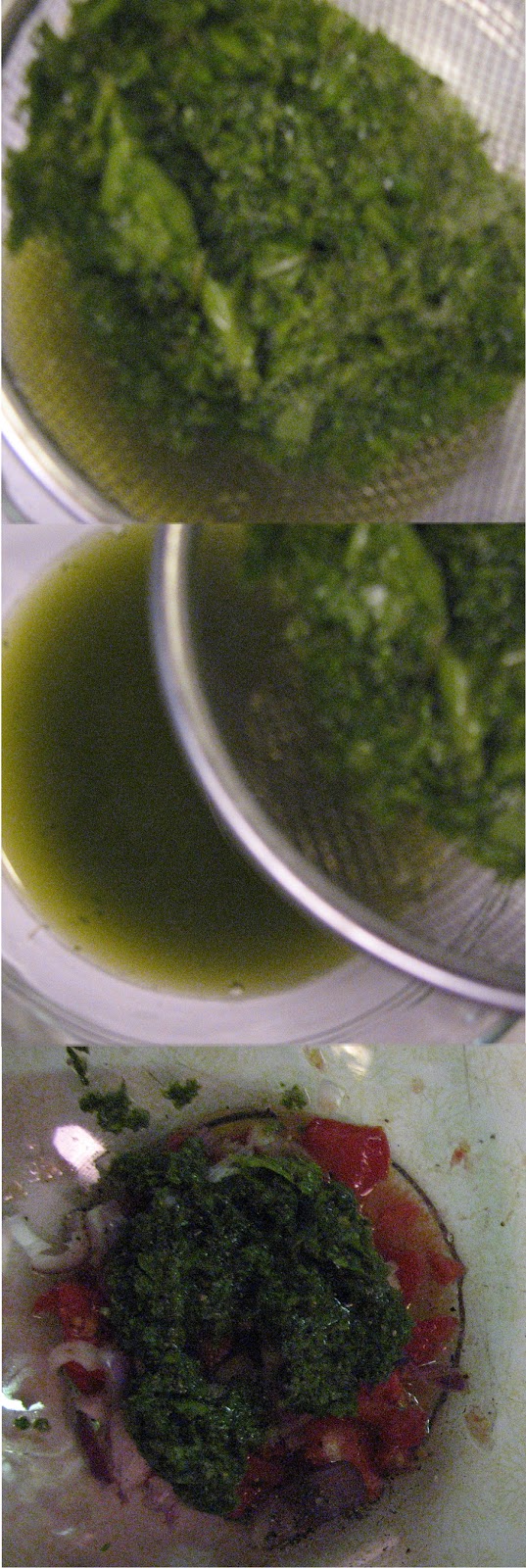
I got to thinking about a celery leaf "pesto" and the Sweet Potato Linguine I have and dinner was now planned.  (The pasta is from locally producer DeCio Pasta in Tempe, and I purchased at the Mesa Community Farmers Market.  Great products with excellent ingredients.) Also pictured in the last farme, I sauteed up some sliced beets and beet tops (from the garden) for Deane as a side dish for him (he loves them, I'm slightly allergic to them).

Celery Pesto Pasta Primavera

This kind of dish is not about exact ingredient ratios, increase or reduce as you like.  I decided on a "raw" sauce created by chopping fresh tomatoes and onion and placing in a bowl, adding the "pesto" a dribble of olive oil, and salt and pepper.  Then when the pasta is done, drain quickly and add to bowl, let sit for a minute or two to heat the veggies and then toss.

Handful of celery leaves (substitute parsley or more basil if you do not have celery)
4 small sprigs of basil
2 small sweet peppers, cored and slivered
1-2 small tomatoes or 1 medium size, chopped
Scallion, 2 inch piece, minced
Parmesan Cheese, grated
Chopped walnuts
Linguine or Spaghetti (1-2 servings)
Salt & Pepper to taste

In a bowl, place chopped tomatoes and onion.

Rinse celery and basil, place in a blender or bullet grinder with a bit of water and buzz until ground up.  Drain, catching the water*.  Add to bowl, drizzle with a tablespoon or so of olive oil, add cracked black pepper and salt to taste.

Boil pasta according to directions.  In the last minute add the slivered peppers, stir to mix with pasta.  When done, drain, but leave slightly damp and immediately add to bowl.  Let sit for 1-2 minutes to allow the veggies to heat up.  Toss, plate up and top with Cheese and Walnuts.

Turned out great.  The sweet peppers added a note of sweetness to all the savory elements.

*This "herb" water contains a lot of flavor from the herbs/greens used, so I add it to my stock container in the freezer for the next stock making time.

So, what else can you use fresh celery leaves for?  Some nice ideas found on the internet:

Make a celery simple syrup -- ratio is 1/2 to 1 cup of rinsed celery leaves, 1 cup each sugar and water.  Bring water and sugar to a boil, stir until well dissolved, add celery and let steep until cool or overnight (to taste). Drain, discard the leaves and store the syrup in the frig for up to 1 week.
-----Use to make celery soda -- 1/4 cup of celery syrup, add 3/4 cup of cold seltzer or sparkling water, stir and enjoy.
-----Use as the simple syrup in any cocktail.  Combine with fresh mint for a different Mojito 

Use in place of parsley or lettuce in a recipe.

Substitute for Loveage (a celery flavored herb) in recipes. (Loveage is a far stronger flavored celery taste so adjust recipe when using celery.)

What new or old fashioned way have you used celery leaf?

. . .

Next Events Coming Up:

I am speaking at the monthly meeting at the Arizona Herb Association on June 2nd.  Topic is Stevia and Syrian Oregano.  Their business meeting starts at 7 p.m. and my talk will be approximately 8 p.m.  Great organization to join.

June 24, 2016, Friday, 9 a.m. - Noon
FREE Seed Share / Swap
Mesa Farmers Market

June 25, 2016, Saturday, 6 p.m.
Sow! 105? Yes!
Lecture at Mesa Urban Garden (MUG) on sowing in the summer
Free (consider donating to the garden or renting a bed)

. . .

Check out my books and calendar on Amazon.

Follow me on Facebook


-- Catherine, The Herb Lady

If you enjoyed this post, subscribe in the upper side bar link, to get all my posts!

Disclaimer: Clicking on links on this blog may earn me a small commission if you purchase something. Your price does not change.

Saturday, April 23, 2016

Oreganos To Know, Grow and Love.

Dear Folks,

I grow 3 types of Oregano and thoroughly enjoy them all.

Actually I grow a fourth Oregano for its beautiful flowers but not its flavor. Hopley's Purple Oregano   I don't have a picture right now - the ground around and under the plant is a purple confetti vision in the late spring.

The Origanum Family includes two of the three and also includes Marjoram (Origanum marjorana) which has a very different flavor from the Oreganos discussed today.

First up is Greek Oregano Origanum vulgaris hirtum.  The herb most associated with Italian and Greek cooking.  There is an Oregano called Italian Oregano but it is not THE herb most people think of.  Greek Oregano has a peppery bite strong enough to bite back a bit if you bite into the fresh leaf.

So associated with Italian foods like pizza and sauces to substitute a very, very mild tasting Oregano would simply not work flavor wise.

Most chefs call for using Greek Oregano dried, but it is a choice.  In the picture this patch of Greek Oregano also contains some of my Jerusalem Artichoke plants and some Nasturtium flowers.

Next is Syrian Oregano Origanum Maru.  Syrian Oregano is the Hyssop of the Bible and is also called Za'atar in the Middle East where it is the anchor herb for the spice mix by the same name.  When Syrian Oregano is not available English Thyme is often substituted, which is acceptable, but does not have nearly the complexity of the savory and almost sweet tasting herb.  One could call Za'atar the salt and pepper of the region.  It is used in many, many dishes.

The spice is a mixture of Syrian Oregano, Sumac Berries (lemony taste) and sesame seed.  It is a lovely spice mix.

Syrian Oregano has a slight gray coloring to the leaves.  In my bee post yesterday, I showed a bee on Syrian Oregano flowers.


The final Oregano is Mexican Oregano Lippia graveolens, a relative of Lemon Verbena.

This oregano has a wonderful flavor and fragrance.  I like to use this in vinaigrette dressings.

While each of the Oreganos has its own flavor and goes well with certain foods, I would encourage you to experiment with each of them.

Think of them as you would wine or beer varieties, experimenting with them singly and as a part of your own blend of go-to-mixes for what you love to make most.

For any herb place a pinch in your hand, rub it and smell.  If you are looking to try making a blend, add another herb, rub, smell, repeat.  Your nose - knows as your taste buds are unique to your sense of smell.

For an idea of making your own blends, how about making your own bouillon.  I knew I would get a good flavor and scent when I went about drying my own bouillon mix, but I was blow-away by just how wonderful it turned out.  Check out my post on sun drying your own mix of what grows in your garden.

Enjoy!   

Growing Oreganos

All three of these wonderful herbs grow very well here in the valley.  They like full sun but can tolerate some shade.

They are all hardy perennials, however in sustained killing frosts the Mexican Oregano can suffer damage.  In a super hard freeze about 8 years ago my 7 foot Mexican Oregano (with a trunk diameter of about 7 inches) died back, struggled to come back and finally did not make it.

Greek Oregano is a trailing ground cover with upright new growth.

Syrian Oregano is a low mounding bushy type of growth.

Mexican Oregano is a shrub.  My current plant is about 4+ feet tall depending on where you measure it.  It is kind of the "wild hair" variety of growth and takes pruning well.

All flower in the spring. All dry very well for storage.

The Greek and Syrian Oregano can be grown from seed (I got my Syrian seed from Bake Creek).  If you do want to transplant now or going into the heat, harden off the plants first by introducing them into the sun over the course of several days (1 hour first day, 2 hours second day, repeat until 4 hours in sun), then transplant, water in well and water every 2 days then back off watering to every 3 to help the roots grow down.  Gradually increase the amount of water with less frequency.  My established gardens are watered every 5 days this time of year and will go down to every 4 days as the heat goes higher.

I hope you decide to add one or more of these great herbs to your garden.  For best success, plant in the fall.  

. . .
 
You can find me on Facebook: 

My books and month-by-month planting calendar are available at my publisher's site page.or available through links on the sidebar here on the blog.


Have a great time in your garden!

-- Catherine, The Herb Lady

If you enjoyed this post, subscribe in the upper side bar link, to get all my posts!

Disclaimer: Clicking on links on this blog may earn me a small commission if you purchase something. Your price does not change.

Wednesday, December 16, 2015

25 Days of Herbs and Celebrations - December 16

Dear Folks,


Celebrating the Multicultural festivities of December, I thought I would pick an herb or spice which is referenced in the Bible (land of three of the Major Religions of the world) and used in many cuisines around the entire world, as a way of gathering together all the wealth of diversity around us - in true celebration.
My Syrian Oregano in July - with Bee!


Day 16
Herb:  Hyssop – of the Bible is generally recognized as Syrian Oregano Origanum syriacumaka Origanum maru, is native to the lands of the bible.  Leviticus 14:52 "He shall thus cleanse the house with the blood of the bird and with the running water, along with the live bird and with the cedar wood and with the hyssop and with the scarlet string. 53 "However, he shall let the live bird go free outside the city into the open field. So he shall make atonement for the house, and it will be clean."

Syrian Oregano is a superior culinary herb and can be used in place of Greek Oregano Origanum vulgare.  Where Greek Oregano has a distinctive “bite” the Syrian is slightly sweeter, still having all of the culinary and medicinal properties of oregano.

If you have enjoyed the authentic Middle Eastern spice blend Za’atar, then you have tasted Syrian Oregano, known as “Za’atar in that region.  The blend is a combination of ground sesame seeds, sumac berries (a specific plant -- Rhus coriaria -- known as the “lemonade tree” for the tangy flavor of the ripe berries – not to be confused with poison sumac) and Syrian Oregano, and is the “go-to” blend for seasoning many dishes.  Many Za’atar blends substitute some form of Thyme for the Syrian Oregano.

Planting:
Baker Creek sells the seeds and they germinate easily in our desert gardens. The herb can get really happy in the garden if planted in full sun, well draining soil, giving you years of harvest potential.  http://www.rareseeds.com/oregano-wild-zaatar/

Craft Project:
Yule Log!  The Yule Log is an old tradition used by both pagans and Christians for different celebrations.  It is a fun project for the family to create for use in your fireplace (do check on burn restrictions because of air quality), firepit or chiminea.

Gather ingredients for a Yule Log.  The Log can be lite on December 20th/ 21st (celebrating the Solstice) or December 24th (Celebrating Christmas Eve) or both.  It can be used as a centerpiece and/OR you can burn it - to burn it the herbs etc. must be perfectly dry or it will smoke.

My 'yule log' "recipe" - this is a fun project using all edible herbs and spices for decoration and aroma. You can make the log exactly as described or use your own special herbs, edible plants, fruits and flowers - just be sure if you are going to actually burn it (it makes a lovely centerpiece) that all components are perfectly dry before lighting or it will smoke.  Pictured are the ingredients I chose from my garden, some wrapping paper, paper ribbon, some of the last of my Roselles, lavender, myrtle, rosemary, orand and grapefruit peeo, and bay leaf, I also gathered some cloves to tuck in here and there and elmer's glue.  I am so not creative, but I think this turned out nice.  It will dry nicely and be ready to light in a week or so.

YULE LOG
--1 piece of log wood with bark, cut to fit your fireplace, chiminea or fire pit (the knurlier the better) - use hardwood for fireplace or concrete/metal fire pit; use softwood for chiminea (this is important hardwood will get so hot it can crack your terra cotta chiminea).
--Peel of 2 oranges, cut in strips, small pieces or spirals
--Elmer's (or other white) glue (not cement, hot glue or like – will create toxic fumes)
--Sprigs of rosemary, lavender, oregano, thyme, sage or any aromatic herb
--Any combination of whole spices:  allspice, star anise, cloves, cinnamon sticks
--1 Bow (or you can arrange orange peel in the form of a bow before drying) you can use strips of Christmas paper to make a bow or bows.  The paper ribbon which can be twisted using a sharp blade are pretty also.

     Glue herb sprigs decoratively all over top and sides of log.  Arrange and glue orange peel in amongst the herbs.  Fill in with whole spices.  Add bow.

       If the bow is not made of paper or orange peel, remove before lighting.

       Legend says the longer the log burns the longer your good luck for the new year. 
      For Christians, traditionally lite on Christmas Eve, this is so fragrant and pretty you may wish to make several and use during our winter months for special celebrations.

Music:

White Christmas
Bing Crosby

Oh Christmas Tree (from the Perspective of the Cat)


. . .

Garden more successfully in the Desert with my month-by-month planting calendar.


-- Catherine, The Herb Lady
If you enjoyed this post, subscribe in the upper side bar link, to get all my posts!

Disclaimer: Clicking on links on this blog may earn me a small commission if you purchase something. Your price does not change.