Dear Folks,
I apologize for not getting this segment of my 25 days of Herbal Celebrations up on time. Distracted with under-the-weather-days for us, and I lost track of where I was with this series.
Celebrating
the Multicultural festivities of December, I thought I would pick an
herb or spice which is referenced in the Bible (land of three of the
Major Religions of the world) and used in many cuisines around the
entire world, as a way of gathering together all the wealth of diversity
around us - in true celebration.
A note about the herbs and spices I selected. There is agreement on some
of the herbs (garlic, onion and mint for example) and some continuing
discussion on which plant the Bible referred to. After many years there
is a consensus - although still discussed by some - that the Hyssop of
the Bible is Syrian Oregano (Origanum maru). Since Hyssop (Hyssopus
officionalis) is not indigenous to the lands of the BIble but Syrian
Oregano is, I have included it as the Biblical plant.
References to Hanukkah are listed in some of the posts but may not fall
within the celebration time because the dates vary each year.
Day 15
Herb: Mint, Mentha from the Lamiaceae (Mint)family which includes its relatives such as Basil and Lavender. Mentioned in the bible Matthew 23:23, Luke11:42 "But woe to you Pharisees! For you pay tithe of mint and rue and every kind of garden herb, and yet disregard justice and the love of God; but these are the things you should have done without neglecting the others.” Mint along with other herbs were so valued they were used as a form of currency.
"As for the garden of mint, the very smell of it alone recovers and refreshes our spirits" --Pliny the Elder
Meet The Neighbors – The Lamiaceae Family – The Mint Branch!
By Catherine, The Herb Lady - originally from my Newsletter January 18, 2003
Lamiaceae (formerly labiatae) is the well-known and well loved mint Family. Botanically, the members of this family have a square stem, two-lipped flowers, and simple usually undivided leaves. Many are herbs such as lavender, basil, thyme, rosemary, and of course the mints--and it is the mints we will visit with today.
As neighbors, mints are an old established family. Grandma planted them under an old leaky faucet, because they just love to playin the water! One of the few herbs that likes its feet wet, mint needs damp (not wringing wet) soil and a bit of shade in the western summer afternoons. Once established this family of herbs can easily take over the neighborhood. The incredible list of scents and flavors is due in part toits willingness to make new friends, i.e., plant two different side-by-side and you will eventually have a third kind--one reason for separating your beloved favorites to keep them really separated. Cross-strains can produce wonderful results or something not quite so wonderful.
Read More Here
http://edibleherbsandflowers.blogspot.com/2015/12/25-days-of-herbs-and-celebrations_15.html
Day 16
Herb: Hyssop – of the Bible is generally recognized as Syrian Oregano Origanum syriacum aka Origanum maru, is native to the lands of the bible. Leviticus 14:52 "He shall thus cleanse the house with the blood of the bird and with the running water, along with the live bird and with the cedar wood and with the hyssop and with the scarlet string. 53 "However, he shall let the live bird go free outside the city into the open field. So he shall make atonement for the house, and it will be clean."
Syrian Oregano is a superior culinary herb and can be usedin place of Greek Oregano Origanum vulgare. Where Greek Oregano has a distinctive “bite”the Syrian is slightly sweeter, still having all of the culinary and medicinal properties of oregano.
If you have enjoyed the authentic Middle Eastern spice blend Za’atar, then you have tasted Syrian Oregano, known as “Za’atar in that region. The blend is a combination of ground sesame seeds, sumac berries (a specific plant -- Rhus coriaria -- known asthe “lemonade tree” for the tangy flavor of the ripe berries – not to be confused with poison sumac) and Syrian Oregano, and is the “go-to” blend for seasoning many dishes. Many Za’atar blends substitute some form of Thyme for the Syrian Oregano.
Read More Here
http://edibleherbsandflowers.blogspot.com/2015/12/25-days-of-herbs-and-celebrations_16.html
Day 17
Herb: Garlic (Allium sativum) Numbers 11:5 “"We remember the fish which we used to eat free in Egypt,the cucumbers and the melons and the leeks and the onions and the garlic,”
Both regular garlic (Allium sativum) and elephant garlic (Allium empeloprasum) are members of the onion family. Elephant garlic is not actually a "garlic" but rather a Leek on Steroids, and has a milder (some think too mild) garlic flavor. You can't see the leaves in the picture, but they are 'strappy' like leek and could be used to flavor foods. In fact, even the stalk and leaves of either plant, which are generally disposed of after harvest, can be used to flavor soup, stews, and broths.
Other “named” garlics are Garlic Chives, aka Asian or Chinese Chives, Allium tuberosum, and Society Garlic, Tulbaghia violacea. Garlic Chives like onion chives are grown for their leaves and flowers to be used in cooking and has a milder garlic flavor. Society Garlic is a totally different plant family and is grown for its beautiful orchid like flowers and leaves in cooking. Society Garlic is said to have the Anti-Garlic affect on your breath.
Garlic is best known for its edible cloves contained in a ‘head’ which have from 6/8 and up to 14 cloves depending on the variety grown.
Read More Here
http://edibleherbsandflowers.blogspot.com/2015/12/25-days-of-herbs-and-celebrations_17.html
Day 18
Herb: Leek, Allium porrum, Number 11:5 "We remember the fish which we used to eat free in Egypt,the cucumbers and the melons and the leeks and the onions and the garlic.”
The biblical reference aside, leeks have been recorded as early as 2000 BC.
The leek is one of the national emblems of Wales, worn along with the daffodil(in Welsh, the daffodil is known as "Peter's leek," Cenhinen Bedr) on St. David’s Day.The Welsh leek appeared on the coronation gown of Elizabeth II. It was designed by Norman Hartnell; when Hartnell asked if he could exchange the leek for the more aesthetically pleasing Welsh daffodil, he was told no. -- wikipedia
Think of the leek as a scallion on steroids – bigger with strappy leaves. The leek’s mild onion flavor lends itself well to many dishes where the onion flavor is desired but not as pronounced.
Easily grown from seed, it does take about 100 days from sowing to harvest time, so it is best to seed in every 2-3 weeks through end of February in the desert garden for a supply going into late spring.
My first sowing are usually right at peek (BIG – but can be harvested sooner) just in time for St. Patrick’s day feasting and making colcannon, a mixture of leeks, cabbage and potatoes that is just plain comfort food.
Read More Here
http://edibleherbsandflowers.blogspot.com/2015/12/25-days-of-herbs-and-celebrations_18.html
Day 19
Herb: Sage - (Salvia sp.) Jeremiah 18:18 – “Then they said, "Come and let us devise plans against Jeremiah. Surely the law is not going to be lost to the priest, nor counsel to the sage, nor the divine word to the prophet! Come on and let us strike at him with our tongue, and let us give no heed to any of his words."
The word Sage has long been used to denote a wise person.
2016 has been designated by the United Nations as the International Year of the Pulses, to celebrate all the great benefits of eating legumes. See the references for beans in recipesbelow.http://www.un.org/apps/news/story.asp?NewsID=52505#.VnA0ym7cYr0
The Bible describes the belief, even then, of the health value of eating pulses.
Daniel 1:12 --"Please test your servants for ten days, and let us be given some vegetables to eat and water to drink. 13 "Then let our appearance be observed in your presence and the appearance of the youths who are eating the king's choice food; and deal with your servants according to what you see."
During captivity, Daniel shows the benefits of eating only pulses (vegetables etc.) and water, so effective "And in all matters of wisdom and understanding, that the king enquired of them, he found them ten times better than all the magicians and astrologers that were in all his realm." -- https://en.wikipedia.org/wiki/Daniel_Fast
Sage, Salvia officinalis, is a member of the prodigious mint family (Lamiaceae formally Labiatae).
Read More Here
http://edibleherbsandflowers.blogspot.com/2015/12/25-days-of-herbs-and-celebrations_19.html
Day 20
Herb: Nigella, Nigella sp. Isaiah 28:26, different translations of the Bible refer to Cumin, BlackCumin, or Black Caraway, which of God’s instructions for sowing and reaping. 25. Does he not level its surface And sow dill and scatter cummin And plant wheat in rows, Barley in its place and rye within its area? 26 For his God instructs and teaches him properly. 27 For dill is not threshed with a threshings ledge, Nor is the cartwheel driven over cummin; But dill is beaten out with a rod, and cummin with a club.
Two plants share the name Black Cumin, Bunium bulbocastanum and Nigella sativa. For the purposes of this post we will discuss Nigella, aka Love-In-A-Mist.
Nigella --Love-In-A-Mist (also called Black Onion Seed) is an unusual and striking flower, also called Black Onion Seed, and Black Cumin and used in East Indian foods. The seeds smell like strawberries and taste like pepper, a most interesting spice.
Read More Here
http://edibleherbsandflowers.blogspot.com/2015/12/25-days-of-herbs-and-celebrations_20.html
-- Catherine, The Herb Lady
If you enjoyed this post, subscribe below by entering your email, to get all my posts!
Disclaimer: Clicking on links on this blog may earn me a small commission if you purchase something. Your price does not change.
Showing posts with label Garlic. Show all posts
Friday, December 16, 2016
Sunday, October 30, 2016
Witching Hour Approaches to Ensure Garlic Harvest in the Spring - October 31st
Dear Folks,
To ensure a nice healthy crop of fat, plump heads of garlic to harvest in the Spring (late April into May) here in the desert you need to have your garlic cloves planted by October 31st.
This gives the garlic all of the winter cold soil and air temps to develop a full head of garlic. Without the cold, you will get a fat 'scallion' but no heads of cloves.
[I planted my garlic on October 1st and most of the leaves if I held them up straight would be 14-15 inches tall already.]
Plant extra if you would LIKE green garlic through the winter, harvest every other one to give room to the remaining growing plants. You can choose to harvest when they are this tall and/or when the base (clove) swells slightly and feels and looks like a scallion base.
Have a great time in your fall garden!
-- Catherine, The Herb Lady
If you enjoyed this post, subscribe in the upper side bar link, to get all my posts!
Disclaimer: Clicking on links on this blog may earn me a small commission if you purchase something. Your price does not change.
To ensure a nice healthy crop of fat, plump heads of garlic to harvest in the Spring (late April into May) here in the desert you need to have your garlic cloves planted by October 31st.
This gives the garlic all of the winter cold soil and air temps to develop a full head of garlic. Without the cold, you will get a fat 'scallion' but no heads of cloves.
[I planted my garlic on October 1st and most of the leaves if I held them up straight would be 14-15 inches tall already.]
Plant extra if you would LIKE green garlic through the winter, harvest every other one to give room to the remaining growing plants. You can choose to harvest when they are this tall and/or when the base (clove) swells slightly and feels and looks like a scallion base.
Have a great time in your fall garden!
-- Catherine, The Herb Lady
If you enjoyed this post, subscribe in the upper side bar link, to get all my posts!
Disclaimer: Clicking on links on this blog may earn me a small commission if you purchase something. Your price does not change.
Tuesday, September 27, 2016
Around The Garden Garlic and Peppers, More Pictures and Reminder About Free Seed Share and Lecture.
Dear Folks,
When is garlic not "the" garlic?
When it is Society Garlic or Elephant Garlic (but that is for another post).
The gorgeous orchid-like, lavender flowers of the Society Garlic (Tulbaghia violacea), comes in a plain or striped leaf (I have the striped) variations. This is a perennial member of the larger Amaryllidaceae family. The "family" includes onions, garlic, leeks and Amaryllis.
Society Garlic is a strong garlic flavored plant. The leaves and flowers are used not the roots. It grows in clumps and should be separated every few years. It will thrive in dappled shade, but can tolerate more sun.
The name comes from a feature people have reported -- no garlic breadth! This lovely plant is worth adding to your garden, even if you prefer true garlic.
This spring I got two new-to-me sweet pepper plants from Suzanne Vilardi (of Vilardi Gardens) a very unusual and rare with a very long name Paradicsom Alaku Sarga Szentes Pepper from Hungary. ("Paradicsom" short name.)
I gave the plants a challenge by planting in one of my large pots with a southern exposure. They settled down but it took all summer (I planted late) and now are pushing out a lot of fruit. A "pumpkin" or "scalloped" shape they are meaty and sweet. I am trying to decide if I will try stuffing them with something or just use in salads and pastas when they are fully ripe. Most of these are about an inch and half or slightly bigger. Reportedly they can get up to 3 inches across.
I am trying to establish a larger amount of sweet peppers in various areas of my gardens to give me a more consistent harvest.
Sun/Shade Tips. While the peppers need the sun and warmth it is clear to me from my plants responses, that they appreciate some afternoon shade. While they grew well in the middle of the summer, fruit not shielded from the sun by the leaves got sunburn. This is particularly true for the fatter bells and this Paradicsom because they tend to fruit high on the stems, while my Lipstick/Gypsy peppers are more pendulous and hang below the leaf canopy.
I have prepared the bed where I will plant out my garlic on October 1st. If you want head garlic in the spring, you need to plant no later than October 31st to ensure all the winter chill/cold necessary to force the garlic to produce clove heads.
It looks like a muddy bog right now and that was intentional. I dug, sifted a bunch of gravel out of it, it was flooded and leveled. This particularly area gets flooded for watering, so it is necessary to have it level.
I will plant very close together to have "green garlic" to pull through the winter for cooking. Green Garlic aka Garlic Scallions is used just like a green onion/scallion - only garlic flavored. Pulling every other plant during the winter gives me this great green garlic and slowly expands the area for the remaining plants to grow fat clove/filled heads.
Reminder:
Free Seed Share at the Mesa Farmers Market this week.
Free Lecture at the Mesa Urban Garden, MUG, Mesa's public community garden.
-- Catherine, The Herb Lady
If you enjoyed this post, subscribe in the upper side bar link, to get all my posts!
Disclaimer: Clicking on links on this blog may earn me a small commission if you purchase something. Your price does not change.
When is garlic not "the" garlic?
When it is Society Garlic or Elephant Garlic (but that is for another post).
The gorgeous orchid-like, lavender flowers of the Society Garlic (Tulbaghia violacea), comes in a plain or striped leaf (I have the striped) variations. This is a perennial member of the larger Amaryllidaceae family. The "family" includes onions, garlic, leeks and Amaryllis.
Society Garlic is a strong garlic flavored plant. The leaves and flowers are used not the roots. It grows in clumps and should be separated every few years. It will thrive in dappled shade, but can tolerate more sun.
The name comes from a feature people have reported -- no garlic breadth! This lovely plant is worth adding to your garden, even if you prefer true garlic.
This spring I got two new-to-me sweet pepper plants from Suzanne Vilardi (of Vilardi Gardens) a very unusual and rare with a very long name Paradicsom Alaku Sarga Szentes Pepper from Hungary. ("Paradicsom" short name.)
I gave the plants a challenge by planting in one of my large pots with a southern exposure. They settled down but it took all summer (I planted late) and now are pushing out a lot of fruit. A "pumpkin" or "scalloped" shape they are meaty and sweet. I am trying to decide if I will try stuffing them with something or just use in salads and pastas when they are fully ripe. Most of these are about an inch and half or slightly bigger. Reportedly they can get up to 3 inches across.
I am trying to establish a larger amount of sweet peppers in various areas of my gardens to give me a more consistent harvest.
Sun/Shade Tips. While the peppers need the sun and warmth it is clear to me from my plants responses, that they appreciate some afternoon shade. While they grew well in the middle of the summer, fruit not shielded from the sun by the leaves got sunburn. This is particularly true for the fatter bells and this Paradicsom because they tend to fruit high on the stems, while my Lipstick/Gypsy peppers are more pendulous and hang below the leaf canopy.
I have prepared the bed where I will plant out my garlic on October 1st. If you want head garlic in the spring, you need to plant no later than October 31st to ensure all the winter chill/cold necessary to force the garlic to produce clove heads.
It looks like a muddy bog right now and that was intentional. I dug, sifted a bunch of gravel out of it, it was flooded and leveled. This particularly area gets flooded for watering, so it is necessary to have it level.
I will plant very close together to have "green garlic" to pull through the winter for cooking. Green Garlic aka Garlic Scallions is used just like a green onion/scallion - only garlic flavored. Pulling every other plant during the winter gives me this great green garlic and slowly expands the area for the remaining plants to grow fat clove/filled heads.
Reminder:
Free Seed Share at the Mesa Farmers Market this week.
Free Lecture at the Mesa Urban Garden, MUG, Mesa's public community garden.
-- Catherine, The Herb Lady
If you enjoyed this post, subscribe in the upper side bar link, to get all my posts!
Disclaimer: Clicking on links on this blog may earn me a small commission if you purchase something. Your price does not change.
Wednesday, August 10, 2016
Baby Watermelon Fell Off Plant - What To Do? & Sun Drying Garlic
Dear Folks,
I'm back from vacation and cruising through the garden to see what happened while I was gone. While nudging the huge watermelon vine of an heirloom variety I'm trying I seed tiny baby watermelon. Nudge the vine a little more (it is trying to get on to the lawn) and off drops a baby melon that was going good. DARN!
Initially I was just going to compost it and dropped it temporarily back onto the ground. Then I thought, it looks like a zucchini - should I try and cook it up?
I did some research on the internet and found references to cooking it, many with notes that the immature fruit can be bitter. Well, okay, taste it. It tasted like zucchini. Bingo!
Granted it is kind of small, but Deane loves all squash sauteed so, I added a bit of red bell pepper for color and volume and it turned out great.
Moral - any member of the cucumber, melon, or squash family baby (immature) fruit can be eaten. :-)
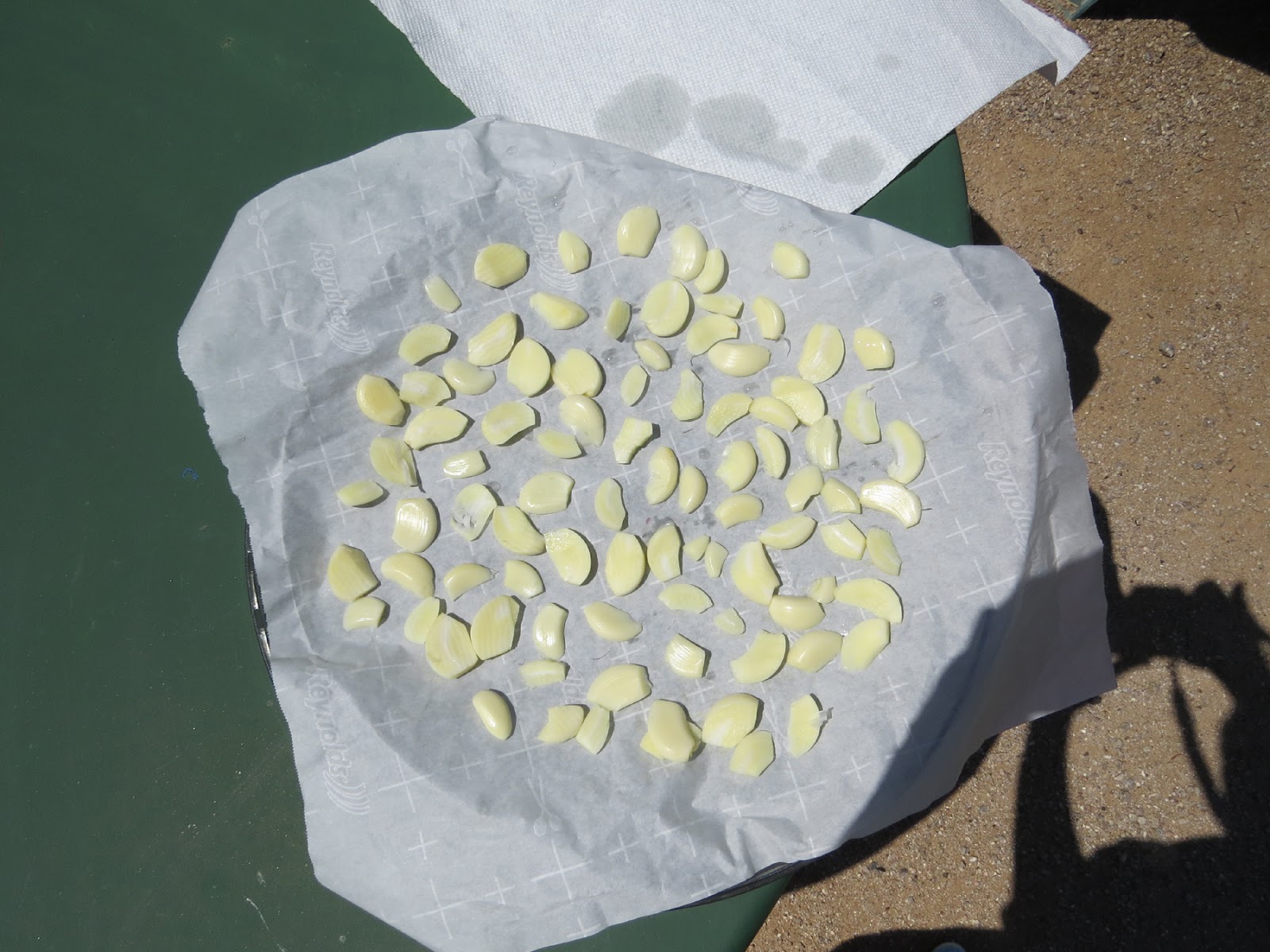
I decided it was time to dry some of my garlic (harvested a month or so ago).
When I have sun dried my garlic before I used the garlic press to squeeze the small bits out. That worked 'okay' and it is great to use but the bits kind of clumped together so it is hard to measure for use.
This time I decided to peel, trim and slice the cloves. What you see is 3 heads, drying. Now when they are completely dried I can use slices in cooking or grind a couple in my spice grinder for powder or granules, giving me options on how to use this wonderful herb.
Lecture
I am working with the Mesa Urban Garden to set up my next lecture there on Fall Planting. Watch for the time and date.
On my website you can find links (Amazon etc.) to purchase my books etc. If you enjoy my recipes you may like my cookbooks. If you choose my publisher's source they frequently have discounts, so check for them. The codes are case sensitive.
Farmers Market -- I will be back at the Mesa Farmers Market this Friday. I plan on bringing Limequats, Purslane (verdolagas) and I will see what amount of sweet potato leaves I can bring also, along with fresh cut Basil.
Have a great day,
-- Catherine, The Herb Lady
Website
If you enjoyed this post, subscribe in the upper side bar link, to get all my posts!
Disclaimer: Clicking on links on this blog may earn me a small commission if you purchase something. Your price does not change.
I'm back from vacation and cruising through the garden to see what happened while I was gone. While nudging the huge watermelon vine of an heirloom variety I'm trying I seed tiny baby watermelon. Nudge the vine a little more (it is trying to get on to the lawn) and off drops a baby melon that was going good. DARN!
Initially I was just going to compost it and dropped it temporarily back onto the ground. Then I thought, it looks like a zucchini - should I try and cook it up?I did some research on the internet and found references to cooking it, many with notes that the immature fruit can be bitter. Well, okay, taste it. It tasted like zucchini. Bingo!
Granted it is kind of small, but Deane loves all squash sauteed so, I added a bit of red bell pepper for color and volume and it turned out great.
Moral - any member of the cucumber, melon, or squash family baby (immature) fruit can be eaten. :-)
I decided it was time to dry some of my garlic (harvested a month or so ago).
When I have sun dried my garlic before I used the garlic press to squeeze the small bits out. That worked 'okay' and it is great to use but the bits kind of clumped together so it is hard to measure for use.
This time I decided to peel, trim and slice the cloves. What you see is 3 heads, drying. Now when they are completely dried I can use slices in cooking or grind a couple in my spice grinder for powder or granules, giving me options on how to use this wonderful herb.
Lecture
I am working with the Mesa Urban Garden to set up my next lecture there on Fall Planting. Watch for the time and date.
On my website you can find links (Amazon etc.) to purchase my books etc. If you enjoy my recipes you may like my cookbooks. If you choose my publisher's source they frequently have discounts, so check for them. The codes are case sensitive.
Farmers Market -- I will be back at the Mesa Farmers Market this Friday. I plan on bringing Limequats, Purslane (verdolagas) and I will see what amount of sweet potato leaves I can bring also, along with fresh cut Basil.
Have a great day,
-- Catherine, The Herb Lady
Website
If you enjoyed this post, subscribe in the upper side bar link, to get all my posts!
Disclaimer: Clicking on links on this blog may earn me a small commission if you purchase something. Your price does not change.
Thursday, December 17, 2015
25 Days of Herbs and Celebrations - December 17
Dear Folks,
Celebrating the Multicultural festivities of December, I thought I would pick an herb or spice which is referenced in the Bible (land of three of the Major Religions of the world) and used in many cuisines around the entire world, as a way of gathering together all the wealth of diversity around us - in true celebration.
-- Catherine, The Herb Lady
If you enjoyed this post, subscribe in the upper side bar link, to get all my posts!
Disclaimer: Clicking on links on this blog may earn me a small commission if you purchase something. Your price does not change.
Celebrating the Multicultural festivities of December, I thought I would pick an herb or spice which is referenced in the Bible (land of three of the Major Religions of the world) and used in many cuisines around the entire world, as a way of gathering together all the wealth of diversity around us - in true celebration.
Day 17
Herb: Garlic (Allium sativum) Numbers 11:5 “"We remember the fish which we used to eat free in Egypt,
the cucumbers and the melons and the leeks and the onions and the garlic,”
![]() |
| Garlic, elephant garlic bulbettes and elephant garlic |
Both regular garlic (Allium sativum)
and elephant garlic (Allium empeloprasum) are members of the onion
family. Elephant garlic is not actually a "garlic" but rather a
Leek on Steroids, and has a milder (some think too mild) garlic flavor.
You can't see the leaves in the picture, but they are 'strappy' like leek and
could be used to flavor foods. In fact, even the stalk and leaves of
either plant, which are generally disposed of after harvest, can be used to
flavor soup, stews, and broths.
Other “named” garlics are Garlic Chives, aka Asian or
Chinese Chives, Allium tuberosum, and Society Garlic, Tulbaghia violacea.
Garlic Chives like onion chives are grown for their leaves and flowers
to be used in cooking and has a milder garlic flavor. Society Garlic is a totally different plant
family and is grown for its beautiful orchid like flowers and leaves in
cooking. Society Garlic is said to have
the Anti-Garlic affect on your breath.
![]() |
| End of my harvest after "curing." |
Garlic is best known
for its edible cloves contained in a ‘head’ which have from 6/8 and up to 14
cloves depending on the variety grown.
Garlic has long
been known for its health benefits dating back to 2000 BC and Galen eulogized
it as the "rustic's theriac" (cure-all) – wikipedia
Garlic has antimicrobial properties and has been suggested
for use, and researched in issues like cholesterol, cardiac, cancer and the
common cold.
And it makes many foods taste wonderful, which is why the ancient Jews lamented the lack of them in their food!
Planting:
We plant garlic
October 1-31st in the desert garden do ensure enough winter chill to
form the heads in April.
But a lesser
known type of growth is ‘green garlic’ where the young plant is pulled, similar
to an onion scallion and the whole bulb and green tops are used to provide a
mild garlic flavor in cooking.
In the desert
garden you can plant the cloves now through mid-February, every 2-3 weeks, to
provide a continuous crop of Green Garlic to your kitchen.
Recipes:
Herbed Butter
Herbed butters, so called
"compound butters" because they mix herbs and spices with butter and
occasionally oil, are an excellent way to add flavor to your holiday cooking.
All fresh herb butters should be refrigerated and used within 5-7 days. Can be frozen as a log and sliced and used when needed.
1 stick of softened butter
1 teaspoon of chopped Garlic
1 teaspoon of chopped parsley
1 teaspoon of chopped celery leaves
Blend well. Spread mixture in a long "tube" on wax paper, roll and store in the refrigerator. Cut slices for use.
Uses: use in mashed potatoes or on top of baked potatoes, top steamed vegetables, herb toasted bread, slide chilled slices under the skin of poultry, place a small pat on just grilled steak, or place a small slice in center of crescent roll dough before rolling up and baking.
A Better Butter can be made my blending (your blender will work better with this than a food processor) equal parts of olive or avocado oil and softened butter, to which the herbs can be added. This creates a sweeter, spreadable butter mixture.
All fresh herb butters should be refrigerated and used within 5-7 days. Can be frozen as a log and sliced and used when needed.
1 stick of softened butter
1 teaspoon of chopped Garlic
1 teaspoon of chopped parsley
1 teaspoon of chopped celery leaves
Blend well. Spread mixture in a long "tube" on wax paper, roll and store in the refrigerator. Cut slices for use.
Uses: use in mashed potatoes or on top of baked potatoes, top steamed vegetables, herb toasted bread, slide chilled slices under the skin of poultry, place a small pat on just grilled steak, or place a small slice in center of crescent roll dough before rolling up and baking.
A Better Butter can be made my blending (your blender will work better with this than a food processor) equal parts of olive or avocado oil and softened butter, to which the herbs can be added. This creates a sweeter, spreadable butter mixture.
Roasting Whole Garlic Heads
Most Preferred: Slice off the tippy top of the garlic head to expose just a small part of each clove. Drizzle a bit of olive oil on the cut top.
1) Roast on the grill on indirect heat for approximately 40-45 minutes - squeeze to test (don't burn yourself!) - it should feel softened.
2) Oven: at 400 degrees for 45 minutes.
Second Most Preferred: Separate the clove from the head and do NOT not peel. Toss in along side of any roast you are cooking, or place in a single layer in a pan and oven back at 400 degrees for approximately 25 minutes - squeeze to see if they have softened.
Roasting garlic mellows the flavor, bringing an incredible nutty taste to it. Squeezing the pulp from the skins is the easiest way to express the roasted garlic out. Add to mashed potatoes, spread on toasted bread with or without added tomatoes, basil and cheese, add to salad dressing and sauces.
Freeze in air tight container for long term storage. Refrigerate and use within a week for short term keeping.
Most Preferred: Slice off the tippy top of the garlic head to expose just a small part of each clove. Drizzle a bit of olive oil on the cut top.
1) Roast on the grill on indirect heat for approximately 40-45 minutes - squeeze to test (don't burn yourself!) - it should feel softened.
2) Oven: at 400 degrees for 45 minutes.
Second Most Preferred: Separate the clove from the head and do NOT not peel. Toss in along side of any roast you are cooking, or place in a single layer in a pan and oven back at 400 degrees for approximately 25 minutes - squeeze to see if they have softened.
Roasting garlic mellows the flavor, bringing an incredible nutty taste to it. Squeezing the pulp from the skins is the easiest way to express the roasted garlic out. Add to mashed potatoes, spread on toasted bread with or without added tomatoes, basil and cheese, add to salad dressing and sauces.
Freeze in air tight container for long term storage. Refrigerate and use within a week for short term keeping.
Music:
Mistletoe and Holly
Frank Sinatra
Santa Claus Is Coming To Town
Bruce Springsteen
-- Catherine, The Herb Lady
If you enjoyed this post, subscribe in the upper side bar link, to get all my posts!
Disclaimer: Clicking on links on this blog may earn me a small commission if you purchase something. Your price does not change.
Subscribe to:
Posts (Atom)


