Garden, Plant, Cook!

Wednesday, May 25, 2016

What To Make When You Have A LOT of Celery.

Dear Folks,

I grow celery - in the desert garden - and because I let it reseed each year I usually have a LOT of it this time of year.  Some of it is going into flower (and I will capture some seed later for my seed bank inventory), but right now I have a lot of fresh leaves.

What to do?  Most people do not think of celery as a vegetable, they think in terms of a bit of flavor for soups, stews, sandwich salads (Tuna, etc.).


Over a decade ago I developed a braised celery and cranberry dish for Thanksgiving and it was great.  I posted it here on the blog last fall.

However I have not done much with it since (outside of always adding to sandwich salads) except to dry to add to my pantry, and even make it a part of my homemade vegetable bouillon.

But now that I have no lettuce in the garden, and I have a LOT of celery I mulled what I could do with it.

I thought about using it "in place" of lettuce, so our lunch yesterday was a Bacon, Celery, Basil, Tomato sandwich with our apples on the side, on raisin toast :-)

I got to thinking about a celery leaf "pesto" and the Sweet Potato Linguine I have and dinner was now planned.  (The pasta is from locally producer DeCio Pasta in Tempe, and I purchased at the Mesa Community Farmers Market.  Great products with excellent ingredients.) Also pictured in the last farme, I sauteed up some sliced beets and beet tops (from the garden) for Deane as a side dish for him (he loves them, I'm slightly allergic to them).

Celery Pesto Pasta Primavera

This kind of dish is not about exact ingredient ratios, increase or reduce as you like.  I decided on a "raw" sauce created by chopping fresh tomatoes and onion and placing in a bowl, adding the "pesto" a dribble of olive oil, and salt and pepper.  Then when the pasta is done, drain quickly and add to bowl, let sit for a minute or two to heat the veggies and then toss.

Handful of celery leaves (substitute parsley or more basil if you do not have celery)
4 small sprigs of basil
2 small sweet peppers, cored and slivered
1-2 small tomatoes or 1 medium size, chopped
Scallion, 2 inch piece, minced
Parmesan Cheese, grated
Chopped walnuts
Linguine or Spaghetti (1-2 servings)
Salt & Pepper to taste

In a bowl, place chopped tomatoes and onion.
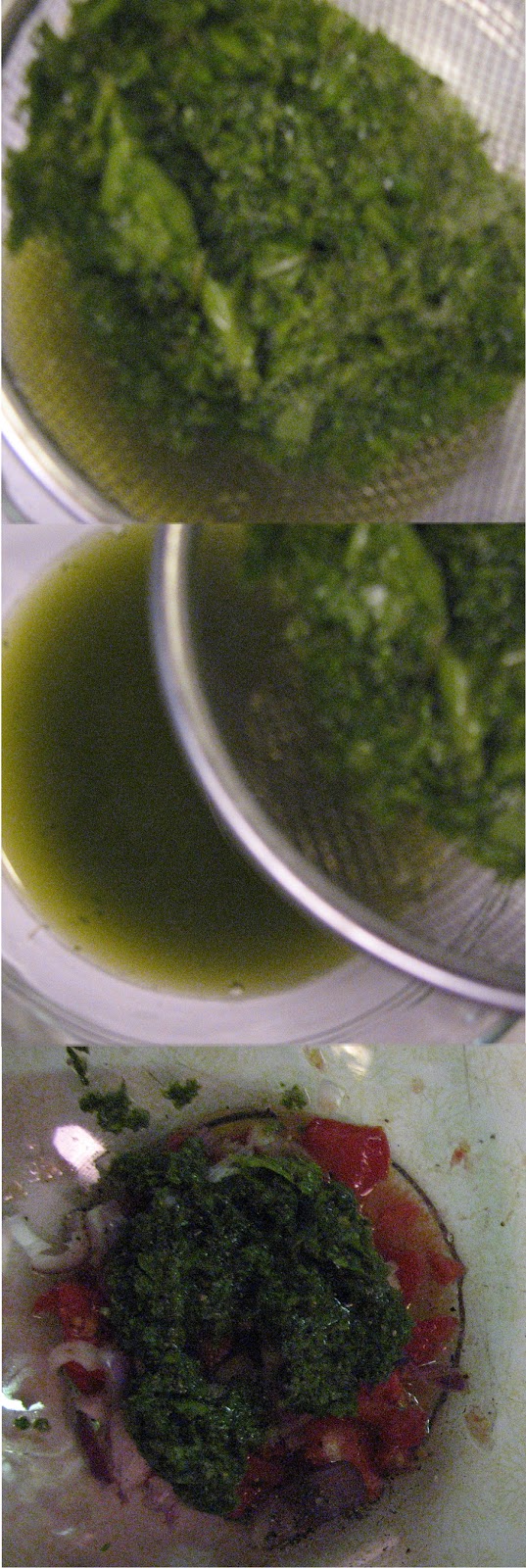
Rinse celery and basil, place in a blender or bullet grinder with a bit of water and buzz until ground up.  Drain, catching the water*.  Add to bowl, drizzle with a tablespoon or so of olive oil, add cracked black pepper and salt to taste.

Boil pasta according to directions.  In the last minute add the slivered peppers, stir to mix with pasta.  When done, drain, but leave slightly damp and immediately add to bowl.  Let sit for 1-2 minutes to allow the veggies to heat up.  Toss, plate up and top with Cheese and Walnuts.

Turned out great.  The sweet peppers added a note of sweetness to all the savory elements.

*This "herb" water contains a lot of flavor from the herbs/greens used, so I add it to my stock container in the freezer for the next stock making time.

So, what else can you use fresh celery leaves for?  Some nice ideas found on the internet:

Make a celery simple syrup -- ratio is 1/2 to 1 cup of rinsed celery leaves, 1 cup each sugar and water.  Bring water and sugar to a boil, stir until well dissolved, add celery and let steep until cool or overnight (to taste). Drain, discard the leaves and store the syrup in the frig for up to 1 week.
-----Use to make celery soda -- 1/4 cup of celery syrup, add 3/4 cup of cold seltzer or sparkling water, stir and enjoy.
-----Use as the simple syrup in any cocktail.  Combine with fresh mint for a different Mojito 

Use in place of parsley or lettuce in a recipe.

Substitute for Loveage (a celery flavored herb) in recipes. (Loveage is a far stronger flavored celery taste so adjust recipe when using celery.)

What new or old fashioned way have you used celery leaf?

. . .

Next Events Coming Up:

I am speaking at the monthly meeting at the Arizona Herb Association on June 2nd.  Topic is Stevia and Syrian Oregano.  Their business meeting starts at 7 p.m. and my talk will be approximately 8 p.m.  Great organization to join.

June 24, 2016, Friday, 9 a.m. - Noon
FREE Seed Share / Swap
Mesa Farmers Market

June 25, 2016, Saturday, 6 p.m.
Sow! 105? Yes!
Lecture at Mesa Urban Garden (MUG) on sowing in the summer
Free (consider donating to the garden or renting a bed)

. . .

Check out my books and calendar on Amazon.

Follow me on Facebook


-- Catherine, The Herb Lady

If you enjoyed this post, subscribe in the upper side bar link, to get all my posts!

Disclaimer: Clicking on links on this blog may earn me a small commission if you purchase something. Your price does not change.

Tuesday, May 24, 2016

Into the 100s and Beyond in the Desert Garden - What to plant in June and July

Dear Folks,


For anyone wondering what if anything you can plant now, try these, going into and through June:

(Pictured is my Stevia (and some strawberry plants) last July 1st.)

June/ July PLANTING (Sowing):

Cantaloupe
Corn
Cucumber, Armenian
Eggplant
Gourds
Luffa Gourd
Melons, Musk
Okra
Peas, Black Eyed
Peppers, Chiles
Portulaca (Moss Rose)
Potato, Sweet
Purslane (Portulaca X Hybrida)

Roselle -- (soak the seeds overnight and get them in the ground ASAP).
Sunflower

Using existing plantings you can under- seed with:
Basil
Chives


WEEK OF JULY 16TH Seeds Only Planting: Anise; Cantaloupe; Caraway; Chervil; Cilantro; Corn; Dill; Fennel; Luffa Gourds; Musk Melons; Parsley; Peppers; Pumpkins; Squash, Winter

WATERING: Higher humidity can reduce moisture loss to plants, reducing watering frequency, but check with water meter regularly.  It may sound strange but you can over water in the summer even on days in the 100s.


Some plants can go a little dormant in the summer, causing a root rot problem because of the extra water.  Sage is one.  Well draining soil helps mitigate this problem.

ALSO the extra water can deplete the iron availability to some plants (chlorosis) , so ironite or green sand can be used. (Future tip:  cold, damp soil in the winter can also cause chlorosis.)

SUNBURN damage:  Like frost damage - do not prune until danger of sunburn is over - the damaged plant protects the lower growth.


IF YOU are transplanting this time of year use leaf-type mulch to keep the soil surface cool around "but not touching" the transplant.

Give some thought to the beginning of the fall "sowing" season starting in the middle of July and into August.  If you want pumpkins for Halloween or Thanksgiving you have to count backwards 90 to 120 days.

Cool weather loving plants are triggered by cooling soil, the reverse of plants which like their feet warm like basil.


Check out my books and calendar on Amazon.

Follow me on Facebook


-- Catherine, The Herb Lady

If you enjoyed this post, subscribe in the upper side bar link, to get all my posts!

Disclaimer: Clicking on links on this blog may earn me a small commission if you purchase something. Your price does not change.

Tuesday, May 17, 2016

Fun Lectures at the Lavender Herb Farm - And a "New" Herb To Check Out!

Dear Folks,

My 2 day lecture event,  "Let's Talk Culinary Herbs" at the Lavender Herb Farm in Chino Valley, AZ this past weekend was by all measures a fun success.  The audience enjoyed the herb-inspired light menu, I had great questions from the folks, and I believe many left inspired to try some new or more herbs in their garden and kitchen.

Linda Nedblach hosts a tea and a luncheon each month at her beautiful farm and I would encourage you to join her "club" of happy guests by signing up at her website to receive the regular emails on the next events, teas and luncheons.  She tells me the lavender should be blooming in June, so try to take advantage of one of her events.  NOTE:  She is only open the days of the events and asks that you take note of hours and guidance on participating in the events.  She CANNOT take reservations via email, you must call to arrange your reservation.  This is a working farm and there are NO handicap facilities.

Linda attended one of my lectures quite a few years ago and she told me when we met several years when I came up for a tea, that lecture inspired her to grow and do more with herbs.  How wonderful is that, that my lecture inspired, at least in a tiny part, this beautiful farm.

I can't take credit for the incredible effort Linda has put into the farm.  The pictures hopefully give you a little idea of this piece of tranquility.

Thank you to Lee Ann Aronson, who is with the Arizona Herb Association, for taking the picture of Linda and I.

I will be giving a talk on Stevia and Za'atar at the June 2nd meeting of the Arizona Herb Association, following their business meeting.

If you are not familiar with the AzHA and are wanting to find out more, consider joining them and participate in their meetings and events.

A "New" Herb To Try

Lamb's Ears Stachys byzantina, is a petable and edible herb.

After more than 30 years of my trowel & error gardening with all things edible and my insatiable desire to try new-to-me edibles, I discovered over the weekend that this member of the prodigious mint family is not only useful (I knew that part) but also edible!!  I am also always learning new-to-me edibles and I love that!

And it was a kismet moment after Friday's lecture and a question from an audience member about Lamb's Ears and reading an issue of Island Homes in my guest room, that I learned about Lamb's Ears edible status.

The question had to with whether this velvety soft-leafed, pretty plant was edible because it can be "VERY" happy in their, and your gardens.

I have grown Lamb's Ears in my garden, but not currently, the picture is from some years ago with a Lamb's Ears (the gray velvety leaf) next to my Dark Opal Basil.  I knew from my research that the anti-bacterial, and soft, leaf was used as wound dressing during the Civil War.  What I did not know until this weekend is the leaf is edible.

"In Brazil it is used as an edible herb, called lambari." -- Wikipedia

Later that evening as I was relaxing in my room, reading an Island Homes article by Richelle Directo, where Directo describes the leaf as having a rosemary flavor and use.

Various blogs and references on the internet indicate the culinary use as possibly raw in salads (some say not a great taste), steamed, made into a tea or battered and fried up (the preferred method in Brazil).

I can tell you it is an easy plant to grow here, somewhat drought tolerant and will re-seed in your gardens.  The flowers are a lovely purple contrasting beautifully with gray leaves and produces tall spikes of the flowers.  Toward the end of the flower cycle the flower heads can get prickly, so just a note of caution to the little ones and you, who may love petting the leaves and soft stems.

. . .

My Next Free Seed Share is at the end of June, watch for the details.

Also I will be giving a free lecture at Mesa Urban Garden at the end of June, watch for the details.

Have a best day!


-- Catherine, The Herb Lady

If you enjoyed this post, subscribe in the upper side bar link, to get all my posts!

Disclaimer: Clicking on links on this blog may earn me a small commission if you purchase something. Your price does not change.

My Website:

http://www.herbs2u.net/ 

Tuesday, May 10, 2016

What If . . .The Market Shelves Were Empty?

Dear Folks,

I am very concerned about the economic impact of the political fights going on right now.  Not just for now, but also for the future.  I am concerned about a worsening problem of access to quality food.

And there is a simple solution which gives a family or individual, food, a peaceful activity, and more control over their own destiny.

Grow Food!

What if you went to the grocery store tomorrow, and you found that the shelves were mostly empty?  Would it be too late for you to learn to grow your own food?

That was part of the lead paragraphs in an email I received from the Grow Network.  http://thegrownetwork.com/


Which made me remember the phrase:

Grow food not lawns?  It is estimated that there are 35 million lawns in the US.  What if many or most of them were turned into food gardens?

The average lawn is 5,000 square feet.


Which made me remember a great article in Mother Earth News.
 

Edible Landscaping: Grow $700 of Food in 100 Square Feet!

In 2008 well known edible landscaping author Rosalind Creasy (the link is to her author page on Amazon) with Cathy Wilkinson Barash (well known edible flower author) began a test of how much food and food savings could be achieved from just 100 square feet (5 x 20 feet). The result?  $700 over 6 months.

A little simple math will show you how much your lawn could be producing or a new garden bed.  AND in the desert, since we can garden year-round the math looks even better 2 x $700 from 100 square feet.  Image if you had more area to grow in?

http://www.motherearthnews.com/organic-gardening/edible-landscaping-zmaz09djzraw.aspx

Rosalind wrote a follow up blog to the article.

http://www.rosalindcreasy.com/edible-garden-how-to/

Creasy's first book published in 1982 was what pushed my "growing" interest in edibles going forward.  The Complete Book of Edible Landscaping: Home Landscaping with Food-Bearing Plants and Resource-Saving Techniques

I ultimately published my book "Edible Landscaping in the Desert Southwest: Wheelbarrow to Plate," to address the year round growing capabilities of our desert gardens.

As an aside, Creasy's  book The Edible French Garden, showed me for the first time the "Alpine" type strawberry.  It was some years later that I discovered those berry seeds for growing in my own garden.

Back to growing food instead of lawns, or just adding too or staring a vegetable bed.  What are you waiting for - the grocery shelves to be partially empty?


I am not trying to be one of those end-of-the-world people who are telling you to build shelters, I am saying - Growing some or most of your own food gives you remarkable control over your future.  If you can grow some or most of your own food, you won't go hungry. Period.

AND you will have a possible source of extra income. Most of the farmers markets welcome backyard gardeners and many now have "community tables" where you do not have to set up your own table - they sell for you for a small percentage.

You can share your extra with your neighbors and food banks.

What are you waiting for?


Growing your own food is a win/win.


-- Catherine, The Herb Lady

If you enjoyed this post, subscribe in the upper side bar link, to get all my posts!

Disclaimer: Clicking on links on this blog may earn me a small commission if you purchase something. Your price does not change.

Monday, May 02, 2016

Berry Picking This Morning - Two You May Not Know.

Dear Folks,

These two great varieties of berries give me multiple crops each year.  This is one of those 'seasons'.

The dark berries are a tomato relative called Wonderberry sometimes called Sunberry-- (Solanum burbankii)

A sweet berry with a hint of its tomato connection in the background of taste. They have a lot of seeds in them but are very soft and the whole berry is totally enjoyable.

I like them fresh, but some folks like to make pies with them.  If I ever get a designated spot for them I will have enough for pies.  For now I let them come up in most areas of the garden.  That is one of their traits - they freely re-seed wherever.  For me it is not a problem, but you may wish to keep them a little corralled in your gardens.  Happy plants can get about 18 inches tall.

You can find the seed at Baker Creek   It is an heirloom and the seeds breed true.

Next up are my white -- yes those are white and fully ripe strawberries, and red Alpine Strawberries (Fragaria vesca).  Related to the wild strawberries these berries pack an amazing flavor in a small package and are incredibly fragrant when ripe.  You can smell them as you approach the patch..

Unlike the larger strawberries, Alpines send out few runners, rather seeding in place (or wherever the seed ends up).

White Alpine Strawberries have a couple of unique qualities. The first is their taste -- tropical with a hint of pineapple.  The second nice quality is two-fold, birds have difficulty seeing white and yellow fruit, so you get more to harvest for yourself.  The other aspect is the foliage of both white and red tends to ride high and canopy the fruit, further shielding them from the critters.

Baker Creek also carries the seed for varieties of these Alpine Strawberries

I have been growing all three of these berries in my gardens for years and because I really enjoy them I tend to let them go were they will, but you can certainly establish your garden borders for them.  They will reward you with years of production.  They will grow in full sun or with some afternoon shade.

I highly recommend your adding these great berries to your garden.  If you get the seed, you can under-sow (under the canopy edge) of existing garden plants NOW.  Both types of berry germinate freely most of the year, with the exception of "our" deep winter (December-January).

The Alpine's are a bit fussy about transplanting, so if you need to start outside of the ground, my recommendation is jiffy pellets where you plant the whole pellet in the ground when you are ready to transplant.  Wonderberry plants are a little more forgiving, however with both plants be careful of the roots when transplanting.

My next Free Seed Share at the Mesa Farmers Market will be Friday, June 24th - 9 a.m. to Noon.

I "may" have seed for these berry plants.  I will have to see what produces mature seed - if I don't eat all the berries :-)

Check out my books and calendar on Amazon.

Follow me on Facebook


Or subscribe to this blog on the sidebar here.

Have a great day in the garden and kitchen!

-- Catherine, The Herb Lady


If you enjoyed this post, subscribe in the upper side bar link, to get all my posts!

Disclaimer: Clicking on links on this blog may earn me a small commission if you purchase something. Your price does not change.

Thursday, April 28, 2016

Mother's Day Ends a Week of Celebrating Herbs!

Dear Folks,

This year National Herb Week runs from Monday, May 2nd to Sunday May 8th.

National Herb Week begins the first Monday of May and ends each year on Mother's Day, a fitting and fun combination of celebrating love and the fragrance and helpfulness of herbs.

Pictured is my Arizona Wild Rose.  You did know roses are herbs didn't you!

If you are looking for flowers considering adding some fragrant herbs to the roses and other flowers and create a one of a kind  bouquet for Mom.  She will remember it long after the flowers fade

. . .


As a gardener, cook, writer and lecturer on all things edible, and particularly herbs, I have some ideas for gifts for your Mother, Grandmother or someone has been like a mother to you, which can extend her special day by gifting some useful books or calendar, or take her to a lovely lunch / lecture.

Here are some belated gift ideas are:

My special "Let's Talk Culinary Herbs" lecture at the beautiful Lavender Herb Farm  in Chico on your choice of May 13 (Friday) or May 14 (Saturday).  Read my full blog post on the lecture and how to register ($20 / person).

Perhaps Mom or Grandmom enjoys gardening.

My month-by-month wall calendar helps her know what to plant each month in the Valley, including herbs, vegetables, fruits and edible flowers.

My beginner's guide to gardening more successfully in the desert is a good reference book with gardening tips, month-by-month planting and some recipes to get your started.

If she likes to cook my 101+ Recipes book featuring herbs and spices for flavor FIRST is a favorite of my readers for how prepare meals full of flavor with less salt and fat.

And my newest cookbook is a unique take on a 12 Course Victorian Meal (you don't have to prepare them all at once!) using one or more herbs as the focal point.

You can also find all of these on Amazon

I hope your Mother's Day celebrations, whether your own or shared, are lovely, fun and serene.

Find me on Facebook.

-- Catherine, The Herb Lady

If you enjoyed this post, subscribe in the upper side bar link, to get all my posts!

Disclaimer: Clicking on links on this blog may earn me a small commission if you purchase something. Your price does not change.

Monday, April 25, 2016

A very Special Lecture Opportunity -- "Let's Talk Culinary Herbs"

Dear Folks,

I was invited to present a lecture at the Lavender Herb Farm in Chino Valley by Linda, the owner.  This lovely farm is a pleasure to visit and a perfect location for this topic.  Plus I LOVE lavender :-)

I am very pleased to have this opportunity to present an in depth talk on culinary herbs A to Z.  I hope you are able to attend one of the days.

“Let’s Talk Culinary Herbs!”

Presented by Catherine, The Herb Lady
Hosted by Linda of Lavender Herb Farm, Chino Valley, Arizona

This, approximately 2 hour, program is offered on your choice of Friday or Saturday

YOU MUST CALL to register for either day.  Linda is unable to accept any reservation via email.

May 13 or 14, 2016
12:00 p.m.
$20.00/person
Lavender Herb Farm,
1907 North James Drive
Chino Valley, AZ 86323*
928-636-5270

Enjoy an afternoon of discussion on the fascinating subject of culinary herbs, A to Z with Catherine, The Herb Lady, while enjoying a delicious, herb inspired light lunch.

Using culinary herbs first when seasoning and preparing your foods reduces the need for salts and oils (and we do need some of these), while enhancing the flavor and satisfaction of enjoying your meals.  And they are good for you too!  Many culinary herbs aid digestion and boost your immune system.

Catherine will discuss the role of essential oils in the flavor and fragrance of herbs, growing and methods of preserving them, and most important, the wonderful variety and ways to use them in your cooking.

About Catherine, The Herb Lady

Catherine "The Herb Lady" Crowley, considered an expert in edible landscaping in the desert, writes and teaches how to grow edibles in all their wonderful variety, both usual and unusual, and then, how to cook with them, including low fat, low salt and meatless dishes.

"The Herb Lady" has been gardening for over 3 decades. During the "budding" part of her gardening "trowel & error" she was personally responsible for a lot of "green death," and from those lost friends, she has learned a great deal and developed her personal gardening philosophy – "enlightened neglect."

Catherine has taught classes at various locations private and public including:

– Boyce Thompson Arboretum, lectures, cooking demonstrations and events such as the Annual Herb Festival

– Desert Botanical Garden (the summer and fall of 2006 she was an expert consultant to the installation of the Herb Garden at the DBG)

– Corporation and Companies / Garden Clubs / Municipal Wellness Training / Public Education Events and other events private and public

--Catherine, wrote for the East Valley Tribune as a contributing columnist for over 4 years, on the subject of growing and using edible herbs.

– She was a regular guest on streaming radio with Ed Phillips at The Arizona Almanac.

Catherine blogs and writes an irregular internet newsletter on greening, gardening and cooking in the Valley of the Sun, and also participates in the Mesa Farmers.Market.

***Please call Linda for your reservations @ 928-636-5270.***

*The farm is approximately 2 to 2.5 hours drive from the valley depending on your location.  Chino Valley is north of Prescott and Prescott Valley.

Linda (Owner)
Lavender Herb Farm
1907 North James Drive
Chino Valley, AZ 86323
928-636-5270
http://www.lavenderherbfarm.com


-- Catherine, The Herb Lady
If you enjoyed this post, subscribe in the upper side bar link, to get all my posts!
Disclaimer: Clicking on links on this blog may earn me a small commission if you purchase something. Your price does not change.

Saturday, April 23, 2016

Oreganos To Know, Grow and Love.

Dear Folks,

I grow 3 types of Oregano and thoroughly enjoy them all.

Actually I grow a fourth Oregano for its beautiful flowers but not its flavor. Hopley's Purple Oregano   I don't have a picture right now - the ground around and under the plant is a purple confetti vision in the late spring.

The Origanum Family includes two of the three and also includes Marjoram (Origanum marjorana) which has a very different flavor from the Oreganos discussed today.

First up is Greek Oregano Origanum vulgaris hirtum.  The herb most associated with Italian and Greek cooking.  There is an Oregano called Italian Oregano but it is not THE herb most people think of.  Greek Oregano has a peppery bite strong enough to bite back a bit if you bite into the fresh leaf.

So associated with Italian foods like pizza and sauces to substitute a very, very mild tasting Oregano would simply not work flavor wise.

Most chefs call for using Greek Oregano dried, but it is a choice.  In the picture this patch of Greek Oregano also contains some of my Jerusalem Artichoke plants and some Nasturtium flowers.

Next is Syrian Oregano Origanum Maru.  Syrian Oregano is the Hyssop of the Bible and is also called Za'atar in the Middle East where it is the anchor herb for the spice mix by the same name.  When Syrian Oregano is not available English Thyme is often substituted, which is acceptable, but does not have nearly the complexity of the savory and almost sweet tasting herb.  One could call Za'atar the salt and pepper of the region.  It is used in many, many dishes.

The spice is a mixture of Syrian Oregano, Sumac Berries (lemony taste) and sesame seed.  It is a lovely spice mix.

Syrian Oregano has a slight gray coloring to the leaves.  In my bee post yesterday, I showed a bee on Syrian Oregano flowers.


The final Oregano is Mexican Oregano Lippia graveolens, a relative of Lemon Verbena.

This oregano has a wonderful flavor and fragrance.  I like to use this in vinaigrette dressings.

While each of the Oreganos has its own flavor and goes well with certain foods, I would encourage you to experiment with each of them.

Think of them as you would wine or beer varieties, experimenting with them singly and as a part of your own blend of go-to-mixes for what you love to make most.

For any herb place a pinch in your hand, rub it and smell.  If you are looking to try making a blend, add another herb, rub, smell, repeat.  Your nose - knows as your taste buds are unique to your sense of smell.

For an idea of making your own blends, how about making your own bouillon.  I knew I would get a good flavor and scent when I went about drying my own bouillon mix, but I was blow-away by just how wonderful it turned out.  Check out my post on sun drying your own mix of what grows in your garden.

Enjoy!   

Growing Oreganos

All three of these wonderful herbs grow very well here in the valley.  They like full sun but can tolerate some shade.

They are all hardy perennials, however in sustained killing frosts the Mexican Oregano can suffer damage.  In a super hard freeze about 8 years ago my 7 foot Mexican Oregano (with a trunk diameter of about 7 inches) died back, struggled to come back and finally did not make it.

Greek Oregano is a trailing ground cover with upright new growth.

Syrian Oregano is a low mounding bushy type of growth.

Mexican Oregano is a shrub.  My current plant is about 4+ feet tall depending on where you measure it.  It is kind of the "wild hair" variety of growth and takes pruning well.

All flower in the spring. All dry very well for storage.

The Greek and Syrian Oregano can be grown from seed (I got my Syrian seed from Bake Creek).  If you do want to transplant now or going into the heat, harden off the plants first by introducing them into the sun over the course of several days (1 hour first day, 2 hours second day, repeat until 4 hours in sun), then transplant, water in well and water every 2 days then back off watering to every 3 to help the roots grow down.  Gradually increase the amount of water with less frequency.  My established gardens are watered every 5 days this time of year and will go down to every 4 days as the heat goes higher.

I hope you decide to add one or more of these great herbs to your garden.  For best success, plant in the fall.  

. . .
 
You can find me on Facebook: 

My books and month-by-month planting calendar are available at my publisher's site page.or available through links on the sidebar here on the blog.


Have a great time in your garden!

-- Catherine, The Herb Lady

If you enjoyed this post, subscribe in the upper side bar link, to get all my posts!

Disclaimer: Clicking on links on this blog may earn me a small commission if you purchase something. Your price does not change.

Friday, April 22, 2016

Bee Hive/Swarm On Your Property - Can it Be Saved or Rescued?

Bee On My Flowering Syrian Oregano
Dear Folks,

This is a follow up to my post the other day on May Gardening Tips and my comments about Bee-Aware and calling the Fire Department who will destroy the hive.


I received a note from a reader who asked why I did not list some beekeeper / rescue organizations who can recover the hive and keep the hive/swarm alive.

It is a good question and the reason I did not address it is most people who encounter a hive / swarm on their property are too concerned about the safety of their family and pets to do more than call for First Responders.  I wanted folks to know the Firefighters do not have a choice in destroying the hive because of the Africanized Bee problem.

Sooooo, let me give you 3 stories and several resources for beekeepers who MAY be able to rescue / recovery the hive.  I say MAY because of two of the stories which are very typical.  Bee recovery folks are brave and knowledgeable individuals who capture the hive, kill the queen and replace her with a gentle bee variety who in short order morphs the hive into a non-africanized colony by immediately laying eggs with her gentle disposition.

Story 1
My Deane is a retired Fireman/EMT and was a beekeeper and loved his bees like pets.  He cared for them in the best ways possible.  I learned much of what I know about bees from him.

While still active, one of the many bee calls came to his station.  Remember he knows bees.  A swarm had invaded the side of a shed and a beekeeper had been called out.  As soon as the beekeeper, who was dressed appropriately started to work the swarm broke over him and was in full rage mode.  When Deane and his crewmates arrived the huge swarm (probably 50,000-75,000+ strong attached the crew.  Those who were in full protective gear needed to get the beekeeper away and pull the foam hose to start spraying the bees and shed.  After everything was settled down, the bees dead and the beekeeper safe, Deane looked at his glove.  He counted 11 stingers per inch on his glove.

A fully enraged hive/swarm is unrecoverable.

Story 2
My cousin and I, along with Deane, feel very strongly about trying to save the swarm rather than kill it.  She noticed activity outside the front of her house near the lower windowsill.   She called me and I gave her the name of a beekeeper who rescues hives and uses them for pollinating orchards and such.

He arrived and determined the swarm had invaded the interior of the walls and there was no way to recover the hive (because there was no way to get to the queen - if you capture the queen the hive will follow into the box or container) without pulling out the front of the house.

She had to call an exterminator who said it was one of the worse jobs he had to do because of how far into the wall the swarm had gotten.

If the swarm gets into the walls or attic of buildings it is impossible to rescue / recover them without destroying property.

Story 3
One of the many aspects of dealing with bees is to 1) not do anything stupid, and 2) understand their typical behavior.

We are careful to move slowly among flowering plants because the girls are doing their job pollinating and because we ALWAYS have things blooming in the garden to encourage them to visit, often.

I wear light clothing colors.  There is a good theory that dark colored clothing is so similar to the bees enemy the bear that the dark colors can irritate them.

If they are near you, DO NOT OPEN your mouth.  They do not like human breath.  Don't swat at them.

So, one morning some years ago I was working in the front of my old home under / near a tangerine tree in the spring.  I am so used to the hum of bees working the flowers near me I never give it any thought.

I was bending over under the tree, stood up and found myself INSIDE a swarm.  They moved that fast into and around the tree.

I immediately stood very still, took stock of where I was, whether the queen had landed on me (that would have made it more difficult but not impossible to be safe), kept my mouth shut and tried to ease my breathing and relax.  It was an equal distance to my front door or my car, so I decided to ease myself towards my car because I had elderly neighbors who I was concerned that they may be outside.

As I slowly back away from the tree the swarm started to "flow" with me like water, but the further I got away from the tree the flow of bees started to eddy back toward the tree where the queen was.  I got to the car with nary a bee near me, got in and made sure the windows were up.

I determined the neighbors were not out, got out of the car and made my way safely to the house and called everyone and told them not go outside until they heard from me.

I Was Not Stung!!

Swarming bees are filled with honey for the trip.  They do not want to get into a fight, they want to find a home and are following their queen.  I did not do anything to annoy them or endanger their queen.  In a while they determined the tangerine tree was not suitable for them and the swarm took off.

Swarming Is A Natural Process of splitting hives and most swarms never present a problem.  If you tree bees, hives and swarms with respect you will not be in danger.


The bottom line is - yes swarms/hives can sometimes be recovered or rescued, but only by professionals.  And sometimes the hives have to be destroyed to protect people and animals, even foolish people who do stupid things to bees.


Beekeepers or Services who can SOMETIMES rescue hives:

Bee Rescue and Removal Service and Local Organic Raw Honey
480-773-0073


Dan Punch

480-298-7983 
Dan also foster's bee hives on people's property.

Dave Petersen
Gilbert, AZ

Phone: 480-221-6875
Email: dave@swbaz.com

AZ POLLINATORS  - have beekeepers in Tucson and Phoenix area
PLEASE EMAIL
DBIES3@YAHOO.COM
FB OR PRIVATE MESSAGE
David Bies! THANK YOU!

928-607-4757


I hope this helps you understand bees more and what options you have if you encounter a swarm / hive on your property.


-- Catherine, The Herb Lady If you enjoyed this post, subscribe in the upper side bar link, to get all my posts! Disclaimer: Clicking on links on this blog may earn me a small commission if you purchase something. Your price does not change.

Monday, April 18, 2016

May Planting - Plant, Sow, Harvest Seeds, And Tips!

Dear Folks,
My Ripe Alpine Strawberries - Yesterday!!

If you are new to gardening in the desert, it is all about planting at the right (optimal) time for best success.

May is one of those months when desert gardeners get either excited (more flowers and fruit ripening) or apprehensive about the impending hot weather.

Timing is everything in our gardens, so sip a cup of iced sun tea and read on.

If you have children or grandchildren read my post on making Sunflower Houses or Teepees.

MAY PLANTING:
Artichoke, Jerusalem
Beans, Soy
Cantaloupe
Cucumbers
Eggplant
Fig Trees
Fruit Trees (With Care)
Melons, Musk
Okra
Peppers, Sweet
Peppers, Chilies
Potato, Sweet
Squash, Summer
Squash, Winter
Tomatillo
SEED IN:  Basil, Chive (Garlic or Onion), Epazote, Perilla, or Catnip-- making use of the canopy of flowering or vegetable plants.

EDIBLE FLOWERS TO PLANT:

Impatients Wallarana
Marigolds, including Tangerine Scented (Tagetes Lemonii), Citrus Scented (Tagetes Nelsonii)
Portulaca
Purslane
Roselle (sow)
Scented Geraniums
Sunflower

GARDEN TIPS for May
    By the end of the month harvest the rest of your potatoes, keeping the smallest ones as “seed” potatoes for next January — store in cardboard egg cartons in your crisper -- don't store near other vegetables or fruits.

Bee-Aware!
    As more and more flowers open and fill the air with their perfume, all the pollinators enjoy the garden as much as you, including bees.
    Swarming is where a new queen goes looking for new digs, taking with her some of the workers (as many as 50,000).  Swarming bees are a challenge to deal with because of the Africanization of the honey bee population.
    But intelligent handling of any contact will not result in a problem for you. First, the bees are not interested in you.  They are usually filled with honey for the new trip and interested in finding a new house before the supply runs out.
    Wear white or light colored clothing while gardening.
    Do not do stupid things to bees!  That should be self-evident, but some of the reports of bee encounters makes me wonder how we have survived as a species.
    If you are near a swarm or they get near you:
    a.  Move slowly and do not make aggressive moves.
    b.  Walk slowly to a house or car and get inside until the swarm moves off.  Keep all pets, children and other people from the area.
    c.  Do not go into the pool!  If the bees have been aggravated, they--will--wait--for--you!
    d. Usually the swarm will move off within a short time.
    e.  If they do not move off, then you have to call a professional service or the fire department.  They will kill the bees.  They do not have a choice because of the danger — and you do not have a choice as a homeowner — they either have to kill the swarm or you have a hive full of dangerous 'neighbors.'

Transplanting and Sowing

This time of year we are in one of those transition times, where going from mild to hot can occur in one felled swoop of heat.

Transplanting vs sowing can be a challenge as transplanting can stress the plants.

1) Harden the plants off by placing in the sun 1 hour then moving to shade, next day in sun 2 hours, move to shade - repeat until the plants have been in the sun for 4 hours and you can transplant then with a whole less stress and shock to the plant.  If the temps are already in the 90+ range double the days for each hardening, e.g., 2 days for 1 hour, then shade, 2 days for 2 hours then shade.  Your plants will thank you by being less likely to die as soon as they are put in the gorund!

2)  Use my "flower mulching" technique for transplant in warm/hot weather.  Get a six pack of flowers at the nursery and either plant your target plant (basil for example) and surround the basil with the flowers (about 5 inches apart), OR plant all at the same time -- imagine a 12 inch circle and plant the basil in the center and 4-6 flower plants around.  Flower mulching canopies the soil and shades the sides of the basil, while allowing the basil to get all the sun it needs.

Use edible flower plants like impatiens wallerana and portulaca to provide 'mulch' around the new transplants.  You can also use Sweet Allysum another edible flower but it can be a bully if it is really happy.  The portulaca does the gardener the supreme favor of dying off completely when the cool weather comes in the fall, although it may reseed next late spring.

3) Sow seeds under existing plants, just under the edge of the plant/flower canopy.

Both the "flower mulching" and the "edge sowing" are variations of the "nurse plant" concept seen in the desert where the cactus seed settles at the base of a Mesquite tree.  Shielded from birds and other critters, the seed, is held in place, watered with the rain and grows up with the mesquite protecting it.

Consider SWEET POTATOES to be planted in late May through early July.  They need 90-120 days of warm weather to grow properly.  I've planted in huge containers and in-ground using leaf cover as I do with the Irish potatoes.  In fact I sometimes use the same bed, planting the sweets after I harvest the Irish.

In case you don't know sweet potatoes, unrelated to the Irish (Solano) family, are completely edible, tuber, leaf and vine.

The sweets can produce an amazing amount of leaf and vine cover so be prepared.  Some varieties are more bushy than others.

Seed Saving

Catching the seed from winter crops like sugar peas, lettuces, celery, parsley, radishes etc. is a way to save money AND get stronger plants the next year.  “Regional adaptation” grows plants more and more suited to your backyard and the area you live.  Remember to perfectly dry them.  I store in paper envelopes labeled with harvest date, in a cool, dry, dark place until next planting time.

Looking at head to June and July, there is little suggested planting options for June, but by mid-July be ready to start seeding (not transplanting) for the fall garden.

If that sounds counter-intuitive, think about wanting pumpkins for Halloween or Thanksgiving and count backwards 90 - 120 days.

Mid-July you can under-seed tomatoes (choose short-maturity varieties) and basil for a fall crop, if you do not have tomatoes or want more.  Tomatoes give us two crops a year (spring and fall) if planted in February.  They stop setting flowers in the middle of the summer because the nights (not the days) are too hot for the pollen to activate.

Save Wood Herb Stems

Harvesting or pruning herbs?  Save woody parts to throw on the grill coals the last 15 minutes to add herb smoke flavor to the food - or better yet do it from the inside out, use woody, soaked branches of herbs to make kabob skewers.

. . .

My Month by Month planting Wall Calendar gives you my monthly tips at your "finger-tips".

Amazon

My Publisher's Site


My Beginners Guide to Edible Landscaping in the Desert is popular with those who want a quick reference guide.  "Edible Landscaping in The Desert Southwest: Wheelbarrow to Plate"

Amazon

My Publisher's Site


Have a wonderful Month in Your Garden and Kitchen!


-- Catherine, The Herb Lady
If you enjoyed this post, subscribe in the upper side bar link, to get all my posts!
Disclaimer: Clicking on links on this blog may earn me a small commission if you purchase something. Your price does not change.

Monday, April 11, 2016

Epazote, The Herb, and Sun Drying!

Dear Folks,

Epazote (Chenopodium ambrosioides also called Dysphania ambrosioides) is a naturalized herb in the Southwest, native to Central and South Americas and Southern Mexico.

The Chenopodium family is somewhat unique in that its family members consist of an herb (Epazote), a grain (Quinoa), greens (Spinach, chard and lambs quarters) and roots (beets).

Known and used for its "natural beano" beneficial qualities in cooking with beans, it has an interesting and robust flavor.  Can be substituted for rosemary or cilantro in dishes if you like experimenting.

FYI when using Epazote with your bean dishes use stems or some of the fresh or dried Epazote while cooking but ALWAYS reserve some to add the last 15 minutes of cooking or just before serving to maximize the beneficial element.

In the garden Epazote can be come a weed, freely re-seeding all over the place (which is why I dried some the other day - it was growing where I did not want it to grow).  Is very heat tolerant and grows pretty much all year long, going through cycles of fresh growth, flower, seed and then more fresh growth.  If allowed to stay in place it develops a huge tap root and can reach 4 feet high.  It is best to keep it under control by harvesting and/or pruning back regularly.

Sun Drying


When I returned from my trip I found 2 nice 14 inch plants where I do not want them to be and decided to sun dry them.

I use a set of dehydrator trays I picked up at a swap meet some years ago and it lets me make maximum use of the table space in the yard with best sun exposure.


Sun dry your herbs, fruits, and vegetables when the temps are 85+ and dry (low humidity).  If they are not dry at the end of the day, bring the trays back inside so they do not reabsorb moisture and place back out the next day to finish drying.

The Epazote dried in one day.

Some things like fruits and vegetables may take 2 days.  If we are in the 90s+ expect many things to dry in a few hours :-) -- taking full advantage of our hot sun saves a lot of energy.

I dry the stems of herbs to use for flavoring while cooking. Removed at the end as you would a bay leaf.

Once completely dry store in dark, cool, moisture-free environment.  I personally like glass jars, but ziplock bags will work also.

Leave "leaves" whole for maximum life and flavor.  Crush when using.
. . .
Check out my publisher's site for my month-by-month planting calendar for the Desert Southwest and USDA Zones 9B and above, my cookbooks and beginnings gardening book for the Desert Southwest.

http://www.lulu.com/spotlight/herbs2u

You can also find me on Facebook where I post gardening and cooking information.

Have a best day!


-- Catherine, The Herb Lady
If you enjoyed this post, subscribe in the upper side bar link, to get all my posts!

Disclaimer: Clicking on links on this blog may earn me a small commission if you purchase something. Your price does not change.

Saturday, April 09, 2016

Spring Bloomed While I was traveling! And, Old Time Radio.

Dear Folks,

I traveled from the East Coast to Arizona with my sister on a 12 day journey that took us along the coasts.  Great trip.

While I was gone spring really arrived in the garden.


Johnny Jump-Ups, a-bloom everywhere along with a mass of Nasturtiums.  The Amaryllis is one of the prodigy of a bulb my father gave me back in the early 80s, simply call Dad's Amaryllis, and one of the few ornamentals in our gardens.

. . .

If you like listening to music or audio books, check out one of  my favorite sites OTRCAT.com.

There is a lot of benefit to just listening rather than watching something.  Many times you get more:  more out of the program, it is more enjoyable, and you can treat it as background entertainment while doing something else.

Here you can find thousands of old time radio programs from comedy to holiday to drama and more.  Some of my favorites I have on my computer and can put on my iPod nano are the old fashioned detective stories, like the original "Christmas Carol" show by Campbell Playhouse, "Yours Truly, Johnny Dollar" and "The Shadow".

There is something wonderful about listening to radio that is not the same as watching tv or streaming video.  You can gently multi-task while enjoying some great stories.

Right now John has some fun "tax" programs.  CDs of the programs are regularly donated to various groups and organizations, he offers free compilation sampler discs with each other, and the value is awesome.  An MP3 cd can hold 50 hours and costs $5.00 or just a little more.

Check them out.

Have a great day in the garden!


-- Catherine, The Herb Lady

If you enjoyed this post, subscribe in the upper side bar link, to get all my posts!

Disclaimer: Clicking on links on this blog may earn me a small commission if you purchase something. Your price does not change.