Garden, Plant, Cook!

Saturday, October 13, 2018

November Planting / Sowing Tips and a Fall Soup.

Greens and Herbs Harvest
Dear Folks,

November planting and sowing is very similar to October, only later and that is an important point when you choose vegetables for their maturity date.  It is VERY important to get long maturity veggies like head cabbage and similar in the ground or sown asap so they have the full cool weather months to grow to harvest size and use.  If these edibles are sown or transplanted later than best time, then you have them growing into the warming times which can stilt the growth or cause them to blast into flower before you get to harvest 
them.

FREE SEED SHARE coming up November 3rd - details below,  click on this link to read on facebook.


Garlic cloves going in!

If it is still October when you read this get YOUR GARLIC cloves planted by October 31st for the same reason as the head vegetables -- they need ALL of the winter chill to develop beautiful heads in the late spring.  Pictured planting on October 8th- I usually try for October 1st.

Successive sow all of your green leafy edibles along with cilantro, dill, chervil and parsley for a continuous harvest all winter and well into spring.

Don't forget to successive sow sugar peas!


Now that we have had some really nice rain this week, and cooler than normal temperatures, I am seriously hoping my belief and those of the weather folks will come true - a stronger El Nino and more rain and snow pack in the mountains this winter.  AND while many folks including myself, don't enjoy real cold, a cooler-than-last-year winter will be good for the gardens, pushing back pest bugs and energizing many of the plants.

November PLANTING:

Anise
Asparagus
Bay, Greek (Sweet)
Beets
Bok Choy
Broccoli
Brussels Sprouts
Cabbage
Cabbage, Ornamental
Caraway
Carrots
Cauliflower
Celery
Chamomile
Chard
Chervil
Cilantro
Dill
Endive (and Chicory)
Fennel, Leaf
Fruit Trees
Garlic (only as green garlic)
Greens
Horseradish
Kale, Ornamental
Kale
Kohlrabi
Lavender
Lemon Verbena
Lettuce
Marjoram
Mints
Mustard
Myrtle
Onions, Green
Onions
Oregano, Greek
Oregano, Mexican
Parsley
Parsnip
Peas
Radishes
Rosemary
Sage
Savory
Spinach
Tarragon, Mexican
Tarragon, French
Thyme
Turnips

EDIBLE FLOWERS TO PLANT:

Calendula
Carnation (Dianthus)
Chamomile
Cornflower (Bachelor Buttons)
English Daisy
Hollyhock
Jasmine Sambac (Arabian)
Johnny-Jump Up
Marigolds, including Tangerine Scented (Tagetes Lemonii), Citrus Scented (Tagetes Nelsonii)
Nasturtiums
Pansies
Primrose
Scented Geraniums
Shungiku Chrysanthemum
Snapdragons
Stocks (Matthiola)
Sweet Alyssum
Sweet William (Dianthus)
Violet


Seed Share and Q&A With Catherine, The Herb Lady at Mesa Urban Garden

Saturday, November 3, 2018
1 p.m. to 2:30 p.m.
Mesa Urban Garden (MUG)

212 E 1st Ave (NE Corner of Hibbert and 1st Avenue)
Mesa, AZ 85210
(602) 370-4459

QUESTION and ANSWERS  Catherine will answer your questions on transition gardening with edibles and sowing in the cool garden.

When to sow
What is successive sowing and why
Maturity dates - what do they mean and why is it important

SEED SHARE -- FREE -- Pick up some seeds to get growing or expand your garden.


I had some organic celery and cut the roots off, let it sit in water for a couple of days to get re-growing and planted them.  Why compost, or worse toss, when they will re-grow and give you harvesting later on!

GARDEN TIPS for November
    First frost date average is around November 17th.
    Frost in the Valley at the 1100 or lower elevations is usually limited to ‘soft frost’ where simple cloth sheets or paper placed over sensitive plants (or moving potted plants beneath patios or trees) is sufficient to protect them.  Never use plastic covers as the plastic transmits the cold to the plant tips.
    For every 1000 feet over 1100 in elevation the first frost day is moved forward 10 days.  The possibility of hard (killing) frosts starts to occur, although at 2000 feet or lower this is still a rare occurrence.
    Frost pockets in the Valley can surprise gardeners.  As a matter of practice, if the weather forecasters predict an overnight temperature of 40 F, I prepare for frost by protecting my sensitive plants with cloth or paper covers This is because heat retention by buildings and walls dissipates by early morning (4 or 4:30 a.m. to dawn the temperature can drop 8 degrees plus or minus).
    Frost danger continues until about mid-February.
    Cool weather annuals and biennials can be sown every 2-4 weeks (beginning in August) through the end of November for a continuous crop through next spring.
    November through January can be a ‘rainy’ season for the desert. You can usually hold off on regular watering if you have received a half inch or more of rain within 2 days of normal watering days.  Make good use of your water meter to determine soil moisture. 
    If rains are heavy this month, in addition to foregoing some water days, you may need to put down Ironite or green sand to compensate for mineral bonding (which makes iron unavailable to the plants) due to both the excess water and the cold soil.

FROST DAMAGE
The best way to think of frost damage on your edibles is the damaged plant material is now a partial protective cover to the underlying growth.

As mentioned in prior notes, frost damage in the lower desert gardens is usually limited to 'soft' frost which is controlled by simply putting cloth or paper covers over the plants at night, or if containers, moving them under evergreen trees or onto the patio.

IF, however we get hard or killing frosts, of extended periods or days, die-back will occur even on protected plants.  The reason is the radiant heat retained by structures and even the soil dissipates completely, leaving the plants exposed to too-cold air.

Whether the frost damage is from soft or hard frosts if the plant is still alive DO-NOT-REMOVE-THE-DAMAGE.  Doing so risks damaging the growth still alive under the top die-back.  I don't remove even dead plants until spring.  I have found basil seedlings coming up under a large dead basil plant killed off by a hard frost.

Obviously we like our gardens to look pretty most of the time, but selectively resisting the urge to pull something a little bedraggled gives you, the gardener, access to earlier production of the warm weather plants because of their larger root systems.


Nasturtiums!  Are yours starting to come up or have you planted seeds yet?  What, no nasturtiums?  These great edible plants should be in your gardens for their taste and benefits to your plants as they help keep pests at bay.

"The Essential Herbal" blog is a great site.  Their newsletter today is all about recipes using nasturtiumsGive a look.   One of my favorite recipes is making "Dolma" stuffed leaves which usually is grape leaves but the nasturtiums are great as a substitute.  Check out my recipe here, and get your nasturtiums growing!  (Sow the seeds covered, they germinate in the dark.)

Two great soups to use your garden bounty.

Herb Soup
From the book : “101+ Recipes From The Herb Lady” - by Catherine Crowley

    A wonderful blend of herbs, lettuces, croutons and cheese. The beauty of this soup, besides its fabulous flavor, is the ability to vary the herbs, lettuces, croutons and cheeses for different flavors. I developed this recipe from Provencal soups.


While this soup is not pureed - it is an option as shown in the following, similar soup recipe.

1    shallot, finely chopped
2    tablespoons butter, unsalted
4    cups mixed fresh herbs, finely chopped (I used Thai basil, cilantro, parsley, see note below*)
1    package spring lettuce mix
1    teaspoon coarse salt
1/8    teaspoon black pepper
6    cups boiling water (can use broth - but try the water the first time)
6    cups croutons (any stale bread diced will work too - some day-old nice artisinal breads would be great for this)
3/4    cups Parmesan cheese

    Set aside 1/2 cup each of herbs and lettuces for garnish. Divide croutons and cheese into 6 soup bowls.
    Saute shallot in butter for 1 minute. Add herbs, salt, and lettuces all at once and cook—stirring for 5 minutes. Add boiling water, cover and simmer for 15 minutes—stirring occasionally. Ladle greens and broth into soup bowls. Add garnish of herbs and lettuces to each bowl. Serve and enjoy. Serves 6.
    *Traditional recipes call for sorrel and chervil or any combination you like - the Thai Basil has a tarragon aspect to it which mimic the chervil with a kick and cilantro's citrus back-note mimic the sorrel.

 
Green Harvest Soup - a pureed soup
Another soup version  February 2009

I adapted this from a recipe I saw in Better Homes and Gardens magazine.  Since I am not overly fond of cooked spinach (in reality after I developed this recipe - I discovered I'm slightly allergic to spinach and beets), I chose a sweet potato over a regular potato (as called for in the original recipe) to sweeten the soup — worked beautifully and the arugula adds just a nice amount of nutty bite.

Green Harvest Soup
1 large shallot, minced
1 medium onion, chopped
2 teaspoons - 1 tablespoon dried Herbes de Provence or Italian herb blend
1 teaspoon of extra virgin olive oil
1 teaspoon unsalted butter
2 cups de-fatted chicken stock - homemade is best - can substitute vegetable
1 large sweet potato, cleaned, peel left on, chopped
1 package (approx 4 cups) mixed greens or baby spinach, rinsed well and dried - set aside 1 cup, torn into bite size pieces
1 cup arugula, torn into bite size pieces
Parmesan cheese curls
edible flowers for garnish (I used pansies, calendula petals and sweet alyssum)
baguette slices
salt to taste

In a heavy pot, melt butter and olive, add shallot, onion and dried herbs and saute on medium heat for 5 minutes.  Add the stock and sweet potato, bring to a boil, reduce to simmer and cook covered until the sweet potato is tender, about 10 minutes.  Begin adding all the greens (except for the reserved 1 cup) a little at a time until incorporated and wilted.  Remove from heat and let sit to cool for about 5 minutes.

I used an immersion (stick) blender, but you can use a regular blender or food processor to puree the soup. Careful! Don't burn yourself - I do love my immersion blender - once you get the hang of it you are not dirtying another container (blender)*.

Taste the pureed soup for salt - you should not need to add any or only a very little.

Ladle into soup bowls, top with a bit of reserved greens and arugula, edible flowers and cheese curls, and serve with baguette slices.

There are so many healthy benefits to these foods, it is almost a sin to not serve it whenever they are available from your local growers.


I hope you try one of these soups.  If you do let me know and also how you may have changed it up to be "your" harvest/herb soup.

. . .

You can have all my gardening tips at your fingertips with my gardening book and/or calendar

My Calendar and Book Links

Wall Calendar

Amazon
https://www.amazon.com/gp/product/1387385798/ref=dbs_a_def_rwt_bibl_vppi_i1

Publisher Direct
http://www.lulu.com/shop/catherine-crowley/edible-landscaping-a-month-by-month-calendar-desert-southwest-usda-zone-9b/paperback/product-23433329.html


Beginner's Southwest Gardening Book

Amazon
https://www.amazon.com/gp/product/141164039X/ref=dbs_a_def_rwt_bibl_vppi_i0

Publisher Direct
http://www.lulu.com/shop/catherine-crowley/edible-landscaping-in-the-desert-southwest-wheelbarrow-to-plate/paperback/product-176297.html

Have a great day in the garden and kitchen with your bounty.


-- Catherine, The Herb Lady

If you enjoyed this post, please share and subscribe below by entering your email, to get all my posts! 

Enter your email address:


Delivered by FeedBurner
Disclaimer: Clicking on links on this blog may earn me a small commission if you purchase something. Your price does not change.

Tuesday, October 09, 2018

Sugar Peas, If You Please!

Picture taken October 9, 2018
Dear Folks,

I am readying my monthly planting post for gardening in November (with two great harvest soup recipes), but I wanted to get this information to you ASAP.

Get your sugar peas in NOW and then successive sow every 2-3 weeks for a continuous harvest into late spring.  Each plant will continue to pump out pods for months as long as you keep them picked regularly.

I love Sugar Peas!!

In fact I love them so much I wrote a block post several years ago (link below) in my Ode To Sugar Peas.

Harvested Last March, pods, peas, shells for dinner.
From tender skinny pods all the way through to harvest green shelled peas (I even use the shelled pods for slivering in salads or cooking as an added vegetable) to saving the dried brown seeds for cooking or sowing later, everything about this vegetable is just wonderful.

So, I have been growing them for quite a few years, successive sowing every 2-3 weeks (more going in today) following the old 1 pea per 4-6 inches in sowing and then I found this wonderful youtube channel a couple of years ago and - bingo - I realized I had been denying myself a true bounty of peas to harvest.

First, the video is on growing English (spring) peas, but the technique is the same for Sugar "Snap" Peas.

Second, while the video highlights a genius method planting LONG rows, it is the seed spacing I want you to pay attention to.

Third, I did this last year and had a huge and continuous crop of sugar peas through March/April, far more in the same of garden area, than in prior years.

TIP:  Soak your pea seeds for a couple of hours - but no more than 8 - to speed up germination.

I hope you find the video and ideas helpful.

Huws Nursery (UK)

My Blog Post "Ode to Sugar Peas"

Find my books and calendar purchase links on the side bar here on the blog.

-- Catherine, The Herb Lady

If you enjoyed this post, please share and subscribe below by entering your email, to get all my posts!

Enter your email address:


Delivered by FeedBurner
Disclaimer: Clicking on links on this blog may earn me a small commission if you purchase something. Your price does not change.

Saturday, October 06, 2018

Eggplant "Bacon" - Oh Boy!

Dear Folks,

My eggplants are really producing nicely, particularly my Listarda (Listada De Gandia) and I decided to do another batch of "Bacon" using a marinade and slices of this gorgeous fruit. Yes I know we call it a vegetable but it is really a fruit.

Anyway, I made some "eggplant bacon" a while back and I loved the taste but I had inconsistent 'doneness' issues with the center being soft while the outside crispy. So re-reading several recipes on line, I lowered the oven temp and got a much better result. BIG tip here, watch them when they are baking, you want crisp but not burnt and you do HAVE to turn them halfway through.

Some recipes note using them as dippers which I think would be good, but hey, we are talking "Bacon" here so BLT and Grilled/Melted Cheese sandwiches were what I wanted.

First the Marinade and it can be refrigerated and used as needed. There are several variations for this marinade around and I liked this combination. You can use avocado oil in place of the olive oil.

Eggplant "Bacon" Marinade
Vegan, Vegetarian and Omnivore friendly

1/8 cup (2 tablespoons) soy
1/8 cup apple cider vinegar
1/8 cup maple syrup
1/8 cup olive oil
1/2 teaspoon paprika
Pinch (1/16 teaspoon) liquid Hickory Smoke

Eggplant "Bacon"

Marinade
Eggplants
Optional Cracked Black Pepper

Use a mandolin if you have it to make the slices of eggplant even. I do not peel these tender heirloom varieties of eggplant.  You want about bacon-type thickness for the slices.

Have a ziplock bag ready. A nice way to do this is to open the bag and tuck into a mug with the top folded down over the sides creating a "stand" for the bag.

Pour the marinade into the bag.

Cut the stem end off the eggplant. Slice a small piece off the "round" sides of the eggplant.

Slice the eggplant an immediately put the slices in the bag. Zip closed and gently move the slices around to coat and lay the bag on a flat counter. Set your timer for 30 minutes and turn the bag once half way through.

Meanwhile get your pan and oven ready. Pre-heat oven to 300 - 325. I did 325 and may try 300 next time. Your first batch will be a test for your oven and what works to create nice crispy "bacon" without burning. I have to say even the "charred" pieces were delicious.

Cover your cookie sheet or large pan with aluminum foil or parchment paper.

Lay the eggplant strips out on the pan. They can be very closed together but not overlapping. They will shrink a bit. If you like you can sprinkle with cracked black pepper.

Flip the eggplant after 20-22 minutes and return to oven. Overall cooking time will range from 40-50 minutes. Watch carefully. Remove and either use immediately or cool and wrap up in the aluminum foil you baked them on and refrigerate. I had to wait until the next day to use and they were just fine and still nice and crispy after being in the refrigerator.

A couple of days ago I harvested a bunch of mixed greens from the garden (sweet potato, roselle and Egyptian Spinach, leaves along with some purslane and basil, and I'itoi onion tops. I used some of the leaves for the BLT.

Now to assemble the sandwiches - BLT with avocado and a melty swiss cheese, "bacon" with some basil leaves.  Both sandwiches on a multi-grain whole wheat toast.  I do not show it but I put some mayo on the BLT.

I literally could not wait to assemble the BLT with Avocado.  I opted to spread the avocado on one side of the toast. On the other, you can't see it, I spread some mayo, the slices of tomato, sprinkle with a bit of salt, then some of the "bacon" greens and more "bacon" - of course, and closed the sandwich up. 

Next the Melty Swiss Cheese, "Bacon" with basil leaves.

Several years ago I started making grilled cheese sandwiches with grilled eggplant and sweet peppers adding fresh basil leaves in the mix.  For these sandwiches I toasted the bread ahead of time.

It is important to layer the cheese between each of the other ingredients.  Here I used Swiss. I have used Provolone, Swiss, White Cheddar and Mozzarella depending on what I have on hand and my mood - maybe even a mix.  After assembling, I pop in the microwave for about 10-20 seconds to melt the cheese.

So, this. . .

 
To THESE . . .

Have you made eggplant "Bacon"?  Or other vegetable "bacons"?  How have you used the "Bacon" or how would you use it?

I think the next batch(es) I make I need to make extra and keep some for crumbling on salads or as a garnish on soups.  Like my "Creamy Potato + Vegetable Soups".

Have a great time in the kitchen with your garden bounty!

Watch for my November Planting tips in another post.

You can find my books and calendars at Amazon or my publishers site.  Check the sidebar here on the blog.


-- Catherine, The Herb Lady

If you enjoyed this post, please share and subscribe below by entering your email, to get all my posts! 

Enter your email address:


Delivered by FeedBurner
Disclaimer: Clicking on links on this blog may earn me a small commission if you purchase something. Your price does not change.

Wednesday, October 03, 2018

Rain = Mushrooms!


Dear Folks,

While checking the rain totals for the last 24 hours, I spotted these in an area designated for a future tree.  I laughed out loud when I caught sight of them!

I check rain totals for a 24 hour period at first light - we received 1.25 inches over the last 3 nights.  Far less than many parts of the valley, but still enough to show mushroom growth in our healthy soil.

AND we got to skip major garden watering because of the totals.  Always cool to let mother nature do your watering.

As I type this at about 8:45 am it has started raining again - and the sun is coming out - good old fashioned sunshower - yipppeeee!

Back to the mushrooms, these puppies are huge!

 
And no I am not going to check and see if they can be eaten:

1)  I have no training; and
2)  My sweety is severely allergic to mushrooms!

. . .

If you are starting to think about gift giving for the holidays, consider my gardening book and/or wall calendar for your gardening friends or family (or those who want to but need help).  The information is applicable in USDA Zone 9b and above - Desert Southwest and Deep South.

My Calendar and Book Links

Wall Calendar
Amazon
https://www.amazon.com/gp/product/1387385798/ref=dbs_a_def_rwt_bibl_vppi_i1

Publisher Direct
http://www.lulu.com/shop/catherine-crowley/edible-landscaping-a-month-by-month-calendar-desert-southwest-usda-zone-9b/paperback/product-23433329.html


Beginner's Southwest Gardening Book
Amazon
https://www.amazon.com/gp/product/141164039X/ref=dbs_a_def_rwt_bibl_vppi_i0

Publisher Direct
http://www.lulu.com/shop/catherine-crowley/edible-landscaping-in-the-desert-southwest-wheelbarrow-to-plate/paperback/product-176297.html


Enjoy the rain, stay safe and look forward to happy gardens!


-- Catherine, The Herb Lady

If you enjoyed this post, please share and subscribe below by entering your email, to get all
my posts! 


Enter your email address:


Delivered by FeedBurner
Disclaimer: Clicking on links on this blog may earn me a small commission if you purchase something. Your price does not change.

Tuesday, October 02, 2018

In Appreciation of Vegetables!

Listarda Eggplant
Dear Folks,

October is "Vegetarian Appreciation Month", which started in 1977.

You do NOT have to be a vegetarian or vegan to appreciate the flavor and beauty of vegetables.

I made a huge batch of Ratatouille the other day:  Eggplant, tomatoes, sweet peppers, onion, and zucchini seasoned with dried Greek Oregano and Celery from the garden.  A tiny bit of uncured bacon fat (1 tablespoon) in a 350 oven for 80 minutes until they were all melty.

I had some leftover, so last night I cooked up some pasta type couscous (1:2 ratio of pasta to water, bring to a boil, add pasta, stir, cover and let sit for 5 minutes off the heat).  I added 2 tablespoons of my basil "pesto" (basil ground with some olive oil), and then stirred in the warmed left over ratatouille and topped with shredded Mozzarella cheese.  A perfect meal whether you are an omnivore or a vegetarian.

The butternut squash seedlings love the site I picked and I am tickled they took.  Not really the right time for them, but I am pushing the envelope this coming year with the climate changing up when to plant and when the plants are happiest.  I mean, why not!  With global weirding and my personal garden journeys using trowel and error to find when and where to help my plants be happy and healthy, the need to keep up with that weirding means continuing to push the envelope.

So far we have received just under .6 tenths of an inch of rain from Rosa (6:30 Tuesday morning), and we are expecting more according to forecasts. It is welcome, but would prefer not damage!

My Roselle is really in full flowering mode and the plant while a bit bent from the rains yesterday morning, are full of flowers - I just love this plant.

I have some small mix lettuce leaves to harvest along with the sweet potato and roselle leaves and I think I will snip a piece of Turmeric leaf to add to the mix  This plant is quite happy in its spot.  My ginger struggled this year so I need to find a better spot for it.  When I harvest the Turmeric later I will also transplant the ginger, as soon as I figure out a better spot for it.

Sugar Pea seedlings are coming along fine. I have started two rows a couple of weeks apart and will continue that until I have about 6 rows. I want to have a LOT of sugar peas.

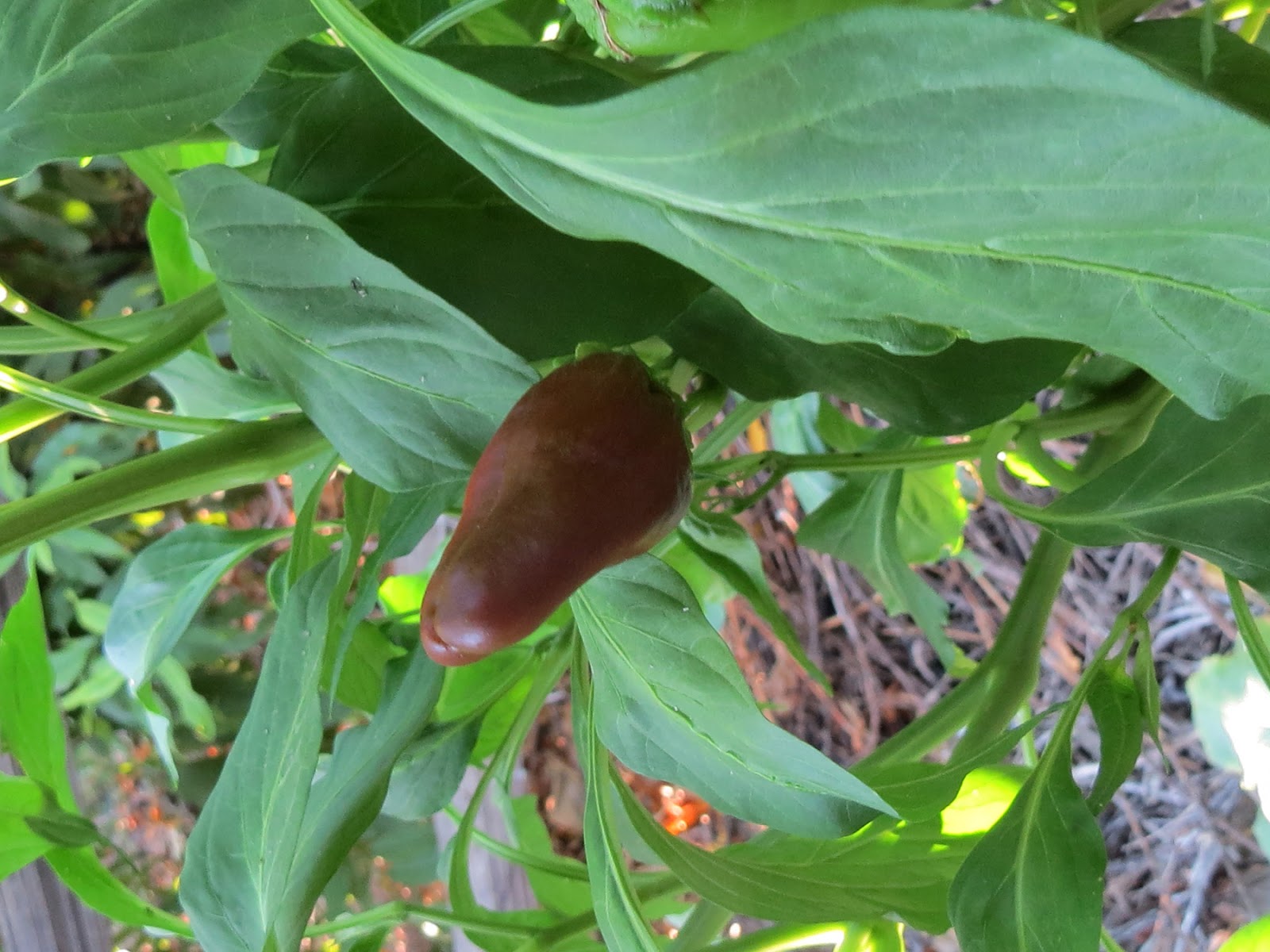
A new location for a sweet pepper is proving to be a good choice.  The plant had some afternoon shade through the hot summer and is now about 3 feet tall and putting out fruit.  This burgundy pepper photo I took about 5 days ago, surprised me with the color.  A pepper I missed on the plant was on the ground yesterday, birds being helpful and it was bright red, so the color transition of this variety is interesting.  I have tried a new variety of sweet pepper - a type of Habanero but with no heat, and I'm wondering if this is what I sowed here.  I have the greatest facility for NOT remembering to note what I planted and where, so it becomes a kind of surprise gift when something comes up not where I expected it!

I hope you use October and all months to appreciate all of the wonderful vegetables and other edibles you can grow in our desert gardens.

DON'T forget - your garlic -- get your cloves in the ground no later than October 31st for the best success possible for spring harvest.

Have a best day,


-- Catherine, The Herb Lady

 If you enjoyed this post, please share and subscribe below by entering your email, to get all my posts!

Enter your email address:


Delivered by FeedBurner
Disclaimer: Clicking on links on this blog may earn me a small commission if you purchase something. Your price does not change.

My Calendar and Book Links

Wall Calendar

Amazon
https://www.amazon.com/gp/product/1387385798/ref=dbs_a_def_rwt_bibl_vppi_i1


Publisher Direct
http://www.lulu.com/shop/catherine-crowley/edible-landscaping-a-month-by-month-calendar-desert-southwest-usda-zone-9b/paperback/product-23433329.html


Beginner's Southwest Gardening Book

Amazon
https://www.amazon.com/gp/product/141164039X/ref=dbs_a_def_rwt_bibl_vppi_i0


Publisher Direct
http://www.lulu.com/shop/catherine-crowley/edible-landscaping-in-the-desert-southwest-wheelbarrow-to-plate/paperback/product-176297.html


Wednesday, September 26, 2018

Around The Garden - the Comings and Going!

Dear Folks,

It is one of the transition times in the garden with edibles going to seed, harvesting, new buds, blooms and fruit!

Back on the 16th of September my Black Tail Mountain watermelon was finally showing ripe!  Tendril drying.

The "Field Spot" which is the yellowing - usually on the underside of the fruit, indicating the ripe stage.

And finally the cut!  Oh how I love this variety.  The picture really does not show the bright red color (poor lighting) and it is delicious! You could call this a "personal" size variety as they are smaller than many varieties - perfect for us.

With the global weirding going on this past year I had to resow seeds, so I did not get these in the ground until March.  THEN as the seasonal changed the sun orientation, the vines, while healthy, got less and less sunlight.  [I have a new place planned for melon and squash going forward.]  Anyway this baby essentially took 6 months from sow to harvest, but it was worth the wait.


My Egyptian Spinach aka Jute, Molokia (Corchorus olitorius) is one of the best summer "lettuce" greens to grow here in the desert and it loves the heat, and this time of year goes to flower and forms the seed pods.  I harvest the pods - which snap open easily when dried - for sowing next spring. The leaf taste is mild and perfect for anything you use lettuce in/on.

I am looking forward to more Ratatouille, as both my Casper and Listarda eggplants are still producing fruit. My Paradicsom sweet pepper is full of new fruit too, now that the temps have cooled off. Pepper grow well here but they do get stressed in the middle of our hot summers and then just leap for joy when the temps start to cool in late summer.  I don't think I have enough squash, so I will have to buy some and tomatoes and then a new batch of roasted deliciousness!

By the way - I got the Paradicsom Pepper plant from Suzanne Vilardi of Vilardi gardens - about 4 YEARS! ago and it still happy as can be.  Catch up with Vilardi Transplants as one of her valley Farmers Market table locations. 

One of my huge Chiltepin Pepper plants is in full flower and I had to wack it back as it was encroaching on my Mango.  This pepper is known for its heat and is a native of the Southwest and will happily take over a spot which offers a bit of afternoon shade.   The birds, which have "asbestos" throats will happily spread the seeds all over the gardens.  Just an FYI.

My Roselle ((Hibiscus sabdariffa) loves the new location I decided to use this year.  In the Valley they grow as annuals and thrive in our summer heat.  It is that time for a whole lot of flower buds and the first flowers - which each only last one day - to show up and show off. The flower is just beautiful.

Late on that burgundy Calyx (the outer part of the flower bud) will swell into the "fruit" we harvest to use in beverages, desserts and salads.

I had to wack back the Roselle also as it was starting to cover my Lemon Grass which had died back to almost nothing from the Sugar Cane - which we removed this spring (I still have the Purple Sugar Cane - but in a hopefully controlled manner).

That is the edge of the Roselle you see in back of the lemon grass in the recent picture.

As my gardens have matured in different ways, this past year and going forward I need to find different places for the "seasonal" edibles to ensure enough sunlight.

Get my planting and sowing post for October - in the archive in the side bar here on the blog.  It may also be in the section "Popular Posts".

. . .

You can have all of my gardening information at your finger tips with my book and/or wall calendar.

My Calendar and Book Links

Wall Calendar

Amazon
https://www.amazon.com/gp/product/1387385798/ref=dbs_a_def_rwt_bibl_vppi_i1

Publisher Direct
http://www.lulu.com/shop/catherine-crowley/edible-landscaping-a-month-by-month-calendar-desert-southwest-usda-zone-9b/paperback/product-23433329.html


Beginner's Southwest Gardening Book

Amazon
https://www.amazon.com/gp/product/141164039X/ref=dbs_a_def_rwt_bibl_vppi_i0

Publisher Direct
http://www.lulu.com/shop/catherine-crowley/edible-landscaping-in-the-desert-southwest-wheelbarrow-to-plate/paperback/product-176297.html


I hope you have a fabulous time enjoying the beauty and rewards of your garden work.


-- Catherine, The Herb Lady 

If you enjoyed this post, please share and subscribe below by entering your email, to get all my posts! 

Enter your email address:


Delivered by FeedBurner
Disclaimer: Clicking on links on this blog may earn me a small commission if you purchase something. Your price does not change.

Thursday, September 20, 2018

FREE Online Baking Bootcamp

Dear Folks,

Selfreliant Schools is offering a Free Baking Bootcamp.

If you want to get your fingers in flour and get your baking game on, check out this free Bootcamp.

From Jennifer Osuch

This bootcamp is for you if you're looking for the perfect sandwich loaf, want to keep the tradition of holiday baking (specifically cookies) alive, and then want to take it up a notch by making your own sourdough starter.

If you’re feeling the weight of technology, debt, the broken medical system or our messed up food supply. I designed this bootcamp to help you ditch store bought and never have to buy sandwich bread again. I've also created cookie recipes for you with a lot of options so you can bake for EVERYONE on your list this year no matter what their dietary restriction might be.


Some of the topics covered

•How to make the PERFECT sandwich bread
•Common bread making mistakes
•How to proof your bread
•Classic cookie recipes for everyone (even if you have dietary restrictions)
•Why traditions are important
•How to make a sourdough starter
•Why you should be a from scratch cook
•An easy to follow blueprint to grow, cook and preserve your own food

Click on the link to sign up.  It closes on October 1st.

FREE Online Baking Bootcamp


Thank you for reading.  Have a best day!

-- Catherine, The Herb Lady

If you enjoyed this post, please share and subscribe below by entering your email, to get all my posts!

Enter your email address:


Delivered by FeedBurner
Disclaimer: Clicking on links on this blog may earn me a small commission if you purchase something. Your price does not change.

Wednesday, September 19, 2018

A Survey For A New Start Up Business

Dear Folks,

I have known Andrew Greaves for a couple of years.  He has a passion for edible landscaping.  He has been working in landscaping and is working on starting his own business.  To that end he has a survey which will give him some foundation for what people are looking for in a backyard garden and the effort involved.

Copy and paste the entire list and email to Andrew with your answers and any additional questions you may have.  If you will never want a backyard (balcony or patio) garden just ignore this request and have a best day.  If you know someone who is looking to have a garden now or in the future, please share this post with them.

You are making no commitments by answering this survey.

Thank you,

Catherine
The Herb Lady

. . .

Andrew Greaves andygreavesss@gmail.com

I would like to introduce you to One of the endeavors ( and a survey YEAH SO FUN!) I have been pursuing for quite some time. I am building a business in which I design, install, maintain, and troubleshoot edible gardens for people.

IF YOU WERE GIVEN THE OPPORTUNITY TO HAVE A GARDEN (ZERO MAINTENANCE ON YOUR PART) IN YOUR BACKYARD, WOULD YOU ENTERTAIN THE IDEA OF HAVING THAT GARDEN?

Possible benefits of having the garden would be lower grocery bills, fresher higher quality produce, health benefits too numerous to list, beautiful serenity in your yard,


1. What is the name of a fruit or vegetable that would be readily consumed in your household and would be difficult to produce enough of?

2. What frustrates you about your yard?

3. What frustrates you about your garden, if you  have one?

4. How concerned are you about the health of the produce you eat? On a scale of 1-10 with 10 being the highest.

5. If you do have a garden, are you happy with it or is it a source of frustration for you? NO? skip this question.


In order to answer the next few questions, I feel that you need to understand completely how my business works. For example, you would like to have a garden, but a number of factors hold you back from getting the garden you want, either you don’t have the time, energy and/or knowledge to dedicate to the garden which you would like, but you do recognize that there are many health benefits to eating fresh produce. Therefore, you rely on me in order to design, install, maintain, and troubleshoot your garden for optimal healthy produce. Your participation level in the gardening process is completely up to you.


6. Have you ever heard of a business like mine and if you remember the name of that business, what is the name of it?


7. What following aspects of a business would entice you to spend money with a business like mine? scale of 1-10


 --------Pictures of successful garden projects


---------Testimonials from past or current clients


---------Video explanation of how my business works


---------Literary (aka worded) explanation of how my business works


---------Other


8. What is your preferred method of communication for communicating with the businesses that you do business with?


--------text


--------email


--------social media


---------hard to say, depends on what type of business


---------telephone


---------other

Thank you for your time,

 – Andrew Greaves


-- Catherine, The Herb Lady

If you enjoyed this post, please share and subscribe below by entering your email, to get all my posts!

Enter your email address:


Delivered by FeedBurner
Disclaimer: Clicking on links on this blog may earn me a small commission if you purchase something. Your price does not change.