Garden, Plant, Cook!

Showing posts with label Roselle. Show all posts

Wednesday, November 30, 2016

Fall Seed Harvesting - AND, Watch For My Herb Celebration Posts Coming Up!

Dear Folks,

Time to harvest seed.  The summer plants are spent, and have "gone to seed" and are dried, meaning they are mature and viable.

I get questions from folks from time to time on when should they harvest seeds and the answer is when they are fully dried or almost dried.  That is it in a nutshell - and of course nuts are the seed of the tree. :-)

In the first picture working clockwise from the top are:  Garlic Chive Seeds, Egyptian Spinach (Corchorus olitorius, C. capsularis), and Roselle (Hibiscus sabdariffa).*

Some seeds like the Garlic Chives are pretty evident.  The tiny flowers begin to open and finish by folding back and revealing the black, dried seed.

Egyptian Spinach is an example of the long seed pod type plant.  The pod gradually dries and when fully or almost fully dried, the pod splits easily when you touch it.  I harvested these by hold the pod over a mason jar, pressing the pod, and the seeds freely flowed into the jar.

Roselle seed pods are a round thick skined capsule inside the swollen cranberry red calyx and you have to watch for when the seed pod starts to split at the seams.  If you harvest to soon the seeds will not be the mature, dull charcoal color.

I will package up these seeds for my use and to add to my Seed Bank Inventory.  They will be sown next March/April to give me Lettuce-Type Leaves (Egyptian Spinach and Roselle) and young garlic chives all next summer. 

I also saved the Roselle Calyx, after I shook out the seeds, to make tea and beverages this winter.  The dried Roselle looks quite different from the gorgeous glistening fresh "fruit" but the benefits are the same.  Some Vitamin C and other antioxidants are still present even dried and that nice lemony / cranberry flavor.

* In case you are not familiar with Roselle - if you have had tea which listed Hibiscus or Red Hibiscus as an ingredient, you have enjoyed the flavor and benefits of Roselle.

25 Days Celebrating Herbs of The Bible 

Worth Repeating!

Myrtle, Anise, Cinnamon, Cassia, Chamomile, Chicory, Dandelion, Sow Thistle, Horseradish, Sorrel, Coriander, Lavender, Cumin, Mint, Hyssop, Garlic, Leek, Sage, NIgella,  Laurel, Onion, Mustard, Marjoram, and Saffron.

[Pictured from my garden: Horseradish, Bay, Garlic and Syrian Oregano aka Hyssop.]

All of these herbs and spices are not only referenced in the Bible but also grown in the Biblical Lands.

Since the area is home to three of the major religions,  last year (2015) I posted a different herb each of the 25 (Advent) days of Christmas with history.  I discuss how the herb is used and some recipe ideas for you to enjoy and a craft project or two.  I also chose song links appropriate to the season.  NOTE:  all links in the posts should be good, but I apologize if any are no longer available.

To give you a heads up in case you want to prepare any of the recipe ideas, I am going to post 2 or 3 Days together every 2 or 3 days, instead of daily.  I don't want to miss a posting and I am current fielding some extra activities.

I hope you enjoy this month long Herbal Celebration!


Be sure to check out my side bar and below for gift ideas


-- Catherine, The Herb Lady

 If you enjoyed this post, subscribe below by entering your email, to get all my posts! 


Enter your email address:


Delivered by FeedBurner

Disclaimer: Clicking on links on this blog may earn me a small commission if you purchase something. Your price does not change. 


Wednesday, October 26, 2016

Sun Drying Roselle - Perfect Day For It!

Dear Folks,

It is supposed to be high 90s today, so it is the PERFECT time to sun dry edibles.

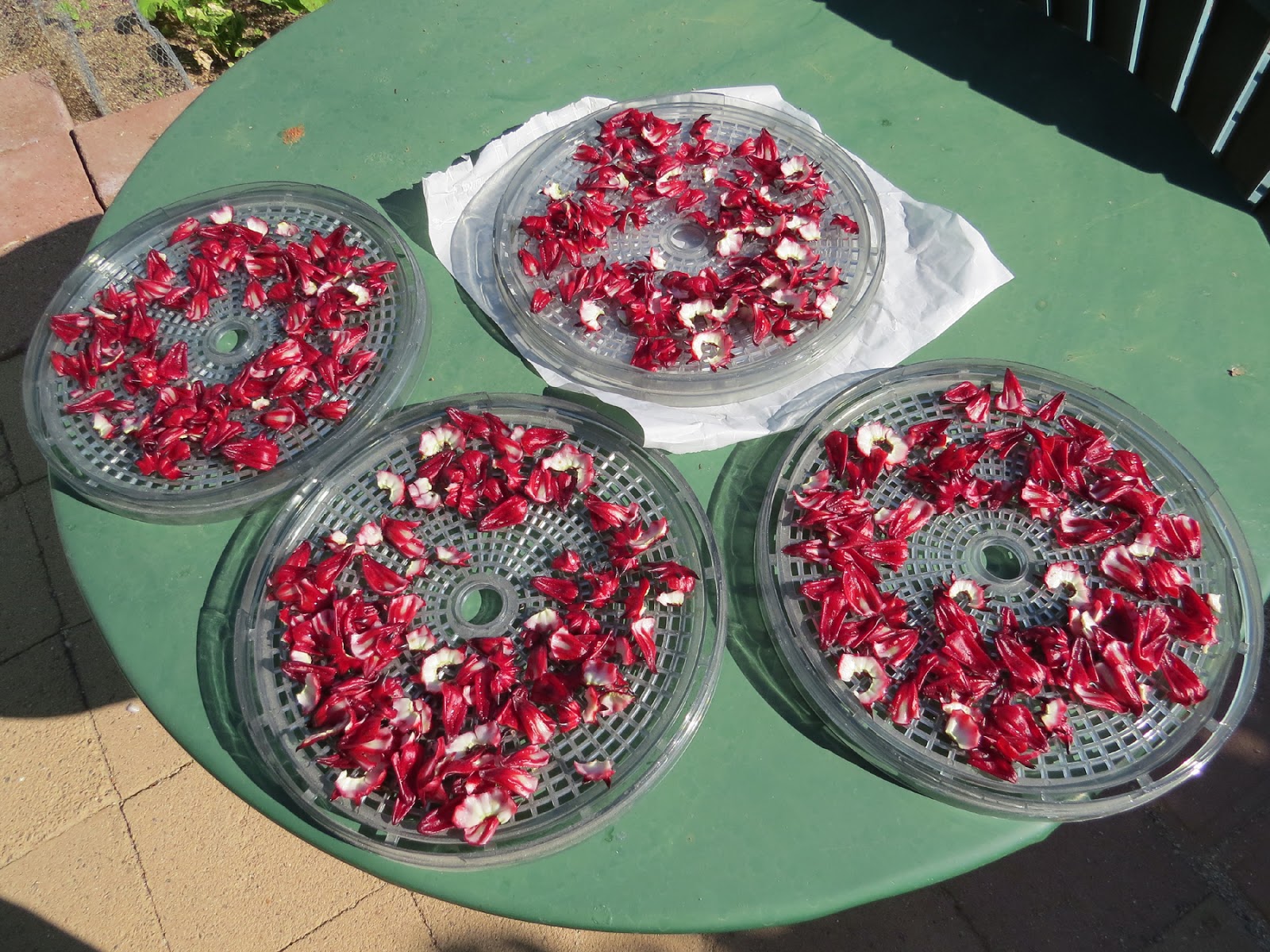
I've been trying to get to this for several days now and finally kicked myself into gear.  I spent over an hour harvesting them and separating the petals from the immature seed pod.

A bit of work but worth it to have the dried petals ready for use anytime I want to make something with them.  The fresh calyx need to be used within a few days of harvest, so drying the extra abundance and using our hot sun is a win/win.

I picked up these used trays a few years ago, without the electric base, because I was looking for a way to expand how much drying room I had.  I filled 4 trays and probably will get near a quart of dried petals when it is finished and they may even be finished today.

If not I bring the trays in overnight so they do not reabsorb moisture and then put them back out tomorrow when the sun is on the table.

I just love these jewel-like edibles!

If you have not grown Roselle (Hibiscus sabdariffa), you should consider sowing the seeds next April.  The leaves and the flower calyx are totally edible with a wonderful lemony / cranberry flavor - and oh, by the way - full of Vitamin C.

I am out of town for about a week and will resume posting when I get back.

I hope you have a wonderful time in your garden and kitchen with your garden bounty.


-- Catherine, The Herb Lady

If you enjoyed this post, subscribe in the upper side bar link, to get all my posts!

Disclaimer: Clicking on links on this blog may earn me a small commission if you purchase something. Your price does not change

Thursday, October 20, 2016

Watermelon "Lemonade" and Hibiscus Roselle

Dear Folks,

We harvested the next big Bradford Watermelon this past Sunday, and in one of those "DARN!" moments, I dropped it!

I had been waiting on this one looking for the tendril to dry as the first one I harvested was really, really good, but could have stayed on the vine longer AND the seeds were not viable. So with this one harvested I thought we had a double winner, bigger, better fruit and with viable seeds.

After the melon crashed to the floor and we salvaged the pieces, the fruit looked a bit past its prime.  Good tasting but actually not as good as the first one.  However the fruit made wonderful drinking juice (making ""Lemonade" out of lemons) and the seeds are viable - Yippeee!

I now  have 1st generation Bradford Watermelons seeds to sow in January.  I am also going to put the germinating test seeds in some jiffy pellets and see if I can have happy transplants in January.  Watermelons are typically sown/planted in January/February.

My view on when to pick ripe, at least for this melon is going to be the "thump" test instead of looking for the tendril to dry.

My Roselle plants are just heavy with the calyx ready for harvesting and using.  I decided to dry some and they dried nicely in the sun.  The picture shows a fresh one and the dried petals.  The lemony / cranberry flavored treats can be used in teas and other dishes.

I had some left over turkey soup I had made, so I thought "turkey and "cranberry" and topped the hot soup with a small sprinkle of the roselle dried petals.

We agreed the flavor and contrast with the soups was delicious, the cranberry flavor was very subdued, so the over all taste was a lemony topping to the soup.  Very nice.  The petals softened some but were still a nice chewy texture to the soft noodles.

I will probably add them to dishes like Pasta Primavera.  I would suggest you try them in any dish which calls for lemon or lime additions.  You will be pleased.

Have a great day in the garden and you kitchen making delicious meals from your bounty!

-- Catherine, The Herb Lady

If you enjoyed this post, subscribe in the upper side bar link, to get all my posts!

Disclaimer: Clicking on links on this blog may earn me a small commission if you purchase something. Your price does not change.

Monday, October 03, 2016

Garlic Planted, Cilantro Re-Seeded, Baby Pumpkin, Me and Roselle, Brining


Dear Folks,

The rain yesterday did two things in my gardens, settled in the garlic I planted on Saturday, October 1st and saved us a watering day.

We got nearly a half inch which means the gardens are nice and wet and do not need the scheduled watering.  Pictured is a clove Elephant Garlic being planted.  Beside that clove are regular garlic ready to be planted.  Plant garlic cloves with the pointy side up.  This will be the center stalk from which the mature head of cloves comes from.

The Allium family includes onions, chives, shallots, garlic, leeks and elephant garlic.  The familiar common Garlic is Allium sativum, while Elephant Garlic is Allium ampeloprasum.   Elephant Garlic is actual a form of leek - on steroids!  It has a milder flavor compared to common garlic's strong, even zingy flavor.

Both grow well here in the valley.  If it looks like I planted too close together -- I did on purpose.  I planted 39+ cloves of common garlic and 8 of the Elephant type.  I always plant extra by planting 3-4 inches apart, so I have "green garlic" to harvest like scallions through the fall/winter/spring.  This delicious addition to your cooking ingredients is a "scallion" only with garlic flavor instead of onion.  Harvest when the greens are about 8-10 inches tall and the clove has swollen slightly.  You can replace with another garlic clove to continue the harvest capability.   Instead, by harvesting every other plant as I need during the cool times, the space between widens allowing more room for each clove to grow to head size.

In April start watching for the plant to send up its flower stalk, called a Scape, it's spiral growth continues and you cut them off when they reach the height of the leaves -- this year it was early May.  Scapes are an edible delicacy only available about 1-2 weeks a year.  Once the Scape is cut off, watch for the leaves to begin turning yellow, about 2-3 weeks later.  This is harvest time. 
Gently dig each plant out, brush off the dirt and hang to dry in a shaded area in the garden or patio.  When the outside skin turns papery it is ready to store.  You can use the green tops as you would scallion tops.  Even the hard center stalk can be used to flavor broths, stews, soups and then removed at serving time.

From the aromatic to the gorgeous, this is my Roselle Hibiscus sabdariffa, now reaching taller than me and beginning the flowering stage moving toward harvest of the gorgeous lemony/cranberry flavored Caylx.  The entire plant is edible.  I've been using the leaves in place of lettuce with their tangy flavor.  While the caylx is known for its high Vitamin C component (if you see "hibiscus" or "red hibiscus" as an ingredient in teas - this is the plant), the leaves also have vitamin C as do the flowers.

Meanwhile, my Cilantro re-seeded and I spotted the new seedlings last week.

I love my gardens.  Many of my favorite plants freely re-seed coming back year after year.  Successive generations of seed is "regional adaptation" at its best.  The seeds which come up naturally are the strongest in your garden.

For this reason I urge you to direct sow if you can.  All of the seeds may not come up, but those which do will be the hardiest.

I am excited about the prospect of an heirloom pumpkin.  I have baby pumpkins on the vine, which has a mind of its own and has spilled out of the raised bed and ranging towards the trees.  I am going to let it roam and just try to keep it out of harm's way while it, hopefully, produces "Upper Ground Sweet Potato Pumpkin" reported to taste like sweet potato and once grown in Thomas Jefferson's gardens at Monticello.

In an "inspired" moment I decided to sow the pumpkin seeds in with the sweet potato, because the SP provided some "nurse" shade to the seed area.  It worked nicely as you can see a bed of sweet potato and pumpkin vines.   I hope to be harvesting pumpkin and sweet potatoes for Thanksgiving.

And, finally I decided to brine more of the Caper buds and berries and have set them to 'work' on the counter.  This is a fermentation brine with no vinegar and when I tried it for the first time, the buds turned out great but the berries not so much because I waited to long to pick them.  This time I picked the berries younger.  What I am looking for is that the berry seeds had not matured turning dark, and that I picked the berry while the seeds are white and immature.  The dark seeds proved to be very bitter, while the berry it self was tasty but not worth eating.  We shall see.  I want to be ready for next spring when the plants start budding and begin a large fermentation jar where I will pick buds regularly adding to my caper version of the old fashioned pickle barrel.  The food you are brining needs to be held completely covered under the liquid so I have a pickle weight wrapped in cheese cloth and tied with a string to allow me to lift and re-position any that rise to the top.  I have a light plastic food cover over it (not seen in the picture) to keep dust off, but allow any bubbles to escape.

That is all for today, folks.  I am always happy to answer questions.

Be sure to check out my youtube channel where I post short videos with helpful tips.

Have a great week in your fall garden!


-- Catherine, The Herb Lady

Website

P.S. I started a Cafepress "store" where I chose some of my favorite photos from the gardens and put them on t-shirts and other things.  The link is in the sidebar.  I welcome feedback and/or suggestions for products you might like to see offered.

If you enjoyed this post, subscribe in the upper side bar link, to get all my posts! And, Please Share.

Disclaimer: Clicking on links on this blog may earn me a small commission if you purchase something. Your price does not change.